



الصفحة 7
الصفحة 7
Applied Linguistics and Language Teacher Education
Applied Linguistics and Language Teacher Education is aimed at applied linguists who are interested in understanding more about the learning of novice teachers in their classes. The 21 studies in this volume provide information on the complexity of novice teachers’ learning and use of knowledge in a variety of applied linguistics classes such as SLA, Syntax, Pragmatics, Sociolinguistics, Phonetics and Phonology, L2 Reading and Writing, Testing, and Content Based Instruction. These studies were conducted in a variety of contexts, from North and South America to Europe, Asia and Australia, and look at the preparation of teachers of English, Spanish and Chinese.
Analytical and Numerical Approaches to Mathematical Relativity
This book contains a representative collection of surveys by experts in mathematical relativity writing about the current status of, and problems in, their fields. There are four contributions for each of the following mathematical areas: differential geometry and differential topology, analytical methods and differential equations, and numerical methods. This book addresses graduate students and specialist researchers alike.
Analysis II
As with the first, the second volume contains substantially more material than can be covered in a one-semester course. Such courses may omit many beautiful and well-grounded applications which connect broadly to many areas of mathematics. We of course hope that students will pursue this material independently; teachers may find it useful for undergraduate seminars. For an overview of the material presented, consult the table of contents and the chapter introductions. As before, we stress that doing the numerous exercises is indispensable for understanding the subject matter, and they also round out and amplify the main text. In writing this volume, we are indebted to the help of many.
Algebraic Biology ; 2nd International Conference, AB 2007, Castle of Hagenberg, Austria, July 2-4, 2007, Proceedings
This volume constitutes the refereed proceedings of the Second International Conference on Algebraic Biology. The conference served as an interdisciplinary forum for the presentation of research on all aspects of the application of symbolic computation in biology, including computer algebra, computational logic, and related methods.

Algebra and Coalgebra in Computer Science; First International Conference, CALCO 2005, Swansea, UK, September 3-6, 2005, Proceedings
CALCO, the Conference on Algebra and Coal-gebra in Computer Science, was created to bring together researchers and practitio-ners to exchange new results related to foundational aspects, and both traditional and emerging uses of algebras and coalgebras in computer science. CALCO 2005 was the first instance of this new conference. The interest that it generated in the scientific community suggests that it will not be the last. Indeed, it attracted as many as 62 submissions covering a wide range of topics roughly divided into two areas: Algebras and Coalgebras as Mathematical Objects: Automata and languages; categorical semantics; hybrid, probabilistic, and timed systems; inductive and coin-ductive methods; modal logics; relational systems and term rewriting.
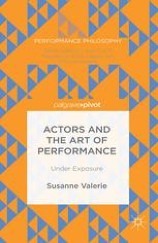
Actors and the Art of Performance : Under Exposure
Actors and the Art of Performance: Under Exposure combines the author's two main biographical paths: her professional commitment to the fields of both theatre and philosophy. The art of acting on stage is analysed here not only from the theoretical perspective of a spectator, but also from the perspective of the actor. The author draws on her experience as both a theatre actor and a university professor whose teachings in the art of acting rely heavily on her own experience and also on her philosophical knowledge. The book is unique not only in terms of its content but also in terms of its style. Written in a multiplicity of voices, the text oscillates between philosophical reasoning and narrative forms of writing, including micro-narratives, fables, parables, and inter alia by Carroll, Hoffmann and Kleist. Hence the book claims that a trans-disciplinary dialogue between the art of acting and the art of philosophical thinking calls for an aesthetical research that questions and begins to seek alternatives to traditionally established and ingrained formats of philosophy.
Accreditation and Evaluation in the European Higher Education Area
This volume presents a rich account of the development of accreditation and evaluation in 20 European countries. The authors are leaders in the field and they have cooperated in this effort by writing richly different, often deep and insightful analyses of the situation in their country. The two editors have added a synopsis detailing the main trends, and sketching commonalities as well as contrasts in the developments across Europe. The book shows how accreditation is becoming a main mechanism in the steering of higher education all over Europe. The book is unique in its analysis of forces driving towards the spread of different models of accreditation in the emerging European Higher Education area. Readers will obtain an up-to-date picture of the state of affairs of accreditation in the framework of evaluation activities in Europe.

A Twenty-First Century Guide to Aldersonian Marketing Thought
The book has three major themes: glimpses into the kind of interesting character he was, key excerpts from his writings, and commentaries on the perceived current relevance of Aldersonian marketing thought. … this book is an excellent vehicle for educating people on a guru, influencer, theoretician, practitioner and leader in the development of marketing theory. … this is a valuable resource for anyone desiring to know about marketing theory and to understand the genesis of a number of concepts currently found in today’s marketing textbooks.
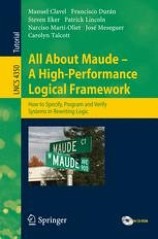
A High-Performance Logical Framework -- All About Maude : How to Specify, Program, and Verify Systems in Rewriting Logic
This book gives a comprehensive account of Maude, a language and system based on rewriting logic. Many examples are used throughout the book to illustrate the main ideas and features of Maude, and its many possible uses. Maude modules are rewrite theories. Computation with such modules is - cient deduction by rewriting. Because of its logical basis and its initial model semantics,aMaude module defines a precise mathematical model.This means that Maude and its formal tool environment can be used in three, mutually reinforcing ways: • as a declarative programming language; • as an executable formal specification language; and • as a formal verification system. Maude’s rewriting logic is simple, yet very expressive. This gives Maude good representational capabilities as a semantic framework to formally represent a wide range of systems, including models of concurrency, distributed al- rithms, network protocols, semantics of programming languages, and models of cell biology. Rewriting logic is also an expressive universal logic,making Maude a fiexible logical framework in which many difierent logics and - ference systems can be represented and mechanized. This makes Maude a useful metatool to build many other tools, including those in its own formal tool environment. Thanks to the logic’s simplicity and the use of advanced semi-compilation techniques, Maude has a high-performance implementation, making it competitive with other declarative programming languages.
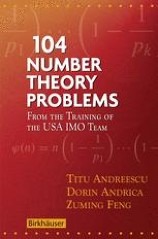
104 Number Theory Problems : From the Training of the USA IMO Team
This challenging problem book by renowned US Olympiad coaches, mathematics teachers, and researchers develops a multitude of problem-solving skills needed to excel in mathematical contests and research in number theory. Offering inspiration and intellectual delight, the problems throughout the book encourage students to express their ideas, conjectures, and conclusions in writing. Applying specific techniques and strategies, readers will acquire a solid understanding of the fundamental concepts and ideas of number theory.
.NET Test Automation Recipes : A Problem-Solution Approach
If you develop, test, or manage .NET software, you will find .NET Test Automation Recipes: A Problem-Solution Approach very useful. The book presents practical techniques for writing lightweight software test automation in a .NET environment and covers API testing thoroughly. It also discusses lightweight, custom Windows application user interface automation and teaches you low-level web application user interface automation. Additional material covers SQL stored procedure testing techniques.
