



الصفحة 7
الصفحة 7

Advances in neural networks - ISNN 2006 ; Vol.3973 : 3rd International symposium on Neural Networks, ISNN 2006, Chengdu, China, May 28 - June 1, 2006, Proceedings, Part III
Constitute the Proceedings of the Third International Symposium on Neural Networks (ISNN 2006) held in Chengdu in southwestern China during May 28–31, 2006. After a successful ISNN 2004 in Dalian and ISNN 2005 in Chongqing, ISNN became a well-established series of conferences on neural computation in the region with growing popularity and improving quality. ISNN 2006 received 2472 submissions from authors in 43 countries and regions,Based on rigorous reviews, 616 high-quality papers were selected for publication in the proceedings with the acceptance rate being less than 25%. The papers are organized in 27 cohesive sections covering all major topics of neural network research and development. In addition to the numerous contributed papers, ten distinguished scholars gave plenary speeches .

Advances in neural networks - ISNN 2006 ; Vol. 3972 : 3rd International symposium on neural networks, ISNN 2006, Chengdu, China, May 28 - June 1, 2006, Proceedings, Part II
Constitute the Proceedings of the Third International Symposium on Neural Networks (ISNN 2006) held in Chengdu in southwestern China during May 28–31, 2006. After a successful ISNN 2004 in Dalian and ISNN 2005 in Chongqing, ISNN became a well-established series of conferences on neural computation in the region with growing popularity and improving quality. ISNN 2006 received 2472 submissions from authors in 43 countries and regions,Based on rigorous reviews, 616 high-quality papers were selected for publication in the proceedings with the acceptance rate being less than 25%. The papers are organized in 27 cohesive sections covering all major topics of neural network research and development. In addition to the numerous contributed papers, ten distinguished scholars gave plenary speeches .

Advances in neural networks - ISNN 2006 ; Vol. 3971 : 3rd International symposium on neural networks, ISNN 2006, Chengdu, China, May 28 - June 1, 2006, Proceedings, Part I
This book and its sister volumes constitute the Proceedings of the Third International Symposium on Neural Networks (ISNN 2006) held in Chengdu in southwestern China during May 28–31, 2006. After a successful ISNN 2004 in Dalian and ISNN 2005 in Chongqing, ISNN became a well-established series of conferences on neural computation in the region with growing popularity and improving quality. ISNN 2006 received 2472 submissions from authors in 43 countries and regions,Based on rigorous reviews, 616 high-quality papers were selected for publication in the proceedings with the acceptance rate being less than 25%. The papers are organized in 27 cohesive sections covering all major topics of neural network research and development. In addition to the numerous contributed papers, ten distinguished scholars gave plenary speeches .

Advances in neural networks - ISNN 2005 ; Vol. 3498 ; 2nd International Symposium on Neural Networks, Chongqing, China, May 30 - June 1, 2005, Proceedings, Part III
The three volume set LNCS 3496/3497/3498 constitutes the refereed proceedings of the Second International Symposium on Neural Networks, ISNN 2005, held in Chongqing, China in May/June 2005. The 483 revised papers presented were carefully reviewed and selected from 1.425 submissions. The papers are organized in topical sections on theoretical analysis, model design, learning methods, optimization methods, kernel methods, component analysis, pattern analysis, systems modeling, signal processing, image processing, financial analysis, control systems, robotic systems, telecommunication networks, incidence detection, fault diagnosis, power systems, biomedical applications, industrial applications, and other applications.
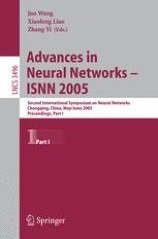
Advances in neural networks - ISNN 2005 ; Vol. 3496 ; 2nd International symposium on neural networks, Chongqing, China, May 30 - June 1, 2005, Proceedings, Part I
The three volume set LNCS 3496/3497/3498 constitutes the refereed proceedings of the Second International Symposium on Neural Networks, ISNN 2005, held in Chongqing, China in May/June 2005. The 483 revised papers presented were carefully reviewed and selected from 1.425 submissions. The papers are organized in topical sections on theoretical analysis, model design, learning methods, optimization methods, kernel methods, component analysis, pattern analysis, systems modeling, signal processing, image processing, financial analysis, control systems, robotic systems, telecommunication networks, incidence detection, fault diagnosis, power systems, biomedical applications, industrial applications, and other applications.

Advances in natural networks - ISNN 2005 ; Vol. 3497 ; 2nd International symposium on neural networks, Chongqing, China, May 30 - June 1, 2005, proceedings, Part II
This book and its sister volumes constitute the proceedings of the 2nd International Symposium on Neural Networks (ISNN 2005). ISNN 2005 was held in the China during May 30–June 1, 2005, as a sequel of 2004 ISNN emerged as a leading conference on neural computation in the region with - creasing global recognition and impact. ISNN 2005 received 1425 submissions from authors on ?ve continents (Asia, Europe, North America, South America, and Oc- nia), 33 countries and regions Based on rigorous reviews, 483 high-quality papers were selected by the Program Committee for presentation at ISNN 2005 and publication

Advances in Natural Computation ; Vol. 4222 ; 2nd International Conference, ICNC 2006, Xi'an, China, September 24-28, 2006, Proceedings, Part II
constitutethe proceedings of the 2nd International Conference on Natural Computation (ICNC 2006), jointly held with the 3rd International Conference on Fuzzy Systems and Knowledge Discovery, ICNC-FSKD 2006 featured the most up-to-date research results in com- tational algorithms inspired from nature, including biological, ecological, and physical systems. It is an exciting and emerging interdisciplinary area in which a wide rangeof techniques and methods arebeing studied for dealing with large, complex, and dynamic problems. The joint conferences also promoted cro- fertilization over these exciting and yet closely-related areas, which had a s- nifcant impact on the advancement of these important technologies. Specifc areas included neural computation, quantum computation, evolutionarycom- tation, DNA computation, fuzzy computation, granular computation, artifcial life, etc., with innovative applications to knowledge discovery, fnance, ope- tions research, and more. In addition to the large number of submitted papers, we were blessed with the presence of six renowned keynote speakers.

Advances in natural computation ; Vol. 4221 ; 2nd International Conference, ICNC 2006, Xi'an, China, September 24-28, 2006, Proceedings, Part I
ICNC-FSKD 2006 featured the most up-to-date research results in com- tational algorithms inspired from nature, including biological, ecological, and physical systems. It is an exciting and emerging interdisciplinary area in which a wide rangeof techniques and methods arebeing studied for dealing with large, complex, and dynamic problems. The joint conferences also promoted cro- fertilization over these exciting and yet closely-related areas, which had a s- nifcant impact on the advancement of these important technologies. Specifc areas included neural computation, quantum computation, evolutionarycom- tation, DNA computation, fuzzy computation, granular computation, artifcial life, etc., with innovative applications to knowledge discovery, fnance, ope- tions research, and more. In addition to the large number of submitted papers, we were blessed with the presence of six renowned keynote speakers.

Advances in natural computation ; Vol. 3612 ; 1st International conference, ICNC 2005, Changsha, China, August 27-29, 2005, Proceedings, Part III
Includes 313 full papers and 189 short papers the refereed proceedings of the First International Conference on Natural Computation, ICNC 2005, held in Changsha, China, in August 2005 as a joint event with the Second International Conference on Fuzzy Systems and Knowledge Discovery FSKD 2005. includ Topics : Artificial Intelligence / Theory of Computation / Computation by Abstract Devices / Algorithm Analysis and Problem Complexity / Image Processing and Computer Vision / Pattern Recognition

Advances in natural computation ; Vol. 3611 ; 1st International conference, ICNC 2005, Changsha, China, August 27-29, 2005, proceedings, Part II
Featured the most up-to-date research results in com-putational algorithms inspired from nature, including biological, ecological, andphysical systems. It is an exciting and emerging interdisciplinary area in whicha wide range of techniques and methods are being studied for dealing with large,complex, and dynamic problems. The joint conferences also promoted cross-fertilization over these exciting and yet closely-related areas, "

Advances in natural computation ; Vol. 3610 ; 1st International conference, ICNC 2005, Changsha, China, August 27-29, 2005, Proceedings, Part I
Featured the most up-to-date research results in computational algorithms inspired from nature, including biological, ecological, andphysical systems. It is an exciting and emerging interdisciplinary area in which a wide range of techniques and methods are being studied for dealing with large, complex, and dynamic problems. The joint conferences also promoted cross-fertilization over these exciting and yet closely-related areas, which had a sig-nificant impact on the advancement of these important technologies. Specificareas included neural computation, quantum computation, evolutionary com-putation, DNA computation, chemical computation, information processing incells and tissues, molecular computation, computation with words, fuzzy com-putation, granular computation, artificial life, swarm intelligence, ants colonies

Advances in Machine Learning and Cybernetics ; 4th International Conference, ICMLC 2005, Guangzhou, China, August 18-21, 2005, Revised Selected Papers
Machine learning and cybernetics play an important role in many modern electronic, computer and communications systems. Automated processing of information by these systems requires intelligent analysis of various types of data and optimal decision making. In recent years, we have witnessed a rapid expansion of research and development activities in machine learning and cybernetics. To provide opportunities for researchers in these areas to share their ideas and foster collaborations, the International Conference on Machines and Cybernetics (ICMLC) has been held annually since 2002. The conference series has achieved a great success in attracting a large number of paper submissions and participants and enabling fruitful exchanges among academic and industrial researchers and postgraduate students. In 2005, the conference (ICMLC 2005) received 2461 full paper submissions and the Program Committee selected 1050 of them for presentation. It is especially encouraging that the conference is attracting more and more international attention.

Advances in Data and Web Management ; Joint 9th Asia-Pacific Web Conference, APWeb 2007, and 8th International Conference on Web-Age Information Management, WAIM 2007, Huang Shan, China, June 16-18, 2007, Proceedings
The rapid prevalence of Web applications requires new technologies for the - sign, implementation and management of Web-based information systems, and for the management and analysis of information on the Web.This book drew research and industrial papers on the theory, design and implementation of Web-based information systems and on the m- agement and analysis of information on the Web.

Advances in cognitive neurodynamics ICCN 2007; Proceedings of the International conference on cognitive neurodynamics - 2007
Contains the Proceedings of the 1st International Conference on Cognitive Neurodynamics held in Shanghai, November 17-21, 2007. The participants were treated to an exciting and stimulating conference that left everyone with an enthusiastic vision for the future of the field. The latest important progress was covered by 13 mini-symposia including: Models of Mental Disorders; Cognitive Machines; Dynamics in learning and memory; Central nervous system synchronization; Neuroinformatics; Cognitive Computational Modeling of Human Language Processing; Cognitive Neurodynamics of Attention; Bottom-Up and Top-Down; Brain Networks; From Anatomy to Dynamics; Translational Cognitive Neuroimaging; K-sets; Theory and Applications; Advanced Signal Processing Techniques for Brain Data Analysis; Visual cortex: information processing and dynamics; Dynamics of Firing Patterns and Synchronization in Neuronal Systems.

Advances in civil engineering materials : Selected articles from the 6th International Conference on architecture and civil engineering (ICACE 2022), August 2022, Kuala Lumpur, Malaysia
Presents selected articles from the 6th International Conference on Architecture and Civil Engineering 2022 (ICACE 2022), held in Malaysia. Written by leading researchers and industry professionals, the papers highlight recent advances and addresses current issues in the fields of civil engineering and architecture.

Advances in Blended Learning ; 2nd Workshop on Blended Learning, WBL 2008, Jinhua, China, Augustl 20-22, 2008. Revised Selected Papers
This book constitutes the thoroughly refereed post-workshop proceedings of the Second Workshop on Blended Learning, WBL 2008, held in Jinhua, China, in August 2008, as a satellite event of ICWL 2008, the 7th International Conference on Web-based Learning.

Advanced Web and Network Technologies, and Applications ; APWeb 2006 International Workshops : XRA, IWSN, MEGA, and ICSE, Harbin, China, January 16-18, 2006, Proceedings
The QOS evaluating model for computational grid nodes put forward can help greatly improving the self-adaptability of resource management and accelerating the appli- tion and development of Computational Grid. Now this model has been applied in NPU Campus Computational Grid. And the good effect brought by it has effectively proved its function. References 1. Foster, I. and C. Kesselman, eds. The Grid: Blueprint for a New Computing Infrastructure. Morgan Kaufmann, 1999. 2. Liu Liang, Zhou Xing-she, and Gu Jian-hua: A Multi-Agent System for Grid Computing. The Second International Conference on Active Media Technology, 2003 3. Yao Wang, Julita Vassileva: Trust and Reputation Model in Peer-to-Peer Networks. Farag Azzedin and Muthucumaru Maheswaran: Integrating Trust into Grid Resource M- agement Systems.

Advanced strategies for tooth extraction in dentistry : Beyond basics
Aims to provide comprehensive insights and techniques to dental students and practicing dentists seeking to expand their skills in tooth extraction. Building upon the foundational knowledge acquired during dental education, this book delves into the intricacies of advanced tooth extraction strategies. It covers a wide range of topics, including complex extractions, impacted teeth, surgical techniques, management of complications, and specialized cases.

Advanced Physicochemical Treatment Technologies ; Vol.5
In Advanced Physiochemical Treatment Technologies, leading pollution control educators and practicing professionals describe how various combinations of different cutting-edge process systems can be arranged to solve air, noise, and thermal pollution problems. Each chapter discusses in detail the three basic forms in which pollutants and waste are manifested: gas, solid, and liquid.

Advanced Physicochemical Treatment Processes
Leading pollution control educators and practicing professionals describe how various combinations of different physicochemical treatment processes can be arranged to solve air, noise, and thermal pollution problems. In Advanced Physicochemical Treatment Processes, the authors discuss strategies for abating pollution by converting it into a less noxious form, using the most feasible technologies. Each chapter discusses in detail a variety of process combinations, along with technical and economic evaluations, and presents explanations of the principles behind the designs, as well as numerous variant designs useful to practicing engineers. The emphasis throughout is on developing the necessary engineering solutions from fundamental principles of chemistry, physics, and mathematics.
