



الصفحة 7
الصفحة 7
Communication Systems
Presents main concepts of mobile communication systems, both analog and digitalIntroduces concepts of probability, random variables and stochastic processes and their applications to the analysis of linear systemsIncludes five appendices covering Fourier series and transforms, GSM cellular systems and more

Clinical concepts and practical management techniques in dentistry
Deals with complete oral health, including prevention, treatment, and cure. This book provides readers with the latest updates on dental clinical concepts and practical management techniques. It is divided into four sections that contain in-depth chapters with concepts and techniques from the fields of oral medicine, periodontology, radiology, endodontics, restorative dentistry, dental trauma, and probability and sampling. It is a compendium of work by internationally recognized oral clinicians and public healthcare leaders in dentistry. It presents updates on some of the most pertinent issues within the practice of dentistry, such as regenerative endodontic procedures, the unique role of radiographs, recognition of child abuse, and dental statistics.
Classical Methods of Statistics : With Applications in Fusion-Oriented Plasma Physics
Classical Methods of Statistics is a blend of theory and practical statistical methods written for graduate students and researchers interested in applications to plasma physics and its experimental aspects. It can also fruitfully be used by students majoring in probability theory and statistics. In the first part, the mathematical framework and some of the history of the subject are described. Many exercises help readers to understand the underlying concepts. In the second part, two case studies are presented exemplifying discriminant analysis and multivariate profile analysis. The introductions of these case studies outline contextual magnetic plasma fusion research. In the third part, an overview of statistical software is given and, in particular, SAS and S-PLUS are discussed. In the last chapter, several datasets with guided exercises, predominantly from the ASDEX Upgrade tokamak, are included and their physical background is concisely described. The book concludes with a list of essential keyword translations.
Classic Works on the Dempster-Shafer Theory of Belief Functions
This book brings together a collection of classic research papers on the Dempster-Shafer theory of belief functions. By bridging fuzzy logic and probabilistic reasoning, the theory of belief functions has become a primary tool for knowledge representation and uncertainty reasoning in expert systems.

Chance Rules : An informal guide to probability, risk and statistics
This second edition of Chance Rules again recounts the story of chance through history and the various ways it impacts on our lives. Here you can read about the earliest gamblers who thought that the fall of the dice was controlled by the gods, as well as the modern geneticist and quantum theory researcher trying to integrate aspects of probability into their chosen speciality. Example included in the first addition such as the infamous Monty Hall problem, tossing coins, coincidences, horse racing, birthdays and babies remain, often with an expanded discussion, in this edition. Additional material in the second edition includes, a probabilistic explanation of why things were better when you were younger, consideration of whether you can use probability to prove the existence of God, how long you may have to wait to win the lottery, some court room dramas, predicting the future, and how evolution scores over creationism. Chance Rules lets you learn about probability without complex mathematics.

Chance : The life of games and the game of life
With its many easy-to-follow mathematical examples, this book takes the reader on an almost chronological trip through the fascinating and amazing laws of chance, omnipresent in the natural world and in our daily lives. Along the route many fascinating topics are discussed, such as: challenging probability paradoxes; "paranormal" coincidences; game odds; causes and effects; interpretation of opinion polls; winning chances as a game proceeds; the nature of randomness; entropy and randomness; randomness in life; algorithmic complexity and the undecidability of randomness; possibilities and limitations of learning the laws of a Universe immersed in chance events. This charming book will inform and entertain the scientist and non-scientist alike.
Cells and Robots : Modeling and Control of Large-Size Agent Populations
Cells and Robots is an outcome of the multidisciplinary research extending over Biology, Robotics and Hybrid Systems Theory. It is inspired by modeling reactive behavior of the immune system cell population, where each cell is considered as an independent agent. In our modeling approach, there is no difference if the cells are naturally or artificially created agents, such as robots. This appears even more evident when we introduce a case study concerning a large-size robotic population scenario. Under this scenario, we also formulate the optimal control of maximizing the probability of robotic presence in a given region and discuss the application of the Minimum Principle for partial differential equations to this problem. Simultaneous consideration of cell and robotic populations is of mutual benefit for Biology and Robotics, as well as for the general understanding of multi-agent system dynamics.The text of this monograph is based on the PhD thesis of the first author. The work was a runner-up for the fifth edition of the Georges Giralt Award for the best European PhD thesis in Robotics, annually awarded by the European Robotics Research Network (EURON).

Cambridge and Vienna : Frank P. Ramsey and the Vienna Circle
The Institute Vienna Circle held a conference in 2003, Cambridge and Vienna: Frank P. Ramsey and the Vienna Circle, to commemorate the philosophical and scientific work of Frank Plumpton Ramsey (1903-1930). This Ramsey conference provided historical and biographical perspectives on one of the most gifted thinkers of the Twentieth Century.
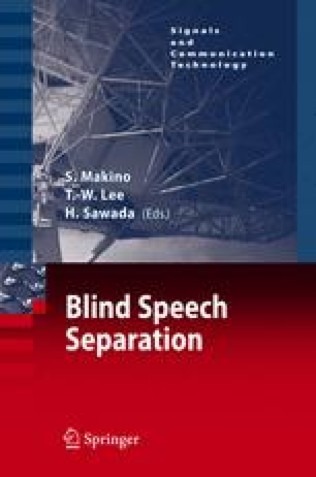
Blind Speech Separation
This is the first book to provide a cutting edge reference to the fascinating topic of blind source separation (BSS) for convolved speech mixtures. Through contributions by the foremost experts on the subject, the book provides an up-to-date account of research findings, explains the underlying theory, and discusses potential applications. The individual chapters are designed to be tutorial in nature with specific emphasis on an in-depth treatment of state of the art techniques. Blind Speech Separation is divided into three parts:Part 1 presents overdetermined or critically determined BSS. Here the main technology is independent component analysis (ICA). ICA is a statistical method for extracting mutually independent sources from their mixtures. Part 2 addresses underdetermined BSS, where there are fewer microphones than source signals. Here, the sparseness of speech sources is very useful; we can utilize time-frequency diversity, where sources are active in different regions of the time-frequency plane.Part 3 presents monaural BSS where there is only one microphone. Here, we can separate a mixture by using the harmonicity and temporal structure of the sources. We can build a probabilistic framework by assuming a source model, and separate a mixture by maximizing the a posteriori probability of the sources.

Between Necessity and Probability : Searching for the Definition and Origin of Life
This study investigates the major theories of the origins of life in light of modern research with the aim of distinguishing between the necessary and the optional and between deterministic and random influences in the emergence of what we call ‘life.’ Life is treated as a cosmic phenomenon whose emergence and driving force should be viewed independently from its Earth-bound natural history. The author synthesizes all the fundamental life-related developments in a comprehensive scenario, and makes the argument that understanding life in its broadest context requires a material-independent perspective that identifies its essential fingerprints.
Bayesian reliability
Bayesian Reliability presents modern methods and techniques for analyzing reliability data from a Bayesian perspective. The adoption and application of Bayesian methods in virtually all branches of science and engineering have significantly increased over the past few decades. This increase is largely due to advances in simulation-based computational tools for implementing Bayesian methods. The authors extensively use such tools throughout this book, focusing on assessing the reliability of components and systems with particular attention to hierarchical models and models incorporating explanatory variables. Such models include failure time regression models, accelerated testing models, and degradation models. The authors pay special attention to Bayesian goodness-of-fit testing, model validation, reliability test design, and assurance test planning. Throughout the book, the authors use Markov chain Monte Carlo (MCMC) algorithms for implementing Bayesian analyses--algorithms that make the Bayesian approach to reliability computationally feasible and conceptually straightforward.
Bayesian Methods in the Search for MH370
This book demonstrates how nonlinear/non-Gaussian Bayesian time series estimation methods were used to produce a probability distribution of potential MH370 flight paths. It provides details of how the probabilistic models of aircraft flight dynamics, satellite communication system measurements, environmental effects and radar data were constructed and calibrated. The probability distribution was used to define the search zone in the southern Indian Ocean. The book describes particle-filter based numerical calculation of the aircraft flight-path probability distribution and validates the method using data from several of the involved aircraft’s previous flights. Finally it is shown how the Reunion Island flaperon debris find affects the search probability distribution.
Bayesian core : A practical approach to computational Bayesian statistics
This Bayesian modeling book provides an operational methodology for conducting Bayesian inference, rather than focusing on its theoretical justifications. Special attention is paid to the derivation of prior distributions in each case and specific reference solutions are given for each of the models.
Basic Probability Theory with Applications
This book presents elementary probability theory with interesting and well-chosen applications that illustrate the theory. An introductory chapter reviews the basic elements of differential calculus which are used in the material to follow. The theory is presented systematically, beginning with the main results in elementary probability theory. This is followed by material on random variables. Random vectors, including the all important central limit theorem, are treated next. The last three chapters concentrate on applications of this theory in the areas of reliability theory, basic queuing models, and time series. Examples are elegantly woven into the text and over 400 exercises reinforce the material and provide students with ample practice.
Basic principles and applications of probability theory
This introductory chapter discusses such notions as determinism, chaos and randomness, p- dictibility and unpredictibility, some initial approaches to formalizing r- domness and it surveys certain problems that can be solved by probability theory. This will perhaps give one an idea to what extent the theory can - swer questions arising in speci?c random occurrences and the character of the answers provided by the theory. 1. 1 The Nature of Randomness The phrase “by chance” has no single meaning in ordinary language. For instance, it may mean unpremeditated, nonobligatory, unexpected, and so on. Its opposite sense is simpler: “not by chance” signi?es obliged to or bound to (happen). In philosophy, necessity counteracts randomness. Necessity signi?es conforming to law – it can be expressed by an exact law. The basic laws of mechanics, physics and astronomy can be formulated in terms of precise quantitativerelationswhichmustholdwithironcladnecessity.
Asymptotic Theory of Statistics and Probability
An encyclopedic treatment of classic as well as contemporary large sample theory, dealing with both statistical problems and probabilistic issues and tools. It is written in an extremely lucid style, with an emphasis on the conceptual discussion of the importance of a problem and the impact and relevance of the theorems. The book has 34 chapters over a wide range of topics, nearly 600 exercises for practice and instruction, and another 300 worked out examples. It also includes a large compendium of 300 useful inequalities on probability, linear algebra, and analysis that are collected together from numerous sources, as an invaluable reference for researchers in statistics, probability, and mathematics.
Aspects of Brownian motion
Stochastic calculus and excursion theory are very efficient tools to obtain either exact or asymptotic results about Brownian motion and related processes. The emphasis of this book is on special classes of such Brownian functionals as: - Gaussian subspaces of the Gaussian space of Brownian motion; - Brownian quadratic funtionals; - Brownian local times, - Exponential functionals of Brownian motion with drift; - Winding number of one or several Brownian motions around one or several points or a straight line, or curves; - Time spent by Brownian motion below a multiple of its one-sided supremum.
Arithmetical investigations : Representation theory, orthogonal polynomials, and quantum interpolations
In this volume the author further develops his philosophy of quantum interpolation between the real numbers and the p-adic numbers. The p-adic numbers contain the p-adic integers Zp which are the inverse limit of the finite rings Z/pn. This gives rise to a tree, and probability measures w on Zp correspond to Markov chains on this tree. From the tree structure one obtains special basis for the Hilbert space L2(Zp,w). The real analogue of the p-adic integers is the interval [-1,1], and a probability measure w on it gives rise to a special basis for L2([-1,1],w) - the orthogonal polynomials, and to a Markov chain on "finite approximations" of [-1,1]. For special (gamma and beta) measures there is a "quantum" or "q-analogue" Markov chain, and a special basis, that within certain limits yield the real and the p-adic theories. This idea can be generalized variously. In representation theory, it is the quantum general linear group GLn(q)that interpolates between the p-adic group GLn(Zp), and between its real (and complex) analogue -the orthogonal On (and unitary Un )groups. There is a similar quantum interpolation between the real and p-adic Fourier transform and between the real and p-adic (local unramified part of) Tate thesis, and Weil explicit sums.
Applied Stochastic Processes
Applied Stochastic Processes uses a distinctly applied framework to present the most important topics in the field of stochastic processes.

Applied Stochastic Control of Jump Diffusions
The main purpose of the book is to give a rigorous, yet mostly nontechnical, introduction to the most important and useful solution methods of various types of stochastic control problems for jump diffusions and its applications.
