



الصفحة 7
الصفحة 7

Beginning xml with C# 2008 : From novice to professional
Beginning XML with C# 2008 focuses on XML and how it is used within .NET 3.5. As you'd expect of a modern application framework, .NET 3.5 has extensive support for XML in everything from data access to configuration, from raw parsing to code documentation. This book demystifies all of this. It explains the basics of XML as well as the namespaces and objects you need to know in order to work efficiently with XML. You will see clear, practical examples that illustrate best practices in action. With this book, you'll learn everything you need to know from the basics of reading and writing XML data to using the DOM, from LINQ and SQL Server integration to SOAP and web services.
Beginning POJOs : Lightweight Java Web development using Plain Old Java Objects in Spring, Hibernate, and Tapestry
Beginning POJOs introduces you to open source lightweight web development using Plain Old Java Objects (POJOs) and the tools and frameworks that enable this. Tier by tier, this book guides you through the construction of complex but lightweight enterprise Java-based web applications. Such applications are centered around several major open source lightweight frameworks, including Spring, Hibernate, Tapestry, and JBoss (including the new lightweight JBoss Seam). This book is ideal if you're new to open source and lightweight Java. You'll learn how to build a complete enterprise Java-based web application from scratch, and how to integrate the different open source frameworks to achieve this goal.
Beginning Java Objects : From concepts to code
Learning to design objects effectively with Java is the goal of Beginning Java Objects: From Concepts to Code, Second Edition. Plenty of titles dig into the Java language in massive detail, but this one takes the unique approach of stepping back and looking at fundamental object concepts first. Mastery of Java—from understanding the basic language features to building complete industrial-strength Java applications—emerges only after a thorough tour of thinking in objects. The first edition of Beginning Java Objects has been a bestseller; this second edition includes material on the key features of J2SE 5, conceptual introductions to JDBC and J2EE, and an in-depth treatment of the critical design principles of model-data layer separation and model-view separation.
Beginning C# 2008 Databases : From novice to professional
Assuming only basic knowledge of C# 2008, Beginning C# 2008 Databases teaches all the fundamentals of database technology and database programming readers need to quickly become highly proficient database users and application developers. A comprehensive tutorial on both SQL Server 2005 and ADO.NET 3.0, Beginning C# 2008 Databases explains and demonstrates how to create database objects and program against them in both T–SQL and C#. Full of practical, detailed examples, it's been fully revised and updated for C# 2008 and offers the most complete, detailed, and gentle introduction to database technology for all C# programmers at any level of experience.

Arts of Allusion : Object, Ornament, and Architecture in Medieval Islam
The art of the object reached unparalleled heights in the medieval Islamic world, yet the deep intellectual dimensions of ceramics, metalwares, and other plastic arts in this milieu have not always been acknowledged. Arts of Allusion reveals the object as a crucial site where premodern craftsmen of the eastern Mediterranean and Persianate realms engaged their creations in fertile dialogue with poetry, literature, painting, and, perhaps most strikingly, architecture. Through close studies of objects from the ninth to the thirteenth centuries, this book reveals that allusions to architecture abound across media in the portable arts of the medieval Islamic world.

Articulated Motion and Doformable Objects ; 4th International Conference, AMDO 2006, Port d'Andratx, Mallorca, Spain, July 11-14, 2006, Proceedings
The subject of the conference was ongoing research in articulated motionon a sequence of images and sophisticated models for deformable objects. Thegoals of these areas are to understand and interpret the motion of complexobjects that can be found in sequences of images in the real world. The maintopics considered as priority were: geometric and physical deformable models,motion analysis, articulated models and animation, modelling and visualizationof deformable models, deformable models applications, motion analysis applica-tions, single or multiple human motion analysis and synthesis, face modelling,tracking, recovering and recognition models, virtual and augmentedreality, haptics devices, biometrics techniques.

Articulated motion and deformable objects ; 5th International Conference, AMDO 2008, Port d’Andratx, Mallorca, Spain, July 9-11, 2008. Proceedings
This book constitutes the refereed proceedings of the 5th International Conference on Articulated Motion and Deformable Objects, AMDO 2008, held in Port d'Andratx, Mallorca, Spain, in July 2008.
Applied Geometry for Computer Graphics and CAD
Focusing on the manipulation and representation of geometrical objects, this book explores the application of geometry to computer graphics and computer-aided design (CAD). An introduction to transformations of the plane and three-dimensional space describes how objects can be constructed from geometric primitives and manipulated. This leads into a treatment of projections and the method of rendering objects on a computer screen by application of the complete viewing operation. Subsequently, the emphasis is on the two principal curve and surface representations, namely, Bézier and B-spline (including NURBS).
An Introduction to Manifolds
Manifolds, the higher-dimensional analogs of smooth curves and surfaces, are fundamental objects in modern mathematics. Combining aspects of algebra, topology, and analysis, manifolds have also been applied to classical mechanics, general relativity, and quantum field theory. In this streamlined introduction to the subject, the theory of manifolds is presented with the aim of helping the reader achieve a rapid mastery of the essential topics. By the end of the book the reader should be able to compute, at least for simple spaces, one of the most basic topological invariants of a manifold, its de Rham cohomology. Along the way the reader acquires the knowledge and skills necessary for further study of geometry and topology.
An Introduction to Echo Analysis : Scattering Theory and Wave Propagation
The use of various types of wave energy is an increasingly promising, non-destructive means of detecting objects and of diagnosing the properties of quite complicated materials. An analysis of this technique requires an understanding of how waves evolve in the medium of interest and how they are scattered by inhomogeneities in the medium. These scattering phenomena can be thought of as arising from some perturbation of a given, known system and they are analysed by developing a scattering theory. This monograph provides an introductory account of scattering phenomena and a guide to the technical requirements for investigating wave scattering problems.

Algebraic informatics ; 2nd International conference, CAI 2007, Thessalonkik, Greece, May 21-25, 2007, Revised Selected and Invited Papers
It covers algebraic semantics on graphs and trees, formal power series, syntactic objects, algebraic picture processing, infinite computation, acceptors and transducers for strings, trees, graphs, arrays, etc., and decision problems.
Algebraic Geometry and Geometric Modeling
Algebraic Geometry provides an impressive theory targeting the understanding of geometric objects defined algebraically. Geometric Modeling uses every day, in order to solve practical and difficult problems, digital shapes based on algebraic models. In this book, we have collected articles bridging these two areas. The confrontation of the different points of view results in a better analysis of what the key challenges are and how they can be met. We focus on the following important classes of problems: implicitization, classification, and intersection. The combination of illustrative pictures, explicit computations and review articles will help the reader to handle these subjects.

Algebra and Coalgebra in Computer Science; First International Conference, CALCO 2005, Swansea, UK, September 3-6, 2005, Proceedings
CALCO, the Conference on Algebra and Coal-gebra in Computer Science, was created to bring together researchers and practitio-ners to exchange new results related to foundational aspects, and both traditional and emerging uses of algebras and coalgebras in computer science. CALCO 2005 was the first instance of this new conference. The interest that it generated in the scientific community suggests that it will not be the last. Indeed, it attracted as many as 62 submissions covering a wide range of topics roughly divided into two areas: Algebras and Coalgebras as Mathematical Objects: Automata and languages; categorical semantics; hybrid, probabilistic, and timed systems; inductive and coin-ductive methods; modal logics; relational systems and term rewriting.

Algebra and Coalgebra in Computer Science ; 2nd International Conference, CALCO 2007, Bergen, Norway, August 20-24, 2007, Proceedings
Addressing two basic areas of application for algebras and coalgebras - as mathematical objects as well as in the context of their application in computer science - the papers cover topics such as abstract models and logics, specialised models and calculi, algebraic and coalgebraic semantics, and system specification and verification.
Agency and causal explanation in economics
This book provides an exploration of the consequences of the ontological differences between natural and social objects (sometimes described as objects of nature and objects of thought) in the workings of causal and agency relationships.

Advances in web-age information management ; Vol. 4016 : 7th International Conference, WAIM 2006, Hong Kong, China, June 17-19, 2006, Proceedings
This book constitutes the refereed proceedings of the 7th International Conference on Web-Age Information Management, WAIM 2006, held in Hong Kong, China in June 2006. The 50 revised full papers presented were carefully reviewed and selected from 290 submissions. The papers are organized in topical sections on, indexing, XML query processing, information retrieval, sensor networks and grid computing, peer-to-peer systems, Web services, Web searching, caching and moving objects, temporal database, clustering, clustering and classification, data mining, data stream processing, XML and semistructured data, data distribution and query processing, and advanced applications.

Advances in spatial and temporal databases ; 9th International symposium, SSTD 2005, Angra dos Reis, Brazil, August 22-24, 2005, Proceedings
Constitutes the refereed proceedings of the introduce the papers of the proceedings of the 9th - ternational Symposium on Spatial and Temporal Databases – SSTD 2005. This year’s symposium continues the tradition of being the premier forum for the presentation of research results and experience reports on leading edge issues of spatial and temporal database systems, including data models, systems, applications and theory. ll the needs of novel applications and heterogeneous environments and identify new directions for future research and development. aspects of database systems for managing spatial and temporal data and for supporting their applications. A total of 77 papers were submitted this year from several countries. After a thorough review process, the program committee accepted 24 papers covering a variety of topics, including indexing techniques and query processing, mobile environments and moving objects, and spatial and temporal data streams.

Advances in spatial and temporal databases ; 7th International symposium, SSTD 2001, Redondo Beach, CA, USA, July 12-15, 2001 Proceedings
The Seventh International Symposium on Spatial and Temporal Databases (SSTD 2001), held in Redondo Beach, CA, USA, July 12{15, 2001, brought together leading researchers and developers in the area of spatial, temporal, and spatio-temporal databases to discuss the state of the art in spatial and temporal data management and applications, and to understand the challenges and - search directions in the advancing area of data management for moving objects. The symposium served as a forum for disseminating research in spatial and temporal data management, and for maximizing the interchange of knowledge among researchers from the established spatial and temporal database com- nities. The exchange of research ideas and results not only contributes to the academic arena, but also bene ts the user and commercial communities.
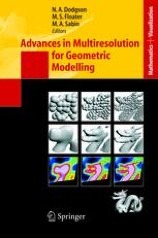
Advances in Multiresolution for Geometric Modelling
Multiresolution methods in geometric modelling are concerned with the generation, representation, and manipulation of geometric objects at several levels of detail. Applications include fast visualization and rendering as well as coding, compression, and digital transmission of 3D geometric objects.The book contains seven survey papers, providing a detailed overview of recent advances in the various fields within multiresolution modelling, and sixteen additional research papers. Each of the seven parts of the book starts with a survey paper, followed by the associated research papers in that area.

Advanced distributed systems ; 5th International School and Symposium, ISSADS 2005, Guadalajara, Mexico, January 24-28, 2005, Revised Selected Papers
Poses the papers accepted and presented at the 5th Int- national School and Symposium on Advanced Distributed Systems (ISSADS) in this LNCS volume. The papers presented in the sessions of the symposium cover the subjects of distributed systems from the system level and applications, but also contributions from the area of theory and artificial intelligence concepts.
