



الصفحة 7
الصفحة 7
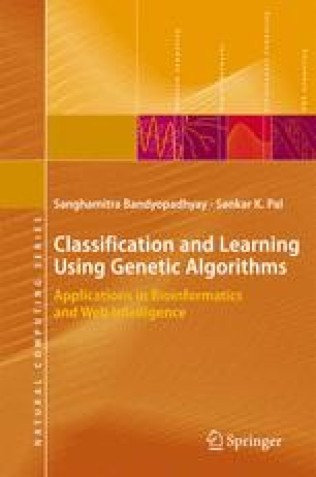
Classification and Learning Using Genetic Algorithms : Applications in Bioinformatics and Web Intelligence
This book provides a unified framework that describes how genetic learning can be used to design pattern recognition and learning systems. The book is unique in the sense of describing how a search technique, the genetic algorithm, can be used for pattern classification mainly through approximating decision boundaries, and it demonstrates the effectiveness of the genetic classifiers vis-à-vis several widely used classifiers, including neural networks. It provides a balanced mixture of theories, algorithms and applications, and in particular results from the bioinformatics and Web intelligence domains.
Cellular Genetic Algorithms
CELLULAR GENETIC ALGORITHMS defines a new class of optimization algorithms based on the concepts of structured populations and Genetic Algorithms (GAs). The authors explain and demonstrate the validity of these cellular genetic algorithms throughout the book. This class of genetic algorithms is shown to produce impressive results on a whole range of domains, including complex problems that are epistatic, multi-modal, deceptive, discrete, continuous, multi-objective, and random in nature. The focus of this book is twofold. On the one hand, the authors present new algorithmic models and extensions to the basic class of Cellular GAs in order to tackle complex problems more efficiently. On the other hand, practical real world tasks are successfully faced by applying Cellular GA methodologies to produce workable solutions of real-world applications.
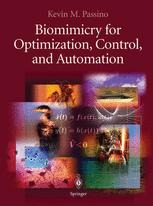
Biomimicry for Optimization, Control, and Automation
In this book, we focus onhowtousebiomimicryof the functionaloperationofthe “hardwareandso- ware” of biological systems for the development of optimization algorithms and feedbackcontrolsystemsthatextendourcapabilitiestoimplementsophisticated levels of automation. The primary focus is not on the modeling, emulation, or analysis of some biological system. The focus is on using “bio-inspiration” to inject new ideas, techniques, and perspective into the engineering of complex automation systems. There are many biological processes that, at some level of abstraction, can berepresentedasoptimizationprocesses,manyofwhichhaveasa basicpurpose automatic control, decision making, or automation.
Biometrics, Computer Security Systems and Artificial Intelligence Applications
This book presents the most recent achievements in some fascinating and rapidly developing fields within Computer Science. The scientific works presented in this book have been partitioned into three topical groups: Image Analysis and Biometrics, Computer Security Systems, and Artificial Intelligence and Applications. Image Analysis and Biometrics is the branch of Computer Science dealing with the very difficult task of artificial, visual perception of objects and surroundings, as well as the problems connected with it. Computer Security and Safety is at present a very important and intensively investigated branch of Computer Science because of the menacing activity of hackers and computer viruses.
Biologically Inspired Approaches to Advanced Information Technology ; 2nd International Workshop, BioADIT 2006, Osaka, Japan 26-27, 2006, Proceedings
This book contains 30 articles and three abstracts of invited talks presented at The Second International Workshop on Biologically Inspired Approaches for Advanced Information Technology,The workshop is intended to provide an e?ective forum for original research results in the ?eld of bio-inspired approaches to advanced information technologies. It also serves to foster the connection between biological paradigms and solutions to building the next-generation information systems.
Biologically Inspired Algorithms for Financial Modelling
Then Part I provides a thorough guide to the various bioinspired methodologies – neural networks, evolutionary computing (particularly genetic algorithms and grammatical evolution), particle swarm and ant colony optimization, and immune systems. Part II brings the reader through the development of market trading systems. Finally, Part III examines real-world case studies where BIA methodologies are employed to construct trading systems in equity and foreign exchange markets, and for the prediction of corporate bond ratings and corporate failures.

Bioinspired optimization methods and their applications ; 9th International conference, BIOMA 2020, Brussels, Belgium, November 19–20, 2020, Proceedings
This book constitutes the refereed proceedings of the 9th International Conference on Bioinspired Optimization Methods and Their Applications, BIOMA 2020, held in Brussels, Belgium, in November 2020. The 24 full papers presented in this book were carefully reviewed and selected from 68 submissions. The papers in this BIOMA proceedings specialized in bioinspired algorithms as a means for solving the optimization problems and came in two categories: theoretical studies and methodology advancements on the one hand, and algorithm adjustments and their applications on the other.

Bio-inspired modeling of cognitive tasks ; 2nd International Work-conference on the interplay between natural and artificial computation, IWINAC 2007, La Manga del Mar Menor, Spain, June 18-21, 2007, Proceedings, Part I
This volume includes all the contributions mainly related with theoretical, conceptual and methodological aspects linking AI and knowledge engineering with neurophysiology, clinics and cognition.
Autonomous Robots and Agents
This book deals with the theoretical and methodological aspects of incorporating intelligence in Autonomous Robots and Agents. Challenges faced in the real world to accomplish complex tasks, which require collaborative efforts, and methods to overcome them, are detailed. Several informative articles deal with navigation, localization and mapping of mobile robots, a problem that engineers and researchers are grappling with all the time.This edited volume is targeted to present the latest state-of-the-art methodologies in Robotics. It is a compilation of the extended versions of the very best papers selected from the many that were presented at the 3rd International Conference on Autonomous Robots and Agents (ICARA 2006) which was held at Palmerston North, New Zealand from 11-14 December, 2006. Scientists and engineers who work with mobile robots will find this book very useful and stimulating.
Autonomous intelligent systems : Multi-agents and data mining ; 2nd International workshop, AIS-ADM 2007, St. Petersburg, Russia, June 3-5, 2007, Proceedings
MAS offiers powerful metaphors for information system conceptualization, a range of new techniques, and technologies specifically focused on the design and implementation of lar- scale open distributed intelligent systems. KDD also provides intelligent inf- mation technology with powerful ideas, algorithms, and software means to help cope with the main problem of artificial intelligence, formulated in the we- known question “Where does the knowledge come from?”, thus actually making modern applications intelligent and adaptive. The evident recent trend in both science and industry is to integrate and take advantage of both technologies. The existing experience with combined application of multi-agent technology to design architectures of distributed (- erarchical and peer-to-peer) data mining and KDD systems, as well as the u- lization of data mining and KDD achievements to provide enhanced intelligence of MAS, confirms the fact that both technologies are capable of mutual enri- ment and their integrateduse may result in intelligent information systems with new emergent properties.

Assembly Line Design : The Balancing of Mixed-Model Hybrid Assembly Lines with Genetic Algorithms
Efficient assembly line design is a problem of considerable industrial importance. Assembly Line Design will be bought by technical personnel working in design, planning and production departments in industry as well as managers in industry who want to learn more about concurrent engineering.
Artificial intelligence techniques for computer graphics
This volume contains both invited and selected extended papers from the last 3IA Conference (3IA’2008), together with an introduction presenting the area of Intelligent Computer Graphics and various Computer Graphics areas where introduction of intelligent techniques permitted to resolve important problems.
Artificial intelligence in theory and practice ; IFIP 19th World Computer Congress, TC 12: IFIP AI 2006 Stream, August 21-24, 2006, Santiago, Chile
The IFIP series publishes state-of-the-art results in the sciences and technologies of information and communication. The scope of the series includes: foundations of computer science; software theory and practice; education; computer applications in technology; communication systems; systems modeling and optimization; information systems; computers and society; computer systems technology; security and protection in information processing systems; artificial intelligence; and human-computer interaction. Proceedings and post-proceedings of referred international conferences in computer science and interdisciplinary fields are featured.

Artificial intelligence applications and innovations II; IFIP TC12 and WG12.5 ; 2nd IFIP conference on artificial intelligence applications and innovations (AIAI-2005), Sept. 7-9, 2005, Beijing, China
Artificial Intelligence is one of the oldest and most exciting subfields of computing, covnering such areas as intelligent robotics, intelligent planning and scheduling, model-based reasoning, fault diagnosis, natural language processing, maching translation, knowledge representation and reasoning, knowledge-based systems, knowledge engineering, intelligent agents, machine learning, neural nets, genetic algorithms and knowledge management. The papers in this volume comprise the refereed proceedings of the Second International Conference on Artificial Intelligence Applications and Innovations,held in Beijing, China in 2005.

Artificial intelligence and soft computing ; 19th International Conference, ICAISC 2020, Zakopane, Poland, October 12-14, 2020, Proceedings, Part I
The two-volume set LNCS 12415 and 12416 constitutes the refereed proceedings of of the 19th International Conference on Artificial Intelligence and Soft Computing, ICAISC 2020, held in Zakopane, Poland*, in October 2020. The 112 revised full papers presented were carefully reviewed and selected from 265 submissions. The papers included in the first volume are organized in the following six parts: neural networks and their applications; fuzzy systems and their applications; evolutionary algorithms and their applications; pattern classification; bioinformatics, biometrics and medical applications; artificial intelligence in modeling and simulation. The papers included in the second volume are organized in the following four parts: computer vision, image and speech analysis; data mining; various problems of artificial intelligence; agent systems, robotics and control.

Artificial intelligence and knowledge engineering applications : A bioinspired approach ; 1st international work-Conference on the interplay between natural and artificial computation, IWINAC 2005, Las Palmas, Canary Islands, Spain, June 15-18, 2005, Proceedings, Part II
The computational paradigm considered here is a conceptual, theoretical andformal framework situated above machines and living creatures (two instantia-tions), sufficiently solid, and still non-exclusive, that allows us:1. to help neuroscientists to formulate intentions, questions, experiments, meth-ods and explanation mechanisms assuming that neural circuits are the psy-chological support of calculus;2. to help scientists and engineers from the fields of artificial intelligence (AI)and knowledge engineering (KE) to model, formalize and program the com-putable part of human knowledge;3. to establish an interaction framework between natural system computation(NSC) and artificial system computation (ASC) in both directions, fromASC to NSC (in computational neuroscience), and from NSC to ASC (inbioinspired computation).

Artificial intelligence and innovations 2007 : from theory to applications ; Proceedings of the 4th IFIP International Conference on Artificial Intelligence Applications and Innovations (AIAI2007)
This book brings together leading research from engineers and practitioners interested in the technical advances, business and industrial applications of intelligent systems.It is focused on providing insights on how AI can be implemented in real world applications. Intelligent Internet Systems: Emerging Technologies and Applications

Artificial intelligence and data mining approaches in security frameworks
Offers solutions to the problems of security, outlining the concepts behind allowing computers to learn from experience and understand the world in terms of a hierarchy of concepts, with each concept defined through its relation to simpler concepts. provides state of the art approaches of artificial intelligence and data mining in these areas. It includes areas of detection, prediction, as well as future framework identification, development, building service systems and analytical aspects. In all these topics, applications of AI and data mining, such as artificial neural networks, fuzzy logic, genetic algorithm and hybrid mechanisms, are explained and explored. This book is aimed at the modeling and performance prediction of efficient security framework systems, bringing to light a new dimension in the theory and practice. This groundbreaking new volume presents these topics and trends, bridging the research gap on AI and data mining to enable wide-scale implementation. Whether for the veteran engineer or the student, this is a must-have for any library. This groundbreaking new volume: Clarifies the understanding of certain key mechanisms of technology helpful in the use of artificial intelligence and data mining in security frameworks ; Covers practical approaches to the problems engineers face in working in this field, focusing on the applications used every day ; Contains numerous examples, offering critical solutions to engineers and scientists ; Presents these new applications of AI and data mining that are of prime importance to human civilization as a whole
Artificial intelligence : Theories, models and applications ; 5th Hellenic Conference on AI, SETN 2008, Syros, Greece, October 2-4, 2008. Proceedings
This book constitutes the refereed proceedings of the 5th Hellenic Conference on Artificial Intelligence, SETN 2008, held at Syros, Greece in October 2008.

Artificial evolution ; 8th International Conference, Evolution artificielle, EA 2007, Tours, France, October 29-31, 2007, revised selected papers
This book constitutes the thoroughly refereed post-conference proceedings of the 8th International Conference on Artificial Evolution, EA 2007, held in Tours, France in October 2007.
