



الصفحة 7
الصفحة 7

Multivalency: Concepts, Research and Applications
Multivalency: Concepts, Research & Applications is divided into three parts. Part one provides background knowledge on various aspects of multivalency and cooperativity and presents practical methods for their study. Fundamental aspects such as thermodynamics, kinetics and the principle of effective molarity are described, and characterisation methods, experimental methodologies and data treatment methods are also discussed. Parts two and three provide an overview of current systems in which multivalency plays an important role in chemistry and biology, with a focus on the design rules, underlying chemistry and the fundamental principles of multivalency.

Multi-Sensor Data Fusion : An Introduction
This textbook provides a comprehensive introduction to the theories and techniques of multi-sensor data fusion. It is aimed at advanced undergraduate and first-year graduate students in electrical engineering and computer science, as well as researchers and professional engineers. The book is intended to be self-contained. No previous knowledge of multi-sensor data fusion is assumed, although some familiarity with the basic tools of linear algebra, calculus and simple probability theory is recommended.
Multiscale Modeling : A Bayesian Perspective
The book is aimed at statisticians, applied mathematicians, and engineers working on problems dealing with multiscale processes in time and/or space, such as in engineering, finance, and environmetrics. The book will also be of interest to those working on multiscale computation research. The main prerequisites are knowledge of Bayesian statistics and basic Markov chain Monte Carlo methods. A number of real-world examples are thoroughly analyzed in order to demonstrate the methods and to assist the readers in applying these methods to their own work. To further assist readers, the authors are making source code (for R) available for many of the basic methods discussed herein.

Multi-Scale Approaches in Drug Discovery : From Empirical Knowledge to In silico Experiments and Back
Drug discovery is an expensive, time-consuming process and the modern drug discovery community is constantly challenged not only with discovering novel bioactive agents to combat resistance from known diseases and fight against new ones, but to do so in a way that is economically effective. Advances in both experimental and theoretical/computational methods envisage that the greatest challenges in drug discovery can be most successfully addressed by using a multi-scale approach, drawing on the specialties of a whole host of different disciplines. Multi-Scale Approaches to Drug Discovery furnishes chemists with the detail they need to identify drug leads with the highest potential before isolating and synthesizing them to produce effective drugs with greater swiftness than classical methods may allow. This significantly speeds up the search for more efficient therapeutic agents.
Multiple-Aspect Analysis of Semantic Trajectories ; First International Workshop, MASTER 2019, Held in Conjunction with ECML-PKDD 2019, Würzburg, Germany, September 16, 2019, Proceedings
This book constitutes the refereed post-conference proceedings of the First International Workshop on Multiple-Aspect Analysis of Semantic Trajectories, MASTER 2019, held in conjunction with the 19th European Conference on Machine Learning and Knowledge Discovery in Databases, ECML PKDD 2019, in Würzburg, Germany, in September 2019.

Multiple Abstraction Hierachies for Mobile Robot Operation in Large Environments
This book focuses on the efficient performance of mobile robots through the use of multi-hierarchical symbolic representations of the environment. A mobile robot intended to perform deliberative actions must possess some symbolic representation of its workspace, but such representations of real environments usually become so large that should be conveniently arranged in order to facilitate and, in some cases, make possible their use. This book addresses all these issues considering symbolic multi-hierarchical structures. Such structures, based on the concept of abstraction, allow a robot to speed up its operation in large environments. Practical solutions tested on real robots (for instance, a robotic wheelchair for elder people) are provided.

Multi-Objective Evolutionary Algorithms for Knowledge Discovery from Databases
The present volume provides a collection of seven articles containing new and high quality research results demonstrating the significance of Multi-objective Evolutionary Algorithms (MOEA) for data mining tasks in Knowledge Discovery from Databases (KDD). These articles are written by leading experts around the world. It is shown how the different MOEAs can be utilized, both in individual and integrated manner, in various ways to efficiently mine data from large databases.
Multiobjective Evolutionary Algorithms and Applications
Multiobjective Evolutionary Algorithms and Applications provides comprehensive treatment on the design of multiobjective evolutionary algorithms and their applications in domains covering areas such as control and scheduling. Emphasizing both the theoretical developments and the practical implementation of multiobjective evolutionary algorithms, a profound mathematical knowledge is not required. Written for a wide readership, engineers, researchers, senior undergraduates and graduate students interested in the field of evolutionary algorithms and multiobjective optimization with some basic knowledge of evolutionary computation will find this book a useful addition to their book case.

Multimodality in architecture : Collaboration, technology and education
Examines multimodality in architecture and its impacts on collaborative, technical and educational processes or systems. Multimodality is becoming increasingly critical in contemporary architectural practice and education. Creative design teams face new challenges when they embrace new modes of communication, technology, and knowledge development processes. From diverse online modes of communication to shared digital environments, generative AI and advanced hardware solutions, new modes of information creation, sharing, and application are changing the ways architects and designers work. The book presents new research which empowers international researchers and designers to work more effectively in a diverse range of digital environments. Whether the readers are architects, teachers, students, or scholars, this book provides critical insights and practical tools for understanding and optimising processes in architecture and design.

Multimodal Texts in Disciplinary Education : A Comprehensive Framework
This book provides an introduction to multimodality and the role of multimodal texts in today’s education. Presenting a comprehensive framework for analysing and working with multimodal texts in disciplinary education, it serves as a tool for researchers and teachers alike. The second part of the book focuses on sample analyses of a variety of educational texts for different age groups and from different disciplines, including games and online resources. The authors also comment on the specific challenges of each text, and how teachers can discuss such texts with their students to enhance both their understanding of the content and their multimodal literacy.

Multimodal Intelligent Information Presentation
Intelligent Multimodal Information Presentation relates to the ability of a computer system to automatically produce interactive information presentations, taking into account the specifics about the user, such as needs, interests and knowledge, and engaging in a collaborative interaction that helps the retrieval of relevant information and its understanding on the part of the user.The volume includes descriptions of some of the most representative recent works on Intelligent Information Presentation and a view of the challenges ahead.

Multimedia Semantics : The Role of Metadata
This book gives an overview on fundamental issues within the field of multimedia metadata focusing on contextualized, ubiquitous, accessible and interoperable services on a higher semantic level. The book in hand provides a selection of basic articles being a base for multimedia metadata research. Furthermore it presents a view on the current state of the art in multimedia metadata research.
Multimedia Data Mining and Knowledge Discovery
Multimedia Data Mining and Knowledge Discovery provides an overview of the current state-of-the-art in the field of multimedia data mining and knowledge discovery, and discusses the variety of hot topics in multimedia data mining research. Consisting of an introductory section and four topical parts, the book describes the objectives and current tendencies in multimedia data mining research and their applications.

Multigenic and Induced Systemic Resistance in Plants
This comprehensive volume consists of a series of up-to-date reviews, each incorporating current models and knowledge related to mechanisms of resistance either expressed constitutively or induced systemically in plants. Each chapter covers a topic related to the phenomenon of plant resistance to fungal and bacterial pathogens, insects, nematodes, viruses or abiotic stress in plants, as well as the application of this knowledge to protect crops now and in the future. Researchers, upper-level undergraduate and graduate students, and those teaching courses in plant physiology, entomology and plant pathology will find this volume a much needed asset.

Multidisciplinary Scheduling : Theory and Applications ; 1st International Conference, MISTA '03 Nottingham, UK, 13-15 August 2003. Selected Papers
MULTIDISCIPLINARY SCHEDULING: Theory and Applications is a volume of nineteen reviewed papers that were selected from the sixty-seven papers presented during the First Multidisciplinary International Conference of Scheduling: Theory and Applications (MISTA). This is the initial volume of MISTA—the primary forum on interdisciplinary research on scheduling. Each paper in the volume has been rigorously reviewed and carefully copyedited to ensure the volume's readability. The book contains leading edge papers on the fundamentals of scheduling, multi-criteria objective scheduling, personnel scheduling, scheduling in space, scheduling the Internet, machine scheduling, bin packing, educational timetabling, sports scheduling, transport scheduling, aircraft scheduling, and heuristic and meta-heuristic scheduling

Multidimensional Screening
The book brings into a focus all necessary mathematical knowledge necessary to understand the economics of multidimensional results screening and applies them straightaway to economic models. The first part of this book contains a review of vector calculus, the theory of partial differential equations, and the theory of generalized convexity. These techniques are extensively used in multidimensional screening models. Part II is devoted to the economics of sceening models. It starts with a detailed discussion of economics and mathematics of unidimensional screening problems and three approaches to their solution: direct, dual, and Hamiltonian. It uses the Hamiltonian approach to unify all known results, which were previously obtained using different arguments. Then the major difficulties with direct and dual approach in the multidimensional context are discussed and the Hamiltonian approach is used to provide the most complete characterization of the solution known in the literature.

Multidetector-Row CT of the Thorax
With the advent of multidetector-row technology, excitement has returned to computed tomography. Not only can we now image faster and with better resolution than ever before; more importantly, the development of sophisticated image acquisition techniques has enabled us to venture into areas previously considered to be beyond the scope of CT imaging. The knowledge, experience, and vision of a host of renowned international experts in cutting-edge thoracic applications of multidetector-row CT are condensed within this book. The result is a critical, comprehensive review of the novel opportunities, but also the new challenges, brought about by the development of ever-faster CT acquisition techniques.

Multidetector-Row Computed Tomography : Scanning and Contrast Protocols
Multidetector-row computed tomography (MDCT) has advanced the approach to diagnostic assessment of many pathologies and now plays an integral role in imaging of both abdominal and cardiovascular diseases. The possibility to acquire diagnostic images with shorter scan duration, longer scan ranges, and/or thinner sections, MDCT has facilitated the opening of new horizons, such as interventional MDCT and functional imaging in stroke and oncology. In addition, advanced postprocessing techniques now permit high quality volumetric imaging in combination with maximum intensity projections, volume rendering, curved planar reformations and multiplanar reconstructions. This volume gathers contributions by internationally renowned specialists in the field who, through presenting their clinical experience, provide a thorough overview not only of MDCT and its practical applications, but also of workflow management in everyday clinical practice. Focussing on scanning and contrast protocols, the current advantages and disadvantages of non-enhanced vs. enhanced MDCT are discussed, along with insights into likely future developments. The volume represents an up-to-date source of technical and practically-oriented clinical information which should prove of great benefit to all who wish to improve or consolidate their knowledge and expertise in MDCT.

Multi-Agent Systems and Applications V ; 5th International Central and Eastern European Conference on Multi-Agent Systems, CEEMAS 2007, Leipzig, Germany, September 25-27, 2007, Proceedings
The technical research paper section of the proceedingscontains pure - search papers as well as research results in application settings. The goal is to demonstrate the real-life value and commercial reality of multi-agent systems as well as to foster the communication between academia and industry in this eld.
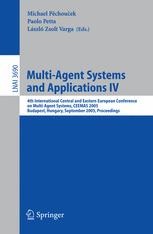
Multi-Agent Systems and Applications IV ; 4th International Central and Eastern European Conference on Multi-Agent Systems, CEEMAS 2005, Budapest, Hungary, September 15-17, 2005, Proceedings
In the very competitive field of agent oriented conferences and workshops nowadays (such as AAMAS, WI/IAT, EUMAS, CIA, MATES) the special profile of CEEMAS is that it is trying to bridge the gap between applied research achievements and theoretical research activities. Our ambition is to provide a forum for presenting theoretical research with an evident application potential, implemented application prototypes and their properties, as well as industrial case studies of successful (but also unsuccessful) agent technology deployments. This is why the CEEMAS proceedings volume provides a collection of research and application papers. The technical research paper section of the proceedings (see pages 11–499) contains pure research papers as well as research results in application settings while the application papers section (see pages 500–530) contains papers focused on application aspects. The goal is to demonstrate the real life value and commercial reality of multi-agent systems as well as to foster communication between academia and industry in this field.
