



الصفحة 69
الصفحة 69
Complex and Adaptive Dynamical Systems : A Primer
We are living in an ever more complex world, an epoch where human actions can accordingly acquire far-reaching potentialities. Complex and adaptive dynamical systems are ubiquitous in the world surrounding us and require us to adapt to new realities and the way of dealing with them. This primer has been developed with the aim of conveying a wide range of "commons-sense" knowledge in the field of quantitative complex system science at an introductory level, providing an entry point to this both fascinating and vitally important subject.
Complex Analysis with Applications to Number Theory
The book discusses major topics in complex analysis with applications to number theory.It 's including the theory of several finitely and infinitely complex variables, hyperbolic geometry, two- and three-manifolds, and number theory. In addition to solved examples and problems, the book covers most topics of current interest, such as Cauchy theorems, Picard’s theorems, Riemann–Zeta function, Dirichlet theorem, Gamma function, and harmonic functions.
Complex Analysis : In the Spirit of Lipman Bers
In this book, the main focus is the theory of complex-valued functions of a single complex variable. This theory is a prerequisite for the study of many current and rapidly developing areas of mathematics including the theory of several and infinitely many complex variables, the theory of groups, hyperbolic geometry and three-manifolds, and number theory.
Complex analysis
The guiding principle of this presentation of ``Classical Complex Analysis'' is to proceed as quickly as possible to the central results while using a small number of notions and concepts from other fields. Thus the prerequisites for understanding this book are minimal; only elementary facts of calculus and algebra are required.
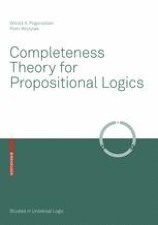
Completeness theory for propositional logics
Completeness is one of the most important notions in logic and the foundations of mathematics. Many variants of the notion have been de?ned in literature. We shallconcentrateonthesevariants,andaspects,of completenesswhicharede?ned in propositional logic. Completeness means the possibility of getting all correct and reliable sc- mata of inference by use of logical methods. The word ‘all’, seemingly neutral, is here a crucial point of distinction. Assuming the de?nition as given by E. Post we get, say, a global notion of completeness in which the reliability refers only to syntactic means of logic and outside the correct schemata of inference there are only inconsistent ones. It is impossible, however, to leave aside local aspects of the notion when we want to make it relative to some given or invented notion of truth. Completeness understood in this sense is the adequacy of logic in relation to some semantics, and the change of the logic is accompanied by the change of its semantics.

Compiler construction ; Vol. 3443 : 14th International Conference, CC 2005, Held as Part of the Joint European Conferences on Theory and Practice of Software, ETAPS 2005, Edinburgh, UK, April 4-8, 2005. Proceedings
"This book constitutes the refereed proceedings of 14th International Conference, CC 2005, Held as Part of the Joint European Conferences on Theory and Practice of Software, ETAPS 2005, including Topics Programming Languages, Compilers, Interpreters Logics and Meanings of Programs / Mathematical Logic and Formal Languages / Software Engineering / Artificial Intelligence"
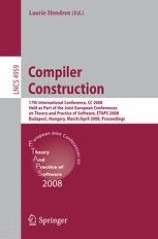
Compiler construction ; 17th International Conference, CC 2008, Held as Part of the Joint European Conferences on Theory and Practice of Software, ETAPS 2008, Budapest, Hungary, March 29 - April 6, 2008. Proceedings
This book constitutes the proceedings of the 17th International Conference on Compiler Construction, CC 2008. It covers analysis and transformations, compiling for parallel architectures, runtime techniques and tools, analyses, and atomicity and transactions.
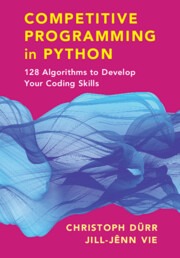
Competitive Programming in Python : 128 Algorithms to Develop your Coding Skills
Learn all the algorithmic techniques and programming skills you need from two experienced coaches, problem setters, and jurors for coding competitions. The authors highlight the versatility of each algorithm by considering a variety of problems and show how to implement algorithms in simple and efficient code. What to expect: * Master 128 algorithms in Python. * Discover the right way to tackle a problem and quickly implement a solution of low complexity.
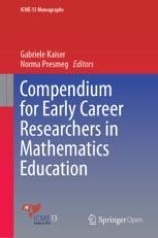
Compendium for Early Career Researchers in Mathematics Education
The book provides a state-of-the-art overview of important theories from mathematics education and the broad variety of empirical approaches currently widely used in mathematics education research.
Compatible Spatial Discretizations
Compatible spatial discretizations are those that inherit or mimic fundamental properties of the PDE such as topology, conservation, symmetries, and positivity structures and maximum principles. It offer a snapshot of the current trends and developments in compatible spatial discretizations. The reader will find valuable insights on spatial compatibility from several different perspectives and important examples of applications compatible discretizations in computational electromagnetics, geosciences, linear elasticity, eigenvalue approximations and MHD. The contributions collected in this volume will help to elucidate relations between different methods and concepts and to generally advance our understanding of compatible spatial discretizations for PDEs.

Comparative genomics : Methods and protocols
Provides new and updated chapters covering computational and mathematical techniques and concepts related to the field of comparative genomics. The topics covered in the chapters range from those that address general techniques and concepts that apply to all organisms to others that are specialized and apply to specific biological systems such as viruses, bacteria, nematodes, and insects.
Compactifying Moduli Spaces for Abelian Varieties
This volume presents the construction of canonical modular compactifications of moduli spaces for polarized Abelian varieties (possibly with level structure), building on the earlier work of Alexeev, Nakamura, and Namikawa. This provides a different approach to compactifying these spaces than the more classical approach using toroical embeddings, which are not canonical. There are two main new contributions in this monograph: (1) The introduction of logarithmic geometry as understood by Fontaine, Illusie, and Kato to the study of degenerating Abelian varieties; and (2) the construction of canonical compactifications for moduli spaces with higher degree polarizations based on stack-theoretic techniques and a study of the theta group.
Compactifications of Symmetric and Locally Symmetric Spaces
Noncompact symmetric and locally symmetric spaces naturally appear in many mathematical theories, including analysis (representation theory, nonabelian harmonic analysis), number theory (automorphic forms), algebraic geometry (modulae) and algebraic topology (cohomology of discrete groups). In most applications it is necessary to form an appropriate compactification of the space. The literature dealing with such compactifications is vast. The main purpose of this book is to introduce uniform constructions of most of the known compactifications with emphasis on their geometric and topological structures. The book is divided into three parts. Part I studies compactifications of Riemannian symmetric spaces and their arithmetic quotients. Part II is a study of compact smooth manifolds. Part III studies the compactification of locally symmetric spaces.
Compact Riemann Surfaces : An Introduction to Contemporary Mathematics
Although Riemann surfaces are a time-honoured field, this book is novel in its broad perspective that systematically explores the connection with other fields of mathematics. It can serve as an introduction to contemporary mathematics as a whole as it develops background material from algebraic topology, differential geometry, the calculus of variations, elliptic PDE, and algebraic geometry. It is unique among textbooks on Riemann surfaces in including an introduction to Teichmüller theory.
Compact Lie Groups
This book covers the structure and representation theory of compact Lie groups. The necessary Lie algebra theory is also developed in the text with a streamlined approach focusing on linear Lie groups.
Commutative algebras of Toeplitz Operators on the Bergman Space
This book is devoted to the spectral theory of commutative C*-algebras of Toeplitz operators on the Bergman space and its applications. For each such commutative algebra there is a unitary operator which reduces Toeplitz operators from this algebra to certain multiplication operators, thus providing their spectral type representations. This yields a powerful research tool giving direct access to the majority of the important properties of the Toeplitz operators studied herein, such as boundedness, compactness, spectral properties, invariant subspaces.

Clinical decision support systems : Theory and practice
Writes the editor, "If used properly, CDSS have the potential to change the way medicine has been taught and practiced." As clinical decision support systems (CDSS) gain an increasingly central role in the delivery of high quality health care, it becomes more important for the health care community to understand their use. This text is designed as a resource for practicing clinicians, informaticians, teachers and students alike, and provides the most current, comprehensive look a the development and evaluation of clinical decision support systems.
Classification des Groupes Algébriques Semi-simples = The Classification of Semi-Simple Algebraic Groups
The third volume of the Collected Works of Claude Chevalley assembles his work on semi-simple algebraic groups contained, for the most part, in the notes of the famous "Sminaire Chevalley" held at the Ecole Normale Suprieure in Paris between 1956 and 1958 and written up by participants of the seminar namely, P. Cartier, A. Grothendieck, R. Lazard and J.L. Verdier. These texts have been entirely reset in TeX for this edition, and edited and annotated by Pierre Cartier. Almost 50 years after the original writing, these texts still constitute a choice reference from which to enter
Classification and Modeling with Linguistic Information Granules : Advanced Approaches to Linguistic Data Mining
Many approaches have already been proposed for classification and modeling in the literature. These approaches are usually based on mathematical mod els. Computer systems can easily handle mathematical models even when they are complicated and nonlinear (e.g., neural networks). On the other hand, it is not always easy for human users to intuitively understand mathe matical models even when they are simple and linear. This is because human information processing is based mainly on linguistic knowledge while com puter systems are designed to handle symbolic and numerical information. A large part of our daily communication is based on words. We learn from various media such as books, newspapers, magazines, TV, and the Inter net through words. We also communicate with others through words. While words play a central role in human information processing, linguistic models are not often used in the fields of classification and modeling. If there is no goal other than the maximization of accuracy in classification and modeling, mathematical models may always be preferred to linguistic models. On the other hand, linguistic models may be chosen if emphasis is placed on interpretability.
Classification Algorithms for Codes and Designs
Almost a century earlier, in 1782, Euler [180] published some results on classifying small Latin squares, but for the ?rst few steps in this direction one should actually go at least as far back as ancient Greece and the proof that there are exactly ?ve Platonic solids. One of the most remarkable achievements in the early, pre-computer era is the classi?cation of the Steiner triple systems of order 15, quoted above. An onerous task that, today, no sensible person would attempt by hand calcu- tion. Because, with the exception of occasional parameters for which com- natorial arguments are e?ective (often to prove nonexistence or uniqueness), classi?cation in general is about algorithms and computation.
