



الصفحة 69
الصفحة 69

Gettering Defects in Semiconductors
The authors address not only well-established gettering techniques but also describe contemporary trends in gettering technologies from an international perspective. The types and properties of structural defects in semiconductors, their generating and their transforming mechanisms during fabrication are described. The primary emphasis is placed on classifying and describing specific gettering techniques, their specificity arising from both their position in a general technological process and the regimes of their application. This book addresses both engineers and material scientists interested in semiconducting materials theory and also undergraduate and graduate students in solid–state microelectronics and nanoelectronics. A comprehensive list of references provides readers with direction for further reading.

Gesundheitsversorgung am Lebensende : Soziale Ungleichheit in Bezug auf Institutionsaufenthalte und Sterbeorte = Health care at the end of life : Social inequality in relation to institutional stays and places of death
Damian Hedinger examines the question of health care at the end of life, which is becoming more and more important due to demographic aging and increasing life expectancy. He proceeds from both a scientific and a socio-political perspective and uses administrative data from Switzerland to find out why one spends a longer or shorter period in a home or hospital and why one dies where. It turns out that in addition to medical factors, socio-economic, familial and cultural determinants also have a significant influence on health care before death.

Gesture smart control
Nowadays actions are increasingly being handled in electronic ways, instead of physical interaction. From earlier times biometrics is used in the authentication of a person. It recognizes a person by using a human trait associated with it like eyes (by calculating the distance between the eyes) and using hand gestures, fingerprint detection, face detection etc. Advantages of using these traits for identification are that they uniquely identify a person and cannot be forgotten or lost. These are unique features of a human being which are being used widely to make the human life simpler. Hand gesture recognition system is a powerful tool that supports efficient interaction between the user and the computer.

Geschichte des Husserl-Archivs Leuven History
This short History of the Husserl-Archives offers a fascinating view on the foundation and development of this important research institute and of the Husserliana edition. Father Van Breda’s personal annotations, which are made public for the first time in English here, paint a captivating picture of the rescue of Husserl’s manuscripts and the foundation of the Archives shortly before the second world war. The overview of the further history of the Archives by Thomas Vongehr concentrates on the history of the editorial work and its reception. These two texts present not only a historical account but explain the scientific goals and tasks of the Husserl-Archives and its research.

Gerodontology Essentials for Health Care Professionals
Provides basic knowledge and skills for non-dental healthcare practitioners, helping them recognize the importance of oral health, perform initial oral health assessments, consult dentists when necessary, and offer preventive advice and counseling. As people age, they tend to refrain from routine dental care, while the number of consultations with non-dental healthcare providers (physicians, nurses, pharmacists, physician assistants, physical therapists, occupational therapists etc.) increases. However, few healthcare providers are adequately trained to assess oral problems.

Germ cell development : Methods and protocols
Explores techniques for the isolation, purification, and establishment of in vitro germ cell (GS) systems at different stages of development in a variety of organisms, including chickens, mice, rats, and humans. The book additionally describes cutting-edge analytic and informatic tools to study germ cell development at the single cell level and meiotic recombination. Written in the highly successful Methods in Molecular Biology series format, chapters include introductions to their respective topics, lists of the necessary materials and reagents, step-by-step and readily reproducible laboratory protocols, and tips on troubleshooting and avoiding known pitfalls.

Geotechnics of Roads : Fundamentals
Presents stresses and strains in road structures, water and heat migration within and between layers of road materials, and the effects of water on the strength and stiffness of those materials. It includes a deep analysis of soil compaction, one of the most important issues in road construction. Compaction accounts for only a small proportion of a construction budget but its effects on the long-term performance of a road are decisive. In addition, the book describes methodologies for nondestructive road evaluation including analysis of continuous compaction control, a powerful technique for real-time quality control of road structures.

Geotechnics of Roads : Advanced Analysis and Modeling
Develops 23 extended examples that cover most of the theoretical aspects presented in the book Geotechnics of Roads: Fundamentals. Moreover, for most examples, Volume 2 describes algorithms for solving complex problems and provides Matlab® scripts for their solution.

Geotechnical Slope Analysis
The influence of initial stresses, pore water pressures and seismic forces has been explored not only on performance indicators such as the ‘Factor of Safety’ but also on the location of critical slip surfaces. In addition to these factors, it is shown that the chosen method of analysis may also have a significant influence on the location of the critical slip surface. This book focuses on research studies concerning slope behaviour, the occurrence of landslides and the use of alternative methods of analysis and interpretation. The importance of uncertainties in slope performance and, more broadly, in geotechnical engineering is emphasised.

Geosynthetics and their applications
Geosynthetics are being used extensively throughout the world as they offer the most efficient and cost-effective solutions of a myriad of civil engineering problems.If properly protected, geosynthetics have the potential of functioning for hundreds of years.Rational design methods - based on sound concepts and standardized text techniques for detemining the technical properties of geosynthetics - are now available, placing the use of geosynthetics on a firm base.

Geostatistics for environmental applications ; Proceedings of the Fifth European Conference on geostatistics for environmental applications
Once applied only to problems of mining-reserves assessment or petroleum-reservoir characterization, geostatistics is now being used in an increasingly large number of disciplines in environmental sciences. On the one hand, it enables the analysis and handling, in a rigorous probabilistic framework of the issues of spatial and temporal interpolation of continuous or categorical environmental variables. On the other hand, the methodology is also used to design and optimize sampling campaigns. "Geostatistics for Environmental Applications" contains forty selected contributions covering the latest progress in a broad spectrum of fields including air quality, climatology, ecology, groundwater hydrology, surface hydrology, oceanography, soil contamination, epidemiology and health, natural hazards, and remote sensing.

Geometry of Müntz Spaces and Related Questions
Starting point and motivation for this volume is the classical Muentz theorem which states that the space of all polynomials on the unit interval, whose exponents have too many gaps, is no longer dense in the space of all continuous functions. The resulting spaces of Muentz polynomials are largely unexplored as far as the Banach space geometry is concerned and deserve the attention that the authors arouse. They present the known theorems and prove new results concerning, for example, the isomorphic and isometric classification and the existence of bases in these spaces. Moreover they state many open problems. Although the viewpoint is that of the geometry of Banach spaces they only assume that the reader is familiar with basic functional analysis. In the first part of the book the Banach spaces notions are systematically introduced and are later on applied for Muentz spaces. They include the opening and inclination of subspaces, bases and bounded approximation properties and versions of universality.

Geometry and monadology : Leibniz’s Analysis Situs and philosophy of space
Reconstructs, from both historical and theoretical points of view, Leibniz’s geometrical studies, focusing in particular on the research Leibniz carried out in the last years of his life. It is indeed the first ever comprehensive historical reconstruction of Leibniz’s geometry that meets the interests of both mathematicians and philosophers. The main purpose of the work is to offer a better understanding of the Leibnizean philosophy of space and mature metaphysics, through a pressing confrontation with the problems of geometric foundations. Regarding the scope of these problems, the book also deals in depth with Leibniz’s theory of sensibility, thus favouring the comparison and contrast between Leibniz’s philosophy and Kant’s transcendentalist solution. The Appendix references to a number of previously unpublished manuscripts on geometry from the Leibniz Archiv in Hannover, which disclose new theories, points of view and technicalities of Leibniz’s thought.
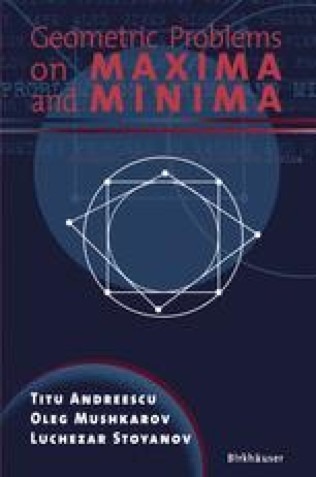
Geometric Problems on Maxima and Minima
Questions of maxima and minima have great practical significance, with applications to physics, engineering, and economics; they have also given rise to theoretical advances, notably in calculus and optimization. Indeed, while most texts view the study of extrema within the context of calculus, this carefully constructed problem book takes a uniquely intuitive approach to the subject: it presents hundreds of extreme-value problems, examples, and solutions primarily through Euclidean geometry.

Geometric mechanics on riemannian manifolds : Applications to partial differential equations
This work presents a purely geometric treatment of problems in physics involving quantum harmonic oscillators, quartic oscillators, minimal surfaces, and Schrödinger's, Einstein's and Newton's equations. Historically, problems in these areas were approached using the Fourier transform or path integrals, although in some cases (e.g., the case of quartic oscillators) these methods do not work. New geometric methods are introduced in the work that have the advantage of providing quantitative or at least qualitative descriptions of operators, many of which cannot be treated by other methods. And, conservation laws of the Euler–Lagrange equations are employed to solve the equations of motion qualitatively when quantitative analysis is not possible. It includes : Lagrangian formalism on Riemannian manifolds; energy momentum tensor and conservation laws; Hamiltonian formalism; Hamilton–Jacobi theory; harmonic functions, maps, and geodesics; fundamental solutions for heat operators with potential; and a variational approach to mechanical curves.

Geometric Integration Theory
This textbook introduces geometric measure theory through the notion of currents. Currents—continuous linear functionals on spaces of differential forms—are a natural language in which to formulate various types of extremal problems arising in geometry, and can be used to study generalized versions of the Plateau problem and related questions in geometric analysis. Key features of Geometric Integration Theory: * Includes topics on the deformation theorem, the area and coarea formulas, the compactness theorem, the slicing theorem and applications to minimal surfaces * Applies techniques to complex geometry, partial differential equations, harmonic analysis, differential geometry, and many other parts of mathematics

Geometric Fundamentals of Robotics
Geometric Fundamentals of Robotics provides an elegant introduction to the geometric concepts that are important to applications in robotics. This second edition is still unique in providing a deep understanding of the subject: rather than focusing on computational results in kinematics and robotics, it includes significant state-of-the art material that reflects important advances in the field, connecting robotics back to mathematical fundamentals in group theory and geometry.
Geometric Data Analysis : From Correspondence Analysis to Structured Data Analysis
Geometric Data Analysis (GDA) is the name suggested by Stanford University to designate the approach to Multivariate Statistics initiated.as Correspondence Analysis, an approach that has become more and more used and appreciated over the years. This book presents the full formalization of GDA in terms of linear algebra - the most original and far-reaching consequential feature of the approach - and shows also how to integrate the standard statistical tools such as Analysis of Variance, including Bayesian methods. Chapter 9, Research Case Studies, is nearly a book in itself; it presents the methodology in action on three extensive applications, one for medicine, one from political science, and one from education (data borrowed from the Stanford computer-based Educational Program for Gifted Youth ). Thus the readership of the book concerns both mathematicians interested in the applications of mathematics, and researchers willing to master an exceptionally powerful approach of statistical data analysis.
Geometric Aspects of Functional Analysis : Israel Seminar 2004-2005
Most of the papers deal with different aspects of the Asymptotic Geometric Analysis, ranging from classical topics in the geometry of convex bodies, to inequalities involving volumes of such bodies or, more generally, log-concave measures, to the study of sections or projections of convex bodies. In many of the papers Probability Theory plays an important role; in some limit laws for measures associated with convex bodies, resembling Central Limit Theorems, are derive and in others probabilistic tools are used extensively. There are also papers on related subjects, including a survey on the behavior of the largest eigenvalue of random matrices and some topics in Number Theory.

Geometric and Topological Methods for Quantum Field Theory
This volume offers an introduction, in the form of four extensive lectures, to some recent developments in several active topics at the interface between geometry, topology and quantum field theory. The first lecture is by Christine Lescop on knot invariants and configuration spaces, in which a universal finite-type invariant for knots is constructed as a series of integrals over configuration spaces. This is followed by the contribution of Raimar Wulkenhaar on Euclidean quantum field theory from a statistical point of view. The author also discusses possible renormalization techniques on noncommutative spaces. The third lecture is by Anamaria Font and Stefan Theisen on string compactification with unbroken supersymmetry. The authors show that this requirement leads to internal spaces of special holonomy and describe Calabi-Yau manifolds in detail. The last lecture, by Thierry Fack, is devoted to a K-theory proof of the Atiyah-Singer index theorem and discusses some applications of K-theory to noncommutative geometry. These lectures notes, which are aimed in particular at graduate students in physics and mathematics, start with introductory material before presenting more advanced results. Each chapter is self-contained and can be read independently.
