



الصفحة 616
الصفحة 616
Advances and Technical Standards in Neurosurgery ; Vol. 33
This series has already become a classic. In general, one volume is published per year. The advances section presents fields of neurosurgery and related areas in which important recent progress has been made. The technical standards section features detailed descriptions of standard procedures to assist young neurosurgeons in their post-graduate training.

Advances and technical standards in neurosurgery ; Vol. 31
Part of the series sponsored by the European Association of Neurosurgical Societies. The Advances section presents fields of neurosurgery and related areas. The Technical Standards section features detailed descriptions of standard procedures to assist young neurosurgeons in their post-graduate training.

Advances and Technical Standards in Neurosurgery ; Vol. 30
This series, sponsored by the European Association of Neurosurgical Societies, has already become a classic. In general, one volume is published per year. The Advances section presents fields of neurosurgery and related areas in which important recent progress has been made. The Technical Standards section features detailed descriptions of standard procedures to assist young neurosurgeons in their post-graduate training. The contributions are written by experienced clinicians and are reviewed by all members of the Editorial Board.
Advances and technical standards in neurosurgery : Vol. 32
This volume of Advances and Technical Standards in Neurosurgery covers some important new developments in functional neurosurgery and endovascular therapy. In the Technical Standards section a variety of topics are considered, including optic pathway gliomas, pineal lesions, cavernous sinus meningiomas, and the eternal problem of minor and repetitive head injury. Endovascular treatment of a variety of lesions is now common practice, and the state of the art in endovascular treatment for acute ischemic stroke is reviewed. An appraisal of the evidence on whether there is a place for microsurgical vascular decompression for essential hypertension raises interesting questions.
Advances and Innovations in Systems, Computing Sciences and Software Engineering
Acollection of world class paper articles addressing the following topics: Image and Pattern Recognition: Compression, Image processing, Signal Processing Architectures, Signal Processing for Communication, Signal Processing Implementation, Speech Compression, and Video Coding Architectures. Languages and Systems: Algorithms, Databases, Embedded Systems and Applications, File Systems and I/O, Geographical Information Systems, Kernel and OS Structures, Knowledge Based Systems, Modeling and Simulation, Object Based Software Engineering, Programming Languages, and Programming Models and tools. Parallel Processing: Distributed Scheduling, Multiprocessing, Real-time Systems, Simulation Modeling and Development, and Web Applications. New trends in computing: Computers for People of Special Needs, Fuzzy Inference, Human Computer Interaction, Incremental Learning, Internet-based Computing Models, Machine Intelligence, Natural Language Processing, Neural Networks, and Online Decision Support System.
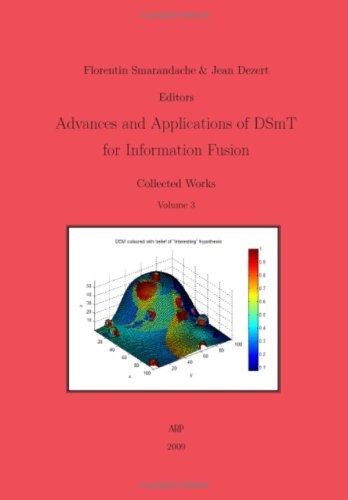
Advances and applications of DSmT for information fusion: Collected works ; Vol.3
One of the most comprehensive and flexible fusion theory based on belief functions. It can work in all fusion spaces: power set, hyper-power set, and super-power set, and has various fusion and conditioning rules that can be applied depending on each application. Some new generalized rules are introduced in this volume with codes for implementing some of them. For the qualitative fusion, the DSm Field and Linear Algebra of Refined Labels (FLARL) is proposed which can convert any numerical fusion rule to a qualitative fusion rule. When one needs to work on a refined frame of discernment, the refinement is done using Smarandache s algebraic codification. New interpretations and implementations of the fusion rules based on sampling techniques and referee functions are proposed, including the probabilistic proportional conflict redistribution rule.
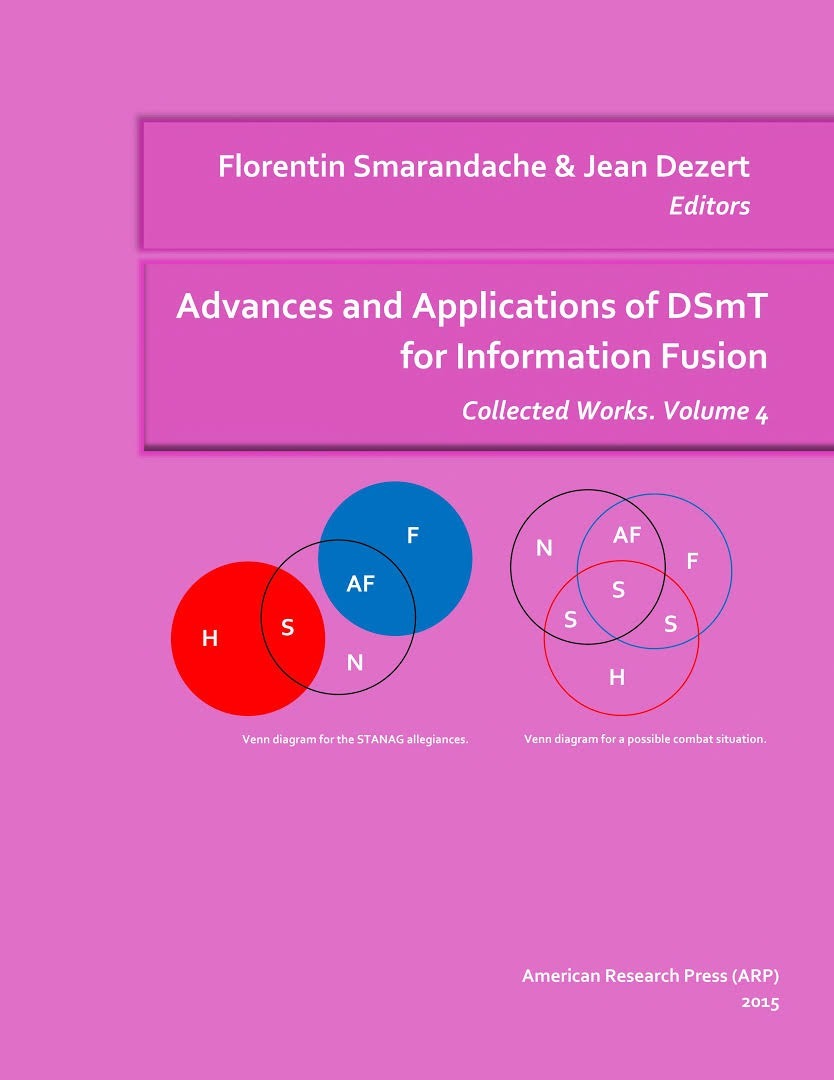
Advances and applications of DSmT for information fusion ; Vol. 4
One of the most comprehensive and flexible fusion theory based on belief functions. It can work in all fusion spaces: power set, hyper-power set, and super-power set, and has various fusion and conditioning rules that can be applied depending on each application. Some new generalized rules are introduced in this volume with codes for implementing some of them. For the qualitative fusion, the DSm Field and Linear Algebra of Refined Labels (FLARL) is proposed which can convert any numerical fusion rule to a qualitative fusion rule. When one needs to work on a refined frame of discernment, the refinement is done using Smarandache s algebraic codification. New interpretations and implementations of the fusion rules based on sampling techniques and referee functions are proposed, including the probabilistic proportional conflict redistribution rule.

Advancements in Electric Machines
Discusses the stateof-the art of electric machines, associated components and contemporary trends of their development. Novel electric machines considered in this book have been limited to rotary electric machines. Linear electric machines and linear actuators have not been included.
Advancements in cybercrime investigation and digital forensics
Offers a comprehensive study on Advancements in Cybercrime Investigation and Digital Forensics, highlighting the most up-to-date tools that help to mitigate cyber-attacks and that extract digital evidence for forensic investigations to recover lost, purposefully deleted, or damaged files Vast manpower and resources are needed to investigate cybercrimes

Advancements and Innovations in OMFS, ENT, and Facial Plastic Surgery
Covers updated practices and cutting-edge innovations pertinent to advanced Oral & Maxillofacial Surgeons, Otolaryngologists (Head and Neck Surgeons), and Facial Plastic Surgeons. Each chapter will review and update the reader on advancements in procedures and technologies in head and neck surgery.
Advancement of Deep Learning and its Applications in Object Detection and Recognition
In just the past five years, deep learning has taken the world by surprise, driving rapid progress in fields as diverse as computer vision, natural language processing, automatic speech recognition, etc. This book presents an introduction to deep learning and various applications of deep learning such as recommendation systems, text recognition, diabetic retinopathy prediction of breast cancer, prediction of epilepsy, sentiment, fake news detection, software defect prediction and protein function prediction.

Advanced Wired and Wireless Networks
ADVANCED WIRED AND WIRELESS NETWORKS brings the reader a sample of recent research efforts representative of advances in the areas of recognized importance for the future Internet, In Part I, we bring ad-hoc networking closer to the reality of practical use. The focus is on more advanced scalable routing suitable for large networks, directed flooding useful in information dissemination networks, as well as self-configuration and security issues important in practical deployments. Part II illustrates the efforts towards development of advanced mobility support techniques (beyond traditional "mobile phone net") and Mobile IP technologies. The issues range from prediction based mobility support, through context transfer during Mobile IP handoff, to service provisioning platforms for heterogeneous networks. The focus of the final section concerns the performance of networks and protocols. Furthermore this section illustrates researchers’ interest in protocol enhancement requests for improved performance with advanced networks, reliable and efficient multicast methods in unreliable networks, and composite scheduling in programmable/active networks where computing resources equal network performance as transmission bandwidth.

Advanced Web and Network Technologies, and Applications ; APWeb 2008 International Workshops : BIDM, IWHDM, and DeWeb Shenyang, China, April 26-28, 2008. Revised Selected Papers
Constitutes the thoroughly refereed joint post-workshop proceedings of three international workshops held in conjunction with the 10th Asia-Pacific Web Conference, APWeb 2008, in Shenyang, China, in April 2008.

Advanced Web and Network Technologies, and Applications ; APWeb 2006 International Workshops : XRA, IWSN, MEGA, and ICSE, Harbin, China, January 16-18, 2006, Proceedings
The QOS evaluating model for computational grid nodes put forward can help greatly improving the self-adaptability of resource management and accelerating the appli- tion and development of Computational Grid. Now this model has been applied in NPU Campus Computational Grid. And the good effect brought by it has effectively proved its function. References 1. Foster, I. and C. Kesselman, eds. The Grid: Blueprint for a New Computing Infrastructure. Morgan Kaufmann, 1999. 2. Liu Liang, Zhou Xing-she, and Gu Jian-hua: A Multi-Agent System for Grid Computing. The Second International Conference on Active Media Technology, 2003 3. Yao Wang, Julita Vassileva: Trust and Reputation Model in Peer-to-Peer Networks. Farag Azzedin and Muthucumaru Maheswaran: Integrating Trust into Grid Resource M- agement Systems.

Advanced Visual Quantum Mechanics
Investigate and to teach quantum mechanics with the aid of computer-generated animations. It is a self-contained textbook that combines selected topics from atomic physics (spherical symmetry, the hydrogen atom, and particles with spin) with an introduction to quantum information theory (qubits, EPR paradox, teleportation, quantum computers). It explores relativistic quantum mechanics and the strange behavior of Dirac equation solutions. A series of appendices covers important topics from perturbation and scattering theory. The book places an emphasis on ideas and concepts, with a fair to moderate amount of mathematical rigor. Though this book stands alone, it can also be paired with Thaller Visual Quantum Mechanics to form a comprehensive course in quantum mechanics. The software for the first book earned the European Academic Software Award 2000 for outstanding innovation in its field.
Advanced Trends in ICT for Innovative Business Management
Contains a collection of scientific chapters addressing the emerging trends in IT and telecommunications, as well as the issues that accompany them in business. It addresses issues in cyber applications, ICT solutions and innovative cyber know-how, and demonstrates how high-tech IT communications resources can be used to improve business production, sales and service strategies, supply chains and logistics.
Advanced Topics in Exception Handling Techniques
Modern software systems are becoming more complex in many ways and are having to cope with a growing number of abnormal situations which, in turn, are increasingly complex to handle.This book is composed of five parts; the first four deal with topics related to exception handling in the context of programming languages, concurrency and operating systems, pervasive computing systems, and requirements and specifications. The last part focuses on case studies, experimentation and qualitative comparisons. The 16 coherently written chapters by leading researchers competently address a wide range of issues in exception handling.

Advanced Topics in Control Systems Theory ; Vol. 328 : Lecture Notes from FAP 2005
"Advanced Topics in Control Systems Theory" contains selected contributions written by lecturers at the third (annual) Formation d’Automatique de Paris (FAP) (Graduate Control School in Paris). Following on from the lecture notes from the second FAP (Volume 311 in the same series) it is addressed to graduate students and researchers in control theory with topics touching on a variety of areas of interest to the control community such as nonlinear optimal control, observer design, stability analysis and structural properties of linear systems. The reader is provided with a well-integrated synthesis of the latest thinking in these subjects without the need for an exhaustive literature review. The internationally known contributors to this volume represent many of the most reputable control centers in Europe.

Advanced Topics in Control Systems Theory ; Vol. 311 : Lecture Notes from FAP 2004
Advanced Topics in Control Systems Theory contains selected contributions written by lecturers at the second (annual) Formation dAutomatique de Paris (FAP) (Graduate Control School in Paris). It is addressed to graduate students and researchers in control theory with topics touching on a variety of areas of interest to the control community such as cascaded systems, flatness, optimal control, and Hamiltonian and infinite-dimensional systems. The reader is provided with a well-integrated synthesis of the latest thinking in these subjects without the need for an exhaustive literature review.

Advanced Time-Correlated Single Photon Counting Techniques
Time-correlated single photon counting (TCSPC) is a remarkable technique for recording low-level light signals with extremely high precision and picosecond-time resolution. TCSPC has developed from an intrinsically time-consuming and one-dimensional technique into a fast, multi-dimensional technique to record light signals. So this reference and text describes how advanced TCSPC techniques work and demonstrates their application to time-resolved laser scanning microscopy, single molecule spectroscopy, photon correlation experiments, and diffuse optical tomography of biological tissue. It gives practical hints about constructing suitable optical systems, choosing and using detectors, detector safety, preamplifiers, and using the control features and optimising the operating conditions of TCSPC devices. Advanced TCSPC Techniques is an indispensable tool for everyone in research and development who is confronted with the task of recording low-intensity light signals in the picosecond and nanosecond range.
