



الصفحة 6
الصفحة 6

Multiscale Optimization Methods and Applications
One general strategy for dealing with a large or difficult problem is to partition it into smaller ones, which are hopefully much easier to solve, and then work backwards towards the solution of original problem, using a solution from a previous level as a starting guess at the next level.The topics of the chapters selected for this volume are focused on the development of new solution methodologies, including general multilevel solution techniques, for tackling difficult, large-scale optimization problems that arise in science and industry. Applications presented in the book include but are not limited to the circuit placement problem in VLSI design, a wireless sensor location problem, optimal dosages in the treatment of cancer by radiation therapy, and facility location.

Multiscale Methods in Science and Engineering
Multiscale problems naturally pose severe challenges for computational science and engineering. The smaller scales must be well resolved over the range of the larger scales. Challenging multiscale problems are very common This volume is an overview of current mathematical and computational methods for problems with multiple scales with applications in chemistry, physics and engineering.

Multi-Robot Systems. From Swarms to Intelligent Automata, Vol. III ; Proceedings from the 2005 International Workshop on Multi-Robot Systems
Documents developments in multi-robot systems research. This volume is the result of the Third International workshop on Multi-Robot Systems that was held in March 2005 at the Naval Research Laboratory in Washington, DC.

Multirate Statistical Signal Processing
This book introduces a statistical theory for extracting information from signals that have di?erent sampling rates. This new theory generalizes the conventional (deterministic) theory of multirate systems beyond many of its constraints.Furthermore,itallowsfortheformulationofseveralnewproblems such as spectrum estimation, time-delay estimation and sensor fusion in the realm of multirate signal processing. I have arrived at the theory presented here by integrating concepts from diverse areas such as information theory, inverse problems and theory of - equalities. The process of merging a variety of concepts of di?erent origin results in both merits and shortcomings. The former include the fresh and - di?erentiated view of an amateur, providing scope of application. The latter include a lack of in-depth experience in each of the original ?elds. Granted, this may lead to gaps in continuity, however it goes without saying that a complete theory can seldom be achieved by one person and in a short time.

Multi-point Interaction with Real and Virtual Objects
This edited book covers some of the most challenging problems on the forefront of today’s research on physical interaction with real and virtual objects, with special emphasis on modelling contacts between objects, grasp planning algorithms, haptic perception, and advanced design of hands, devices and interfaces.

Multiple Heterogeneous Unmanned Aerial Vehicles
Aerial robots can be considered as an evolution of the Unmanned Aerial Vehicles (UAVs). This book provides a quite complete overview of issues related to aerial robotics, addressing problems ranging from flight control to terrain perception and mission planning and execution. The major challenges and potentials of heterogeneous UAVs are comprehensively explored. It builds on the results of the European project COMETS, and highlights a number of key research topics in the area of UAV development, including communication, perception, teleoperation and decision making. The monograph emphasizes the current state of technology, the existing problems and potentialities of systems consisting of multiple UAVs which are heterogeneous in view of the different characteristics of the aerial vehicles, the different on-board payloads, and the different on-board information processing capabilities. The book also examines potential applications of UAVs and details a relevant application case: forest fire detection and monitoring.

Multiple Classifier Systems ; 7th International Workshop, MCS 2007, Prague, Czech Republic, May 23-25, 2007, Proceedings
These proceedings are a record of the Multiple Classifier Systems Workshop, MCS 2007, held at the Institute of Information Theory and Automation, Czech Academy of Sciences, Prague in May 2007. the workshop achieved its objective of bringing together researchers from diverse communities (neural networks, pattern rec- nition, machine learning and statistics) concerned with this research topic.

Multiple Classifier Systems ; 6th International Workshop, MCS 2005, Seaside, CA, USA, June 13-15, 2005, Proceedings
Constitutes the refereed proceedings of the 6th International Workshop on Multiple Classifier Systems, MCS 2005. This book contains papers that are organized in topical sections on boosting, combination methods, performance analysis, and applications. They exemplify the advances in the theory and applications of multiple classifier systems

Multiple Classifier Systems ; 2nd International Workshop, MCS 2001 Cambridge, UK, July 2-4, 2001 Proceedings
Driven by the requirements of a large number of practical and commercially - portant applications, the last decade has witnessed considerable advances in p- tern recognition. Better understanding of the design issues and new paradigms, such as the Support Vector Machine, have contributed to the development of - proved methods of pattern classi cation. However, while any performance gains are welcome, and often extremely signi cant from the practical point of view, it is increasingly more challenging to reach the point of perfection as de ned by the theoretical optimality of decision making in a given decision framework. The asymptoticity of gains that can be made for a single classi er is a re?- tion of the fact that any particular design, regardless of how good it is, simply provides just one estimate of the optimal decision rule.

Multiobjective Problem Solving from Nature : From Concepts to Applications
he book focuses on how MOEAs and related techniques can be used to solve problems, particularly in the disciplines of science and engineering. Contributions by leading researchers show how the concepts of multiobjective optimization can be used to reformulate and resolve problems in broad areas such as constrained optimization, coevolution, classification, inverse modelling and design. The book is distinguished from other texts on MOEAs in that it is not primarily about the algorithms, nor specific applications, but about the concepts and processes involved in solving problems using a multiobjective approach. Each chapter contributes to the central, deep concepts and themes of the book: evaluating the utility of the multiobjective approach; discussing alternative problem formulations; showing how problem formulation affects the search process; and examining solution selection and decision making.

Multiobjective Optimization : Interactive and Evolutionary Approaches
Multiobjective optimization deals with solving problems having not only one, but multiple, often conflicting, criteria. Such problems can arise in practically every field of science, engineering and business, and the need for efficient and reliable solution methods is increasing. The task is challenging due to the fact that, instead of a single optimal solution, multiobjective optimization results in a number of solutions with different trade-offs among criteria, also known as Pareto optimal or efficient solutions. Hence, a decision maker is needed to provide additional preference information and to identify the most satisfactory solution. Depending on the paradigm used, such information may be introduced before, during, or after the optimization process. Clearly, research and application in multiobjective optimization involve expertise in optimization as well as in decision support.

Multi-objective Management in Freight Logistics : Increasing Capacity, Service Level and Safety with Optimization Algorithms
Multi-objective Management in Freight Logistics provides decision makers with new methods and tools to implement multi-objective optimization models in logistics. The book combines theoretical aspects with applications, showing the advantages and the drawbacks of adopting scalarization techniques, and when it is worthwhile to reduce the problem to a goal programming one. The book also shows applications where more than one decision maker evaluates the effectiveness of the logistic system and thus a multilevel programming approach is sought to attain meaningful solutions.

Multi-Objective Machine Learning
This monograph presents a selected collection of research work on multi-objective approach to machine learning, including multi-objective feature selection, multi-objective model selection in training multi-layer perceptrons, radial-basis-function networks, support vector machines, decision trees, and intelligent systems.

Multi-Objective Evolutionary Algorithms for Knowledge Discovery from Databases
The present volume provides a collection of seven articles containing new and high quality research results demonstrating the significance of Multi-objective Evolutionary Algorithms (MOEA) for data mining tasks in Knowledge Discovery from Databases (KDD). These articles are written by leading experts around the world. It is shown how the different MOEAs can be utilized, both in individual and integrated manner, in various ways to efficiently mine data from large databases.
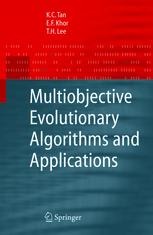
Multiobjective Evolutionary Algorithms and Applications
Multiobjective Evolutionary Algorithms and Applications provides comprehensive treatment on the design of multiobjective evolutionary algorithms and their applications in domains covering areas such as control and scheduling. Emphasizing both the theoretical developments and the practical implementation of multiobjective evolutionary algorithms, a profound mathematical knowledge is not required. Written for a wide readership, engineers, researchers, senior undergraduates and graduate students interested in the field of evolutionary algorithms and multiobjective optimization with some basic knowledge of evolutionary computation will find this book a useful addition to their book case.
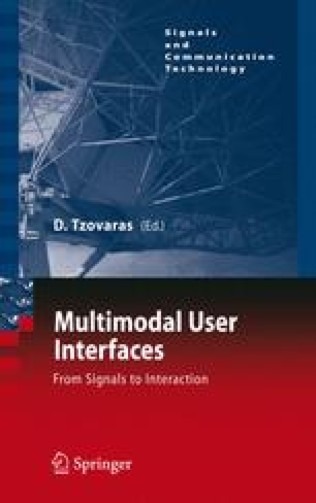
Multimodal User Interfaces : From Signals to Interaction
The book presents a common theoretical framework for fusion and fission of multimodal information using the most advanced signal processing algorithms constrained by HCI rules, described in detail and integrated in the context of a common distributed software platform for easy and efficient development and usability assessment of multimodal tools. The book also demonstrates the use of the multimodal framework for the development of a set of applications in the areas of edutainment, interfaces for disabled people and interfaces for medical applications.

Multimodal Technologies for Perception of Humans ; 1st International Evaluation Workshop on Classification of Events, Activities and Relationships, CLEAR 2006, Southampton, UK, April 6-7, 2006, Revised Selected Papers
This book constitutes the thoroughly refereed post-proceedings of the First International CLEAR 2006 Evaluation Campaign and Workshop on Classification of Events, Activities and Relationships for evaluation of multimodal technologies for the perception of humans, their activities and interactions. The workshop was held in the UK in April 2006.
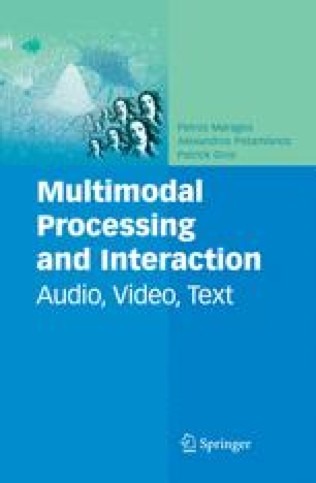
Multimodal Processing and Interaction : Audio, Video, Text
Multimodal Processing and Interaction: Audio, Video and Text presents high quality, state-of-the-art research ideas and results from theoretic, algorithmic and application viewpoints. This edited volume contains both state-of-the-art reviews and original contributions by leading experts in the scientific and technological field of multimedia. It grew out of a four-year collaboration among research groups participating in the European network of Excellence on Multimedia Understanding, Semantics, Computation and Learning (MUSCLE).

Multimedia security : Algorithm development, analysis and applications (algorithms for intelligent systems)
Provides an insight about various techniques used in multimedia security and identifies its progress in both technological and algorithmic perspectives. In the contemporary world, digitization offers an effective mechanism to process, preserve and transfer all types of information. The incredible progresses in computing and communication technologies augmented by economic feasibility have revolutionized the world. The availability of efficient algorithms together with inexpensive digital recording and storage peripherals have created a multimedia era bringing conveniences to people in sharing the digital data that includes images, audio and video. The ever-increasing pace, at which the multimedia and communication technology is growing, has also made it possible to combine, replicate and distribute the content faster and easier, thereby empowering mankind by having a wealth of information at their disposal.
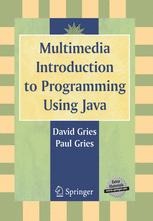
Multimedia Introduction to Programming Using Java
Although vital to modern software development, Java and object-oriented programming can pose significant challenges to newcomers. This text, unique in both scope and approach and accompanied by interactive content that you may find on extras.springer.com, addresses that learning curve by providing a careful, classroom-tested presentation of Java -- from the fundamentals of variables, types, and expressions to procedural concepts like loops and sophisticated object-oriented ideas. Additional key features of this work Introduces objects and classes early in the exposition, rendering object-oriented programming intuitive and natural. Develops programs, rather than simply showcasing them. Supports all concepts through complementary lectures on the zip-file featured on extras.springer.com. Contains numerous self-help exercises that encourage readers to practice programming. With its comprehensive appendices and bibliography, systematic approach, and helpful interactive programs on extras.springer.com, this exciting work provides the key tools they needed for successful object-oriented programming. It is ideal for use at the undergraduate and graduate beginning level, whether in the classroom or for distance learning; furthermore, the text will also be a valuable self-study resource or reference volume in any programmer’s library.
