



الصفحة 6
الصفحة 6

Integrating Innovation in Architecture : Design, Methods and Technology for Progressive Practice and Research
Covers new materials and design methods, advances in computational design practices, innovations in building technologies and construction techniques, and the integration of research with design. Moreover, it discusses strategies for integrating innovation into design practices, risks and economic impacts. Through numerous case studies, it illustrates how innovations have been implemented on actual architectural projects, and how design and technical innovations are used to improve building performance, as well as design practices in cutting-edge architectural and engineering firms.

Integrated Risk and Vulnerability Management Assisted by Decision Support Systems : Relevance and Impact on Governance
This book includes terms of reference and offers an augmented volume of relevant work initiated within the comprehensive concept of “Knowledge Management and Risk Governance”.

Integrated Market and Credit Portfolio Models : Risk Measurement and Computational Aspects
Due to their business activities, banks are exposed to many different risk types. Aggregating various risk exposures to a comprehensive risk position is an important but up-to-date not satisfactorily solved task. This shortfall goes back to conceptual problems of constructing an appropriate risk model and to the computational burden of determining a loss distribution that comprises all relevant risk types. Peter Grundke deals with both problems. On the one hand, he extends a standard credit portfolio model by correlated interest rate and credit spread risk. The analysis shows that the economic capital needed as a buffer to absorb unexpected losses in a portfolio can be severely underestimated when relevant market risk factors are neglected. On the other hand, computational aspects are addressed.

Integrated Groundwater Management : Concepts, Approaches and Challenges
The aim of this book is to document for the first time the dimensions and requirements of effective integrated groundwater management (IGM). Groundwater management is a formidable challenge, one that remains one of humanity’s foremost priorities. It has become a largely non-renewable resource that is overexploited in many parts of the world. In the 21st century, the issue moves from how to simply obtain the water we need to how we manage it sustainably for future generations, future economies, and future ecosystems. The focus then becomes one of understanding the drivers and current state of the groundwater resource, and restoring equilibrium to at-risk aquifers. Many interrelated dimensions, however, come to bear when trying to manage groundwater effectively. An integrated approach to groundwater necessarily involves many factors beyond the aquifer itself, such as surface water, water use, water quality, and ecohydrology.

Innovative Endocrinology of Cancer
Deals with developments in such topics as mechanisms of hormonal carcinogenesis, epidemiology and risk factors, hormone production by tumor tissue and hormonal sensitivity of the latter, genesis, dichotomy and endocrinology of cancer in females, and pharmacogenomics and proteomics in oncoendocrinology.

Innovations in rehabilitation sciences education : Preparing Leaders for the future
We are most fortunate to be housed in an institution that embraces risk taking and innovation in education. Part of the joy of working at McMaster University is the sense that you will be supported in your efforts to develop new ways of facilitating learning even if these are not always successful. We are privileged to work with a group of exceptional colleagues who embrace - novation and strive for ongoing excellence in education.
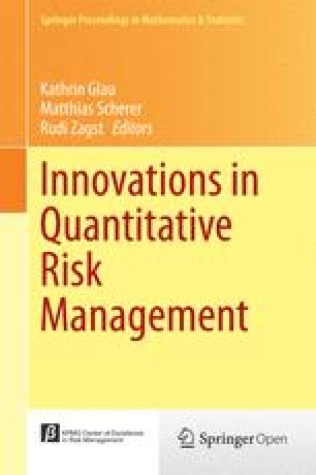
Innovations in Quantitative Risk Management ; TU München, September 2013
The KPMG Center of Excellence in Risk Management conference Risk Management Reloaded and this proceedings volume contribute to bridging the gap between academia –providing methodological advances– and practice –having a firm understanding of the economic conditions in which a given model is used. Discussed fields of application range from asset management, credit risk, and energy to risk management issues in insurance. Methodologically, dependence modeling, multiple-curve interest rate-models, and model risk are addressed. Finally, regulatory developments and possible limits of mathematical modeling are discussed.

Innovations in preventive dentistry
Preventive dentistry is a constantly changing and developing field: As new research emerges, some practices that had once been revolutionary are abandoned, while others continue to withstand the test of time. This book discusses new developments and innovations in preventive dentistry, from primary prevention to secondary prevention by inactivating initial lesions, and on to tertiary prevention to avoid subsequent progression and complications of manifest oral disease. The book relies on a solid evidence base and instructs readers how this can be translated into clinical dental practice—what changes should be made to how we practice and why they should be made. Topics include caries and periodontal disease, orthodontic problems, diagnostic approaches, diet and oral health, oral hygiene, oral disease patterns, caries treatment, fluoride guidelines, risk management, sealants, and probiotics.

Innovations in Derivatives Markets : Fixed Income Modeling, Valuation Adjustments, Risk Management, and Regulation
This book presents 20 peer-reviewed chapters on current aspects of derivatives markets and derivative pricing. The contributions, written by leading researchers in the field as well as experienced authors from the financial industry, present the state of the art in: • Modeling counterparty credit risk: credit valuation adjustment, debit valuation adjustment, funding valuation adjustment, and wrong way risk. • Pricing and hedging in fixed-income markets and multi-curve interest-rate modeling. • Recent developments concerning contingent convertible bonds, the measuring of basis spreads, and the modeling of implied correlations.

Innovation in European Freight Transportation : Basics, Methodology and Case Studies for the European Markets
Serious problems and risks can be observed in European freight transportation development. However, the transport and logistics sector shows a lack of tradition in utilising systematic innovation management to overcome these problems. Hence, this volume puts forward a specific and comprehensive Systemic Migration-Oriented Innovation Management Method.

Information theory and machine learning
The recent successes of machine learning, especially regarding systems based on deep neural networks, have encouraged further research activities and raised a new set of challenges in understanding and designing complex machine learning algorithms. New applications require learning algorithms to be distributed, have transferable learning results, use computation resources efficiently, convergence quickly on online settings, have performance guarantees, satisfy fairness or privacy constraints, incorporate domain knowledge on model structures, etc. A new wave of developments in statistical learning theory and information theory has set out to address these challenges.

Inflammation in the Pathogenesis of Chronic Diseases : The COX-2 Controversy
In this book, a worldwide panel of leading experts discuss the role of inflammation in the pathogenesis of major chronic diseases and the current controversy regarding risk versus benefit of selective cyclooxygenase-2 (COX-2) inhibitors.

Infections à papillomavirus : État des connaissances, pratiques et prévention vaccinale = Human papillomavirus infections : Current knowledge, practices and vaccination prevention
The impact of papillomavirus (HPV) infection is considerable. More than one in two women has been exposed to HPV in her lifetime and around 10% will develop a chronic infection. Of these, 20% will develop cervical cancer in the absence or failure of screening. In France, high-risk HPV infection causes 80,000 precancerous lesions, 3,400 cervical cancers and the death of 1,000 women every year. Smear screening performed at a regular rate and according to quality standards has resulted in a significant decrease in incidence and mortality over the past 20 years. However, despite this considerable success, the so-called preventable disease has not been eradicated; testing is a complex process that only benefits part of the population while those who benefit endure its weaknesses. Optimization of screening and treatment is now made possible by the use of innovative techniques including the smear in liquid suspension, the HPV test, and soon viral genotyping and molecular markers guaranteeing maximum protection. Because cervical cancer is the result of chronic HPV infection, we already have the extraordinary chance to prevent it with a prophylactic vaccine. This progress will have a major impact on our practices as it happens in a poorly prepared medico-sociological environment. This resolutely practical and educational book provides an overview of knowledge and perspectives on HPV infection and its associated pathologies while deciphering the new challenges and practices in the vaccine era.

Infection control in the dental office : A global perspective
This book reviews the principles of infection control and the guidelines and standards of care in multiple countries, discussing them within the context of the practice of dentistry. The aim is to enable dental practitioners to ensure that the appropriate measures are adopted for each patient contact, thereby minimizing the risk of transmission of infection – a goal that is becoming ever more important given the threats posed by new or re-emerging infectious diseases and drug-resistant infections.

Infection control in primary dental care
This book is an easy-to-use guide to all aspects of infection control and decontamination that will support the implementation of effective measures for risk reduction in dental practice.

Industry 4.0 for SMEs : Challenges, opportunities and requirements
This book explores the concept of Industry 4.0, which presents a considerable challenge for the production and service sectors. While digitization initiatives are usually integrated into the central corporate strategy of larger companies, smaller firms often have problems putting Industry 4.0 paradigms into practice. Small and medium-sized enterprises (SMEs) possess neither the human nor financial resources to systematically investigate the potential and risks of introducing Industry 4.0. Addressing this obstacle, the international team of authors focuses on the development of smart manufacturing concepts, logistics solutions and managerial models specifically for SMEs. Aiming to provide methodological frameworks and pilot solutions for SMEs during their digital transformation, this innovative and timely book will be of great use to scholars researching technology management, digitization and small business, as well as practitioners within manufacturing companies.

Industrial Project Management : Planning, Design, and Construction
This book describes – in a precise but practical way – the most recent principles and techniques of project management, at the highest international standards, with a fully company-wide, process-based, multi-project approach. It is unique because of the integration of project management fundamentals with the practices of international contracting, which characterize planning, design and construction of large works (such as plants and machinery) in the industrial sectors. The rigorous academic approach is mixed with the managerial contribution of Danieli, one of the largest worldwide suppliers of equipment and plants to the metals industry. The project management of the latter is described alongside how it can be effectively applied to win and manage large international contracts.

Industrial hygiene in the pharmaceutical and consumer healthcare industries
Use of containment in the pharmaceutical industry and consumer healthcare. It serves to highlight how industrial hygiene acts as a driving force within these industries to reduce the risk of exposure to chemical and physical agents, particularly to powders and dusts, while taking all factors into account. The author emphasizes how this book is not designed to replace other texts on containment; rather, it will serve to show a practical approach of utilizing the technologies within the high-demand industries of pharmaceuticals and consumer healthcare.

Indicator Systems for Sustainable Innovation
In the recent past, environmental innovations have led to a considerable reduction of many pollutants; however, further innovation is required to tackle remaining pollution sources. This work analyses the significance and the effects of framework conditions on innovation activities that contribute to the realisation of a sustainable development. The book links the experiences of different research projects with the aim to develop a system of indicators to evaluate sustainable effects of (environmental) innovations. A comprehensive framework for an indicator system is established that allows to include different environmental innovation fields such as process innovations in the steel production, substitution of dangerous chemicals, organisational innovations in the field of waste disposal or sustainable water management.

Indian Agriculture Towards 2030 : Pathways for Enhancing Farmers’ Income, Nutritional Security and Sustainable Food and Farm Systems
The book comprises of ten contributions. Apart from the overview chapter on transformational change and the concluding chapter on pathways for 2030, there are eight thematic chapters on topics such as transforming Indian agriculture, dietary diversity for nutritive and safe food; climate crisis and risk management; water in agriculture; pests, pandemics, preparedness and biosecurity natural farming; agroecology and biodiverse futures; science, technology and innovation in agriculture; and structural reforms and governance.
