



الصفحة 6
الصفحة 6

Coping with Uncertainty : Modeling and Policy Issues
Ongoing global changes bring fundamentally new scientific problems requiring new concepts and tools. A key issue concerns a vast variety of practically irreducible uncertainties, which challenge our traditional models and require new concepts and analytical tools. The complexity of new problems does not allow to achieve enough certainty by increasing the resolution of models or by bringing in more links. Hence, new tools for modeling and management of uncertainty are needed, as given in this book.

Control of Redundant Robot Manipulators : Theory and Experiments
This monograph provides a comprehensive and thorough treatment of the problem of controlling a redundant robot manipulator. It presents the latest research from the field with a good balance between theory and practice. All theoretical developments are verified both via simulation and experimental work on an actual prototype redundant robot manipulator

Computer Vision, Graphics and Image Processing ; 5th Indian Conference, ICVGIP 2006, Madurai, India, December 13-16, 2006, Proceedings
The Indian Conference on Computer Vision, Graphics and Image Processing (ICVGIP) is a forum bringing together researchers and practitioners in these related areas, coming from national and international academic institutes, from government research and development laboratories, and from industry. The proceedings of ICVGIP 2006, published in Springer's series Lecture Notes in Computer Science, comprise 85 papers that were selected for presentation from 284 papers, which were submitted from all over the world.

Computer Simulations of Liquid Crystals and Polymers ; Proceedings of the NATO Advanced Research Workshop on Computational Methods for Polymers and Liquid Crystalline Polymers, Erice, Italy. 16-22 July 2003
Liquid crystals, polymers and polymer liquid crystals are soft condensed matter systems of major technological and scientific interest. An understanding of the macroscopic properties of these complex systems and of their many and interesting peculiarities at the molecular level can nowadays only be attained using computer simulations and statistical mechanical theories. Both in the Liquid Crystal and Polymer fields a considerable amount of simulation work has been done in the last few years with various classes of models at different special resolutions, ranging from atomistic to molecular and coarse-grained lattice models. Each of the two fields has developed its own set of tools and specialized procedures and the book aims to provide a state of the art review of the computer simulation studies of polymers and liquid crystals. This is of great importance in view of a potential cross-fertilization between these connected areas which is particularly apparent for a number of experimental systems like, e.g. polymer liquid crystals and anisotropic gels where the different fields necessarily merge. An effort has been made to assess the possibilities of a coherent description of the themes that have developed independently, and to compare and extend the theoretical and computational techniques put forward in the different areas.

Computational Multiscale Modeling of Fluids and Solids : Theory and Applications
The book includes the micro-scale, the meso-scale and the macro-scale. The chapters follow this classification. The book will explain in detail many tricks of the trade of some of the most important methods and techniques that are used to simulate materials on the perspective levels of spatial and temporal resolution. Case studies are occasionally included to further illustrate some methods or theoretical considerations. Example applications for all techniques are provided, some of which are from the author’s own contributions to some of the research areas. Methods are explained, if possible, on the basis of the original publications but also references to standard text books established in the various fields are mentioned.

Computational linguistics and intelligent text processing ; Vol. 3878 ; 7th International Conference, CICLing 2006, Mexico City, Mexico, February 19-25, 2006, Proceedings
CICLing 2006 (www.CICLing.org) was the 7th Annual Conference on Intelligent Text Processing and Computational Linguistics. The CICLing conferences are intended to provide a wide-scope forum for discussion of the internal art and craft of natural language processing research and the best practices in its applications.
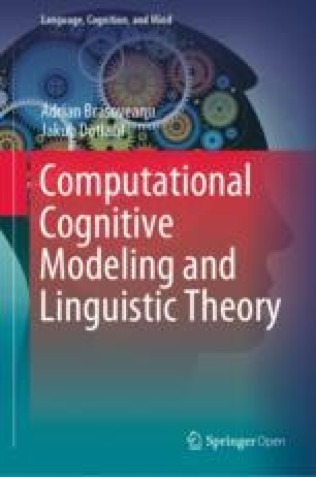
Computational Cognitive Modeling and Linguistic Theory
This book introduces a general framework that allows natural language researchers to enhance existing competence theories with fully specified performance and processing components. Gradually developing increasingly complex and cognitively realistic competence-performance models, it provides running code for these models and shows how to fit them to real-time experimental data. This computational cognitive modeling approach opens up exciting new directions for research in formal semantics, and linguistics more generally, and offers new ways of (re)connecting semantics and the broader field of cognitive science.

Combinatorial Commutative Algebra
Combinatorial commutative algebra is an active area of research with thriving connections to other fields of pure and applied mathematics. This book provides a self-contained introduction to the subject, with an emphasis on combinatorial techniques for multigraded polynomial rings, semigroup algebras, and determinantal rings. The eighteen chapters cover a broad spectrum of topics, ranging from homological invariants of monomial ideals and their polyhedral resolutions, to hands-on tools for studying algebraic varieties with group actions, such as toric varieties, flag varieties, quiver loci, and Hilbert schemes. Over 100 figures, 250 exercises, and pointers to the literature make this book appealing to both graduate students and researchers.
Machine learning methods for reverse engineering of defective structured surfaces
Pascal Laube presents machine learning approaches for three key problems of reverse engineering of defective structured surfaces: parametrization of curves and surfaces, geometric primitive classification and inpainting of high-resolution textures. The proposed methods aim to improve the reconstruction quality while further automating the process. The contributions demonstrate that machine learning can be a viable part of the CAD reverse engineering pipeline.

Low-Power High-Speed ADCs for Nanometer CMOS Integration
Low-Power High-Speed ADCs for Nanometer CMOS Integration is about the design and implementation of ADC in nanometer CMOS processes that achieve lower power consumption for a given speed and resolution than previous designs, through architectural and circuit innovations that take advantage of unique features of nanometer CMOS processes. A phase lock loop (PLL) clock multiplier has also been designed using new circuit techniques and successfully tested.

Logic for Programming, Artificial Intelligence, and Reasoning ; Vol. 3835 : 12th International Conference, LPAR 2005, Montego Bay, Jamaica, December 2-6, 2005, Proceedings
Constitutes the refereed proceedings of the 12th International Conference on Logic for Programming, Artificial Intelligence, and Reasoning, LPAR 2005. This book presents 46 revised papers with 3 abstracts, addressing issues in logic programming, logic-based program manipulation, formal method, automated reasoning, and various kinds of AI logics.

Logic for Computer Scientists
This book introduces the notions and methods of formal logic from a computer science standpoint, covering propositional logic, predicate logic, and foundations of logic programming. It presents applications and themes of computer science research such as resolution, automated deduction, and logic programming in a rigorous but readable way.The style and scope of the work, rounded out by the inclusion of exercises, make this an excellent textbook for an advanced undergraduate course in logic for computer scientists.
Landscape Pattern Analysis for Assessing Ecosystem Condition
Landscape Pattern Analysis for Assessing Ecosystem Condition presents a new method for assessing spatial pattern in raster land cover maps based on satellite imagery in a way that incorporates multiple pixel resolutions. This is combined with more conventional single-resolution measurements of spatial pattern and simple non-spatial land cover proportions to assess predictability of both surface water quality and ecological integrity within watersheds of the state of Pennsylvania (USA).

Knowledge-Driven Computing : Knowledge Engineering and Intelligent Computations
Knowledge-Driven Computing constitutes an emerging area of intensive research located at the intersection of Computational Intelligence and Knowledge Engineering with strong mathematical foundations. It embraces methods and approaches coming from diverse computational paradigms, such as evolutionary computation and nature-inspired algorithms, logic programming and constraint programming, rule-based systems, fuzzy sets and many others. The use of various knowledge representation formalisms and knowledge processing and computing paradigms is oriented towards the efficient resolution of computationally complex and difficult problems.

Jurisdiction and arbitration agreements in international commercial law
This book offers a comprehensive study of the prerequisites, effectiveness, and enforcement of exclusive jurisdiction and arbitration agreements in international dispute resolution. It examines whether jurisdiction and arbitration clauses have identical effects in private international law and whether they have been or should be given the same treatment by most countries in the world. The book considers whether the Hague Convention on Choice of Court Agreements could be treated as a litigating counterpart to the New York Convention.

Jets from Young Stars II : Clues from High Angular Resolution Observations
This volume contains the edited lecture notes of the Second JETSET School on Jets from Young Stars: Clues from High Angular Resolution Observations organised by the Marie Curie Research Training Network JETSET: Jet Simulations, Experiments and Theory. After the opening two chapters on jet emission, readers can learn the fundamental background of modern high-spatial-resolution techniques, and how such methods have impacted on our understanding of young stars.

Israel and the Palestinian refugees
This edited book offers diverse perspectives on the Palestinian refugee problem and the possible ways to facilitate its resolution. The book contains contributions of Israeli, Palestinian and other scholars, and its main goal is to initiate an informed dialogue that will bridge the “knowledge gap” between the different camps.

Complex Effects in Large Eddy Simulations
This volume contains a collection of expert views on the state of the art in Large Eddy Simulation (LES) and its application to complex ?ows. Much of the material in this volume was inspired by contributions that were originally presented at the symposium on Complex E?ects in Large Eddy Simulation held in Lemesos (Limassol), Cyprus, between September 21st and 24th, 2005.

Charged Particle Traps : Physics and Techniques of Charged Particle Field Confinement
This book provides an introduction and guide to modern advances in charged particle (and antiparticle) confinement by electromagnetic fields. Confinement in different trap geometries, the influence of trap imperfections, classical and quantum mechanical description of the trapped particle motion, different methods of ion cooling to low temperatures, and non-neutral plasma properties (including Coulomb crystals) are the main subjects. They form the basis of such applications of charged particle traps as high-resolution optical and microwave spectroscopy, mass spectrometry, atomic clocks, and, potentially, quantum computing.

Case Studies in Environmental Archaeology
Environmental archaeology encompasses the application of biological and geological techniques to the study of human/environmental interactions. Each chapter is an original or revised work by internationally-recognized geoarchaeologists, human biologists, paleoethnobotanists, and zooarchaeologists. Each study demonstrates how and why the information obtained using environmental techniques is important to anthropologists instead of describing, critiquing, or advocating a method. These ethnographic, geological, and biological case studies successfully demonstrate the application of environmental science toward the resolution of questions related to human behavior in the past.
