



الصفحة 6
الصفحة 6

Nurturing Science-based Ventures : An International Case Perspective
The challenge is to nurture entrepreneurial skills and ambitions in science and engineering academic students in the hope that they will consider the starting of a new business based on their research as a compelling alternative to more traditional employment opportunities. The book by Seifert, Leleux and Tucci addresses this challenge. … designed as a teaching support for courses on science-based entrepreneurship and it primarily targets engineering and science students. The book focuses on science based ventures that originate in technological break throughs, but entrepreneurs from all backgrounds can learn from it. Nurturing Science-Based Ventures charts the development of a new venture through five chapters.

Nursing Care of the Pediatric Neurosurgery Patient
Nursing Care of the Pediatric Neurosurgery Patient serves as a detailed reference for all nurses caring for children with neurosurgical problems. Staff nurses (and student nurses) working in clinics, PICU, pediatrics, operating rooms, post-anesthesia care units, emergency department and radiology will benefit from the information presented in this book. The explanations of pathophysiology, anatomy, radiodiagnostic testing and treatment options for each neurosurgical diagnosis will help them to understand the rationale behind the nursing care. Presenting symptoms and findings on neurological examination and history will enable nurses to identify normal signs. Each chapter includes information on patient and family education and will give helpful guidelines.

Numerical Treatment of Partial Differential Equations
In 1988 we started work on the frst German edition of our book, which appeared in 1992. Our aim was to give students a textbook that contained the basic concepts and ideas behind most numerical methods for partial di?er- tial equations. The success of this frst edition and the second edition in 1994 encouraged us, ten years later, to write an almost completely new version, taking into account comments from colleagues and students and drawing on the enormous progress made in the numerical analysis of partial di?erential equations in recent times. The present English version slightly improves the third German edition of 2005: we have corrected some minor errors and added additional material and references.

Numerical Techniques for Chemical and Biological Engineers Using MATLAB® : A Simple Bifurcation Approach
This book addresses the bifurcation characteristics of chemical and biological processes as the general case and treats systems with a unique steady state as special cases. It uses a system approach which is the most efficient for knowledge organization and transfer. The book develops mathematical models for many commercial processes utilizing the mass-, momentum-, and heat-balance equations coupled to the rates of the processes that take place within the boundaries of the system. The models are solved numerically through MATLAB codes with emphasis on the design and optimization of the chemical and biological industrial equipment and plants.

Numerical solution of Variational Inequalities by Adaptive Finite Elements
Franz-Theo Suttmeier describes a general approach to a posteriori error estimation and adaptive mesh design for finite element models where the solution is subjected to inequality constraints. This is an extension to variational inequalities of the so-called Dual-Weighted-Residual method (DWR method) which is based on a variational formulation of the problem and uses global duality arguments for deriving weighted a posteriori error estimates with respect to arbitrary functionals of the error. In these estimates local residuals of the computed solution are multiplied by sensitivity factors which are obtained from a numerically computed dual solution. The resulting local error indicators are used in a feed-back process for generating economical meshes which are tailored according to the particular goal of the computation.
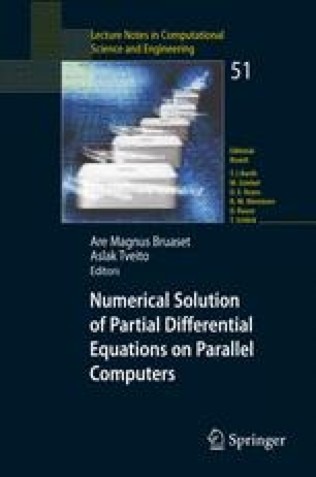
Numerical Solution of Partial Differential Equations on Parallel Computers
The scientific fields of Ma- ematics and Physics provide a powerful vehicle for such descriptions in terms of Partial Differential Equations (PDEs). Formulated as such equations, physical laws can become subject to computational and analytical studies. In the computational setting, the equations can be discreti ed for ef?cient solution on a computer, leading to valuable tools for simulation of natural and man-made processes. Numerical so- tion of PDE-based mathematical models has been an important research topic over centuries, and will remain so for centuries to come. In the context of computer-based simulations, the quality of the computed results is directly connected to the model’s complexity and the number of data points used for the computations. Therefore, computational scientists tend to ?ll even the largest and most powerful computers they can get access to, either by increasing the si e of the data sets, or by introducing new model terms that make the simulations more realistic, or a combination of both. Today, many important simulation problems can not be solved by one single computer, but calls for parallel computing.
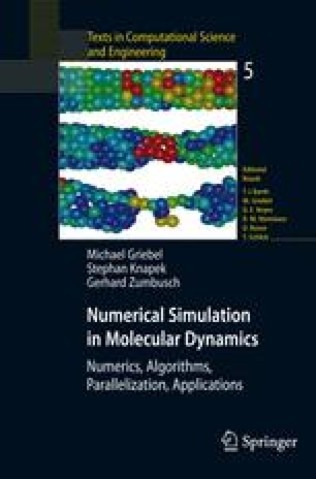
Numerical Simulation in Molecular Dynamics : Numerics, Algorithms, Parallelization, Applications
Particle models play an important role in many applications in physics, chemistry and biology. They can be studied on the computer with the help of molecular dynamics simulations. This book presents in detail both the necessary numerical methods and techniques (linked-cell method, SPME-method, tree codes, multipole technique) and the theoretical background and foundations. It illustrates the aspects modelling, discretization, algorithms and their parallel implementation with MPI on computer systems with distributed memory. Furthermore, detailed explanations are given to the different steps of numerical simulation, and code examples are provided.
Numerical partial differential equations for environmental scientists and engineers : A first practical course
This book concerns the practical solution of Partial Differential Equations (PDEs). It reflects an interdisciplinary approach to problems occurring in natural environmental media: the hydrosphere, atmosphere, cryosphere, lithosphere, biosphere and ionosphere. It assumes the reader has gained some intuitive knowledge of PDE solution properties and now wants to solve some for real, in the context of practical problems arising in real situations. The practical aspect of this book is the infused focus on computation. It presents two major discretization methods - Finite Difference and Finite Element. The blend of theory, analysis, and implementation practicality supports solving and understanding complicated problems. It is divided into three parts. Part I is an overview of Finite Difference Methods. Part II focuses on Finite Element Methods, including an FEM tutorial. Part III deals with Inverse Methods, introducing formal approaches to practical problems which are ill-posed.

Numerical Optimization : Theoretical and Practical Aspects
This book starts with illustrations of the ubiquitous character of optimization, and describes numerical algorithms in a tutorial way. It covers fundamental algorithms as well as more specialized and advanced topics for unconstrained and constrained problems. Most of the algorithms are explained in a detailed manner, allowing straightforward implementation. Theoretical aspects of the approaches chosen are also addressed with care, often using minimal assumptions. It's contains computational exercises in the form of case studies which help understanding optimization methods beyond their theoretical, description, when coming to actual implementation. Besides, the nonsmooth optimization part has been substantially reorganized and expanded.

Numerical Methods Using Java : For Data Science, Analysis, and Engineering
Covers a wide range of topics, including chapters on linear algebra, root finding, curve fitting, differentiation and integration, solving differential equations, random numbers and simulation, a whole suite of unconstrained and constrained optimization algorithms, statistics, regression and time series analysis. The mathematical concepts behind the algorithms are clearly explained, with plenty of code examples and illustrations to help even beginners get started. You will: Program in Java using a high-performance numerical library / Learn the mathematics for a wide range of numerical computing algorithms / Convert ideas and equations into code / Put together algorithms/ and classes to build your own engineering solution / Build solvers for industrial optimization problems / Do data analysis using basic and advanced statistics

Numerical Methods in Finance
The use of mathematical models and numerical techniques in finance is a growing practice, and an increasing number of applied mathematicians are working on applications in finance and business. This book presents some exciting developments arising from the combination of mathematics, numerical analysis, and finance. It covers a wide range of topics, from portfolio management and asset pricing, to performance, risk, debt and real option evaluation. It also presents applications of a variety of cutting edge approaches and techniques, including robust control, min-max optimisation, Bessel processes, stochastic viability, variational inequalities, and Monte-Carlo test techniques. The book also presents surveys of models and approaches in specific areas in finance, such as corporate debt valuation and portfolio selection
Numerical Methods for Laplace Transform Inversion
Operational methods have been used for over a century to solve many problems—for example, ordinary and partial differential equations. In many problems it is fairly easy to obtain the Laplace transform, but it can be very demanding to determine the inverse Laplace transform that is the solution of the given problem. Sometimes, after some difficult contour integration, we find that a series solution results, but even this may be quite difficult to evaluate in order to get an answer at a particular time value.

Numerical Methods for General and Structured Eigenvalue Problems
The purpose of this book is to describe recent developments in solving eig- value problems, in particular with respect to the QR and QZ algorithms as well as structured matrices. Outline Mathematically speaking, the eigenvalues of a square matrix A are the roots of its characteristic polynomial det(A??I). An invariant subspace is a linear subspace that stays invariant under the action of A. In realistic applications, it usually takes a long process of simpli?cations, linearizations and discreti- tions before one comes up with the problem of computing the eigenvalues of a matrix. In some cases, the eigenvalues have an intrinsic meaning, e.g., for the expected long-time behavior of a dynamical system; in others they are just meaningless intermediate values of a computational method. The same applies to invariant subspaces, which for example can describe sets of initial states for which a dynamical system produces exponentially decaying states. Computing eigenvalues has a long history, dating back to at least 1846 when Jacobi [172] wrote his famous paper on solving symmetric eigenvalue problems. Detailed historical accounts of this subject can be found in two papers by Golub and van der Vorst [140, 327].
Numerical Methods for Controlled Stochastic Delay Systems
The Markov chain approximation methods are widely used for the numerical solution of nonlinear stochastic control problems in continuous time. This book extends the methods to stochastic systems with delays. Because such problems are infinite-dimensional, many new issues arise in getting good numerical approximations and in the convergence proofs. Useful forms of numerical algorithms and system approximations are developed in this work, and the convergence proofs are given. All of the usual cost functions are treated as well as singular and impulsive controls. A major concern is on representations and approximations that use minimal memory.

Numerical Mathematics and Advanced Applications ENUMATH 2019 ; European Conference, Egmond aan Zee, The Netherlands, September 30 - October 4
It contians basic aspects and new trends in numerical mathematics and scientific and industrial applications, all examined at the highest level of international expertise.

Numerical Mathematics and Advanced Applications ; Proceedings of ENUMATH 2005 the 6th European Conference on Numerical Mathematics and Advanced Applications, Santiago de Compostela, Spain, July 2005
This book include applications such as atmosphere and ocean, water pollution, electromagnetism, interface problems, waves, finance, heat transfer, unbounded domains, numerical linear algebra, convection-diffusion, fluid-structure, plates, solids, hyperbolic equations, multiphase flow, Navier-Stokes, singular perturbation problems, non linear PDE, control, parabolic equations, as well as methodologies such as a posteriori error estimates, discontinuous Galerkin methods, multiscale methods, optimization, adaptive methods, domain decomposition techniques, exponential integrators, hp-finite elements, level set methods, fractional step methods, penalty procedures, and finite volumes. The book gives an extensive overview of the most recent research in scientific computing, providing to the reader the latest developments concerning the mathematical issues and the applications of this active field of science.

Numerical computation, data analysis and software in mathematics and engineering
Include the aspects of the meshless method, numerical simulation, mathematical models, deep learning and data analysis. Meshless methods, such as the improved element-free Galerkin method, the dimension-splitting, interpolating, moving, least-squares method, the dimension-splitting, generalized, interpolating, element-free Galerkin method and the improved interpolating, complex variable, element-free Galerkin method, are presented. Some complicated problems, such as tge cold roll-forming process, ceramsite compound insulation block, crack propagation and heavy-haul railway tunnel with defects, are numerically analyzed.
Numerical Approximation Methods for Elliptic Boundary Value Problems : Finite and Boundary Elements
Although the aim of this book is to give a unified introduction into finite and boundary element methods, the main focus is on the numerical analysis of boundary integral and boundary element methods. Starting from the variational formulation of elliptic boundary value problems boundary integral operators and associated boundary integral equations are introduced and analyzed. By using finite and boundary elements corresponding numerical approximation schemes are considered.

Numerical and Practical Exercises in Thermoluminescence
Thermoluminescence (TL) is a well-established technique widely used in dosimetric and dating applications. Although several excellent reference books exist which document both the theoretical and experimental aspects of TL, there is a general lack of books that deal with specific numerical and practical aspects of analyzing TL data. Many times the practical details of analyzing numerical TL glow curves and of applying theoretical models are difficult to find in the published literature. Numerical and Practical Exercises in Thermoluminescence provides a practical guide for both established researchers and for new graduate students entering the field of TL, and is intended to be used in conjunction with and as a practical supplement to standard textbooks in the field.

Numerical Analysis and Its Applications ; 3rd International Conference, NAA 2004, Rousse, Bulgaria, June 29 - July 3, 2004, Revised Selected Papers
Constitutes the refereed post-proceedings of the Third International Conference on Numerical Analysis and Its Applications, held in Bulgaria in June/July 2004. This book addresses various aspects of numerical analysis. It covers the application fields such as computational sciences and engineering, chemistry, physics, economics, and simulation.
