



الصفحة 6
الصفحة 6
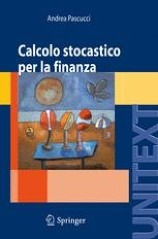
Calcolo stocastico per la finanza = Stochastic Calculation for Finance
Offers an introduction to the mathematical, probabilistic and numerical methods that are the basis of the models for the valuation of derivative instruments, such as options and futures, dealt with in modern financial markets. The book is aimed at readers with scientific training, wishing to develop skills in the field of stochastic calculus applied to finance.
Bifurcations, Instabilities, Degradation in Geomechanics
Leading international researchers and practitioners of bifurcations and instabilities in geomechanics debate the developments and applications which have occurred over the last few decades. The topics covered include modeling of bifurcation, structural failure of geomaterials and geostructures, advanced analytical, numerical and experimental techniques, and application and development of generalised continuum models etc. In addition analytical solutions, numerical methods, experimental techniques, and case histories are presented. Beside fundamental research findings, applications in geotechnical, petroleum, mining, and bulk materials engineering are emphasised.
Basics of Aerothermodynamics
The discrete numerical methods of aerodynamics/aerothermodynamics permit now - what was twenty years ago not imaginable - the simulation of high speed flows past real flight vehicle configurations with thermo-chemical and viscous effects, the description of the latter being still handicapped by in sufficient flow-physics models.
Atomic structure theory : Lectures on atomic physics
This is a textbook for students with a background in quantum mechanics. The text is designed to give hands-on experience with atomic structure calculations. Material covered includes angular momentum methods, the central field Schrödinger and Dirac equations, Hartree-Fock and Dirac-Hartree-Fock equations, multiplet structure, hyperfine structure, the isotope shift, dipole and multipole transitions, basic many-body perturbation theory, configuration interaction, and correlation corrections to matrix elements.
Applied Stochastic Control of Jump Diffusions
The main purpose of the book is to give a rigorous, yet mostly nontechnical, introduction to the most important and useful solution methods of various types of stochastic control problems for jump diffusionsThe types of control problems covered include classical stochastic control, optimal stopping, impulse control and singular control. Both the dynamic programming method and the maximum principle method are discussed, as well as the relation between them. Corresponding verification theorems involving the Hamilton-Jacobi Bellman equation and/or (quasi-)variational inequalities are formulated. There are also chapters on the viscosity solution formulation and numerical methods.The text emphasises applications, mostly to finance. All the main results are illustrated by examples and exercises appear at the end of each chapter with complete solutions. This will help the reader understand the theory and see how to apply it.The book assumes some basic knowledge of stochastic analysis, measure theory and partial differential equations.
Applied Parallel Computing ; 6th International Conference, PARA 2002, Espoo, Finland, June 15-18, 2002. Proceeding
These proceedings contain the papers presented at PARA 2002, the Sixth In-ternational Conference on Applied Parallel Computing. PARA 2002 was held inEspoo, Finland, June 15–18, 2002, and hosted by CSC, the Finnish informationtechnology center for science. The general theme of the conference was advancedscientific computing.The conference demonstrated the ability of advanced scientific computing tosolve real-world problems, and highlighted methods, instruments, and trends infuture scientific computing. The conference began with a one-day tutorial sessionon Grid programming.The conference focused on an application-oriented, multi-disciplinary, andmulti-scale approach. A wide variety of scientific computing applications wereintroduced, from semiconductor processing and behavior of the human body tooceanic and atmospheric phenomena.
Applicazioni ed esercizi di modellistica numerica per problemi differenziali = Applications and exercises in numerical modeling for differential problems
Contains a collection of exercises related to typical topics in a course on analytical and numerical methods offered in a degree program in Engineering or Mathematics. Starting with exercises in functional analysis and approximation theory, the text develops problems related to the numerical resolution of elliptic, parabolic, and hyperbolic partial differential equations, scalar or vector, in one or more spatial dimensions. Pure diffusion and pure convection problems are therefore addressed, alongside diffusion-transport problems and problems in compressible and incompressible fluid dynamics. Particular emphasis is given to the finite element method for the spatial discretization of the problems considered, although exercises on the finite difference and finite volume methods are also included.
Application of numerical methods in engineering problems using MATLAB
Presents an analysis of structures using numerical methods and mathematical modeling. This structural analysis also includes beam, plate, and pipe elements, and examines deflection and frequency or buckling loads. The various engineering theories of beams/plates/shells are comprehensively presented, and the relationships between stress and strain, and the governing equations of the structure are extracted. To solve governing equations with numerical methods, there are two general types, including methods based on derivatives or integrals. Derivative-based methods have the advantage of flexibility in modeling boundary conditions, low analysis time, and a very high degree of accuracy.
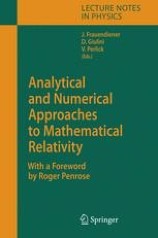
Analytical and Numerical Approaches to Mathematical Relativity
This book contains a representative collection of surveys by experts in mathematical relativity writing about the current status of, and problems in, their fields. There are four contributions for each of the following mathematical areas: differential geometry and differential topology, analytical methods and differential equations, and numerical methods. This book addresses graduate students and specialist researchers alike.
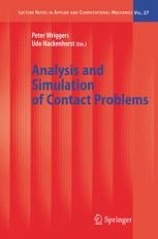
Analysis and Simulation of Contact Problems
Contact mechanics was and is an important branch in mechanics which covers a broad field of theoretical, numerical and experimental investigations. In this carefully edited book the reader will obtain a state-of-the-art overview on formulation, mathematical analysis and numerical solution procedures of contact problems. The contributions collected in this volume summarize the lectures presented during the 4th Contact Mechanics International Symposium (CMIS) held in Hannover, Germany, 2005, by leading scientists in the area of contact mechanics.
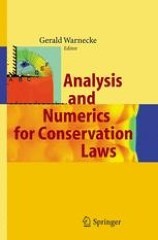
Analysis and Numerics for Conservation Laws
The physical and chemical mechanisms as well as the sizes of these processes are quite different. So are the motivations for studying them scientifically.The super- 8 nova is a thermo-nuclear explosion on a scale of 10 cm. Astrophysicists try to understand them in order to get insight into fundamental properties of the universe. In hows around airfoils of commercial airliners at the scale of 3 10 cm shock waves occur that influence the stability of the wings as well as fuel consumption in ight. This requires appropriate design of the shape and structure of airfoils by engineers. Knocking occurs in combustion, a chemical 1 process, and must be avoided since it damages motors. The scale is 10 cm and these processes must be optimized for efficiency and environmental conside- tions. The common thread is that the underlying ?uid ?ows may at a certain scale of observation be described by basically the same type of hyperbolic s- tems of partial differential equations in divergence form, called conservation laws. Astrophysicists, engineers and mathematicians share a common interest in scientific progress on theory for these equations and the development of computational methods for solutions of the equations. Due to their wide applicability in modeling of continua. A substantial portion of mathematical research is related to the analysis and numerical approximation of solutions to such equations. Hyperbolic conservation laws in two or more space dimensions still poseone of the main challenges to modern mathematics.
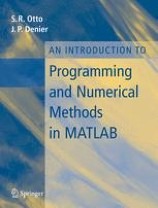
An Introduction to Programming and Numerical Methods in MATLAB
The book covers numerical methods for solving a wide range of problems, from integration to the numerical solution of differential equations or the stimulation of random processes. Examples of programmes that solve problems directly, as well as those that use MATLAB’s high-level commands are given. Each chapter includes extensive examples and tasks, at varying levels of complexity. For practice, the early chapters include programmes that require debugging by the reader, while full solutions are given for all the tasks. The book also includes: A glossary of MATLAB commands / Aappendices of mathematical techniques used in numerical methods / Designed as a text for a first course in programming and algorithm design, as well as in numerical methods courses, the book will be of benefit to a wide range of students from mathematics and engineering, to commerce."
Algorithms for Approximation ; Proceedings of the 5th International Conference, Chester, July 2005
Approximation methods are vital in many challenging applications of computational science and engineering. This is a collection of papers from world experts in a broad variety of relevant applications.
Aging, shaking, and cracking of infrastructures : From mechanics to concrete dams and nuclear structures
Focuses on the safety assessment of existing structures subjected to multi-hazard scenarios through advanced numerical methods. Whereas the focus is on concrete dams and nuclear containment structures, the presented methodologies can also be applied to other large-scale ones. This book is composed of seven sections: Fundamentals: theoretical coverage of solid mechnics, plasticity, fracture mechanics, creep, / seismology, dynamic analysis, probability and statistics / Damage: that can affect concrete structures, such as cracking of concrete, AAR, chloride ingress, and rebar corrosion, / Finite Element: formulation for both linear and nonlinear analysis including stress, heat and fracture mechanics, / Engineering Models: for soil/fluid-structure interaction, uncertainty quantification, probablilistic and random finite element analysis, machine learning, performance based earthquake engineering, ground motion intensity measures, seismic hazard analysis, capacity/fragility functions and damage indeces, / Applications to dams through potential failure mode analyses, risk-informed decision making, deterministic and probabilistic examples, / Applications to nuclear structures through modeling issues, aging management programs, critical review of some analyses, / Other applications and case studies: massive RC structures and bridges, detailed assessment of a nuclear containment structure evaluation for license renewal.
Advances in Mathematical and Statistical Modeling
Enrique Castillo is a leading figure in several mathematical, statistical, and engineering fields, having contributed seminal work in such areas as statistical modeling, extreme value analysis, multivariate distribution theory, Bayesian networks, neural networks, functional equations, artificial intelligence, linear algebra, optimization methods, numerical methods, reliability engineering, as well as sensitivity analysis and its applications. Organized to honor Castillo's significant contributions, this volume is an outgrowth of the International Conference on Mathematical and Statistical Modeling and covers recent advances in the field. Also presented are applications to safety, reliability and life-testing, financial modeling, quality control, general inference, as well as neural networks and computational techniques.
Advances in Dynamic Games: Applications to Economics, Finance, Optimization, and Stochastic Control
This book focuses on various aspects of dynamic game theory, presenting state-of-the-art research and serving as a guide to the vitality and growth of the field and its applications. The selected chapters, written by experts in their respective disciplines, are an outgrowth of presentations originally given at the 9th International Symposium of Dynamic Games and Applications. Featured throughout are useful tools for researchers and practitioners who use game theory for modeling in many disciplines.

Advances in Dynamic Game Theory : Numerical Methods, Algorithms, and Applications to Ecology and Economics
This collection of selected contributions gives an account of recent developments in dynamic game theory and its applications, covering both theoretical advances and new applications of dynamic games in such areas as pursuit-evasion games, ecology, and economics.
Advanced Numerical Methods to Optimize Cutting Operations of Five-Axis Milling Machines
Presents new optimization algorithms designed to improve the efficiency of tool paths for five-axis NC machining of sculptured surfaces. The book introduces the reader to fundamental issues involved in the tool path planning such as the kinematics of five-axis machines, types of 5 axis machines, part surface representation, machining strips, optimal tool orientation, gouging avoidance and forward step error. It also introduces new methods of optimization based on research conducted by the authors, including schemes performed in the spatial domain, angular domain as well as procedures to optimize the initial setup. The book can be used by undergraduate and graduate students and researchers in the field of NC machining and CAD/CAM as well as by the corporate research groups for advanced optimization of cutting operations.
Adaptive Mesh Refinement - Theory and Applications; Proceedings of the Chicago Workshop on Adaptive Mesh Refinement Methods, Sept. 3-5, 2003
Advanced numerical simulations that use adaptive mesh refinement (AMR) methods have now become routine in engineering and science. Originally developed for computational fluid dynamics applications these methods have propagated to fields as diverse as astrophysics, climate modeling, combustion, biophysics and many others. The underlying physical models and equations used in these disciplines are rather different, yet algorithmic and implementation issues facing practitioners are often remarkably similar. Unfortunately, there has been little effort to review the advances and outstanding issues of adaptive mesh refinement methods across such a variety of fields. This book attempts to bridge this gap. The book presents a collection of papers by experts in the field of AMR who analyze past advances in the field and evaluate the current state of adaptive mesh refinement methods in scientific computing.
