



الصفحة 6
الصفحة 6
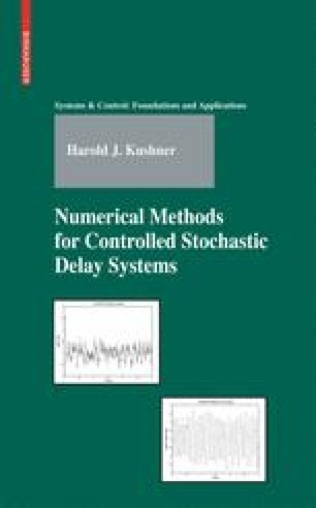
Numerical Methods for Controlled Stochastic Delay Systems
The Markov chain approximation methods are widely used for the numerical solution of nonlinear stochastic control problems in continuous time. This book extends the methods to stochastic systems with delays. Because such problems are infinite-dimensional, many new issues arise in getting good numerical approximations and in the convergence proofs. Useful forms of numerical algorithms and system approximations are developed in this work, and the convergence proofs are given. All of the usual cost functions are treated as well as singular and impulsive controls. A major concern is on representations and approximations that use minimal memory.
Numerical Mathematics and Advanced Applications ; Proceedings of ENUMATH 2007, the 7th European Conference on Numerical Mathematics and Advanced Applications, Graz, Austria, September 2007
The European Conference on Numerical Mathematics and Advanced Applications (ENUMATH) is a series of meetings held every two years to provide a forum for discussion on recent aspects of numerical mathematics and their applications. These proceedings contain a selection of invited plenary lectures, papers presented in minisymposia and contributed papers. Topics include theoretical aspects of new numerical techniques and algorithms as well as of applications in engineering and science. The book will be useful for a wide range of readers, giving them an excellent overview of the most modern methods, techniques, algorithms and results in numerical mathematics, scientific computing and their applications.

Numerical computation, data analysis and software in mathematics and engineering
Include the aspects of the meshless method, numerical simulation, mathematical models, deep learning and data analysis. Meshless methods, such as the improved element-free Galerkin method, the dimension-splitting, interpolating, moving, least-squares method, the dimension-splitting, generalized, interpolating, element-free Galerkin method and the improved interpolating, complex variable, element-free Galerkin method, are presented. Some complicated problems, such as tge cold roll-forming process, ceramsite compound insulation block, crack propagation and heavy-haul railway tunnel with defects, are numerically analyzed.

Numerical Approximation Methods for Elliptic Boundary Value Problems : Finite and Boundary Elements
Although the aim of this book is to give a unified introduction into finite and boundary element methods, the main focus is on the numerical analysis of boundary integral and boundary element methods. Starting from the variational formulation of elliptic boundary value problems boundary integral operators and associated boundary integral equations are introduced and analyzed. By using finite and boundary elements corresponding numerical approximation schemes are considered.

Numerical and Practical Exercises in Thermoluminescence
Thermoluminescence (TL) is a well-established technique widely used in dosimetric and dating applications. Although several excellent reference books exist which document both the theoretical and experimental aspects of TL, there is a general lack of books that deal with specific numerical and practical aspects of analyzing TL data. Many times the practical details of analyzing numerical TL glow curves and of applying theoretical models are difficult to find in the published literature. Numerical and Practical Exercises in Thermoluminescence provides a practical guide for both established researchers and for new graduate students entering the field of TL, and is intended to be used in conjunction with and as a practical supplement to standard textbooks in the field.

Numeri e Crittografia
Number Theory is one of the most classic fields of Mathematics. The numbers he deals with are those that are called natural 0, 1, 2, ... and that we use since childhood to count. Seemingly simple and harmless, they nevertheless hide some of the most difficult and exciting mysteries of the whole of mathematics. Cryptography, on the other hand, is concerned with hiding the content of confidential communications from prying eyes and corresponds to widespread needs in our society. The Theory of Numbers can help Cryptography in these needs, thanks to the mysteries that still surround it. The text gives an account of this link. It first introduces Modern Cryptography, its goals and priorities. He then goes on to expose arguments of Number Theory, with particular reference to the two problems of recognizing prime numbers, and of decomposing a natural into its prime factors; for each of the two issues it provides a vast panorama of the algorithms that deal with it and try to solve it as effectively as possible. In particular, it presents the very recent AKS procedure for recognizing prime numbers. The book then returns to Cryptography and shows how ideas and methods of Number Theory apply to the construction of reliable procedures for the secure transmission of confidential information.

Number Theory ; Vol. II : Analytic and Modern Tools
The central theme of this graduate-level number theory textbook is the solution of Diophantine equations, i.e., equations or systems of polynomial equations which must be solved in integers, rational numbers or more generally in algebraic numbers. This theme, in particular, is the central motivation for the modern theory of arithmetic algebraic geometry. In this text, this is considered through three aspects.

Number Theory ; Vol. I : Tools and Diophantine Equations
The central theme of this graduate-level number theory textbook is the solution of Diophantine equations, i.e., equations or systems of polynomial equations which must be solved in integers, rational numbers or more generally in algebraic numbers. This theme, in particular, is the central motivation for the modern theory of arithmetic algebraic geometry. In this text, this is considered through three aspects.

Number Theory : An Introduction via the Distribution of Primes
This book provides an introduction and overview of number theory based on the distribution and properties of primes. This unique approach provides both a firm background in the standard material as well as an overview of the whole discipline. All the essential topics are covered: fundamental theorem of arithmetic, theory of congruences, quadratic reciprocity, arithmetic functions, and the distribution of primes.

Number Theory : An Introduction to Mathematics ; Part B
This book attempts to provide such an understanding of the nature and extent of mathematics. It is a modern introduction to the theory of numbers, emphasizing its connections with other branches of mathematics. This part B is more advanced than the first and should give the reader some idea of the scope of mathematics today. The connecting theme is the theory of numbers. By exploring its many connections with other branches, we may obtain a broad picture.

Number Theory : An Introduction to Mathematics ; Part A
This book attempts to provide such an understanding of the nature and extent of mathematics. It is a modern introduction to the theory of numbers, emphasizing its connections with other branches of mathematics. This part A, which should be accessible to a first-year undergraduate, deals with elementary number theory.
Nuel Belnap on Indeterminism and Free Action
Seeks to further the use of formal methods in clarifying one of the central problems of philosophy: that of our free human agency and its place in our indeterministic world. It celebrates the important contributions made in this area by Nuel Belnap, American logician and philosopher. Philosophically, indeterminism and free action can seem far apart, but in Belnap’s work, they are intimately linked. This book explores their philosophical interconnectedness through a selection of original research papers that build forth on Belnap’s logical and philosophical work. Some contributions take the form of critical discussions of Belnap's published work, some develop points made in his publications in new directions, and others provide additional insights on the topics of indeterminism and free action.

Nucleic Acids and Proteins in Soil
With millions of different bacterial species living in soil, the microbial community is extremely complex, varying at very small scales. Microbe-driven functions are essential for most processes in soil. Thus, a better understanding of this microbial diversity will be invaluable for the management of the various soil functions. Nucleic Acids and Proteins in Soil combines traditional approaches in soil microbiology and biochemistry with the latest techniques in molecular microbial ecology. Included are methods to analyse the presence and importance of nucleic acids and proteins both inside and outside microbial cells, the horizontal gene transfer which drives bacterial diversity, as well as soil proteomes. Further chapters describe techniques such as PCR, fingerprinting, the challenging use of gene arrays for structural and functional analysis, stable isotope probing to identify in situ metabolic functions, and the use of marker and reporter genes in soil microbial ecology.

Nuclear Risks in Central Asia
Insights into uranium production sites and nuclear explosion testing sites in Former Soviet Union countries Unique information on contamination of NORM and other radionuclides in Central Asia and Caucasus area Highlighting the need of radiation protection in areas contaminated by uranium exploitation in Central Asia and Caucasus area

Nuclear pre-mRNA Processing in Plants
In recent years nuclear pre-mRNA processing has taken center stage as an important regulator of gene expression and ultimately growth and development. Large-scale genome and cDNA sequencing projects together with bioinformatic analyses of these sequences have revealed that alternative splicing of pre-mRNAs contributes greatly to transcriptome and proteome complexity in eukaryotes. During the last few years, tremendous progress has been made in understanding various aspects of pre-mRNA processing including alternative splicing and its importance in plant growth and development as well as in plant responses to hormones and stresses. This book, with contributions from leading scientists in this area, summarizes recent advances in nuclear pre-mRNA processing in plants. It provides researchers in the field, as well as those in related areas, with an up-to-date and comprehensive, yet concise, overview of the current status and future potential of this research in understanding plant biology.

Nuclear Import and Export in Plants and Animals
Nuclear Import and Export in Plants and Animals provides insight into the remarkable mechanisms of nuclear import and export. This book covers a range of topics from the nuclear pore structure, to nuclear import and export of macromolecules in plant and animal cells. In addition, the book covers the special cases of nuclear import of Agrobacterium T-DNA during plant genetic transformation, nuclear import and export of animal viruses, and nuclear intake of foreign DNA. A chapter on research methods to study nuclear transport concludes the book.
Nuclear Energy : Principles, Practices, and Prospects
The world faces serious difficulties in obtaining the energy that will be needed in coming decades for a growing population, especially given the problem of climate change caused by fossil fuel use. This book presents a view of nuclear energy as an important carbon-free energy option. It discusses the nuclear fuel cycle, the types of reactors used today and proposed for the future, nuclear waste disposal, reactor accidents and reactor safety, nuclear weapon proliferation, and the cost of electric power. To provide background for these discussions, the book begins with chapters on the history of the development and use of nuclear energy, the health effects of ionizing radiation, and the basic physics principles of reactor operation. The text has been rewritten and substantially expanded for this edition, to reflect changes that have taken place in the eight years since the publication of the first edition and to provide greater coverage of key topics. These include the Yucca Mountain repository plans, designs for next-generation reactors, weapons proliferation and terrorism threats, the potential of alternatives to nuclear energy, and controversies about low-level radiation.

Nuclear Condensed Matter Physics with Synchrotron : Basic Principles, Methodology and Applications
This book provides a comprehensive introduction to the growing field of nuclear condensed matter physics with synchrotron radiation, a technique which finds numerous applications in fields such as magnetism, physics of surfaces and interfaces, lattice dynamics and more. Due to the enormous brilliance of modern synchrotron radiation sources, the method is particularly suited for the investigation of low-dimensional structures such as thin films and nanoparticles. The use of isotopic probe layers, for example, allows one to determine magnetic and vibrational properties with very high spatial resolution; focusing techniques and x-ray interference effects lead to a very high sensitivity for smallest amounts of material. The book is written on an introductory level with many examples employed to illustrate the special experimental possibilities.

Nuclear Cardiology, The Basics : How to Set Up and Maintain a Laboratory
The purpose of this book is to provide the outline for the "nuts and bolts" establishment and operation of a nuclear cardiology laboratory. In so doing, the authors have attempted to deal with the relevant issues that a laboratory director must address in either setting up the laboratory or maintaining its competitive edge and clinical competence over time. The authors primarily attempted to identify issues related to outpatient imaging facilities. However, where appropriate issues related to inpatients in hospital-based laboratories are also discussed.

Nuclear back-end and transmutation technology for waste disposal : Beyond the Fukushima accident
Covers essential aspects of transmutation technologies, highlighting especially the advances in Japan. The accident at the Fukushima Daiichi Nuclear Power Plant (NPP) has caused us to focus attention on a large amount of spent nuclear fuels stored in NPPs. In addition, public anxiety regarding the treatment and disposal of high-level radioactive wastes that require long-term control is growing. The Japanese policy on the back-end of the nuclear fuel cycle is still unpredictable in the aftermath of the accident. Therefore, research and development for enhancing the safety of various processes involved in nuclear energy production are being actively pursued worldwide.
