



الصفحة 6
الصفحة 6

IQ Calibration Techniques for CMOS Radio Tranceivers
There are a lot of factors that degrade the matching of gains and phases between I/Q signals: the instinct layout mismatch, the random mismatch of the devices, the different temperatures over the I/Q signal paths. IQ Calibration Techniques For CMOS Radio Transceivers describes a fully-analog compensation technique without baseband circuitry to control the calibration process. This book will use an 802.11g transceiver design as an example to give a detailed description on the I/Q gains and phases imbalance auto-calibration mechanism.

Investigating Spoken English : A Practical Guide to Phonetics and Phonology Using Praat
Combining coverage of the key concepts and tools within phonetics and phonology with a systematic introduction to Praat, this textbook provides a lively and engaging 'way in' to the discipline. The author first covers the fundamentals of the articulatory and acoustic aspects of speech and introduces Praat as the main tool for examining and visualising speech. Next, the unit of analysis is gradually expanded (from syllables to words to turns and dialogues) and excerpts of real dialogues exemplify the core concepts for discovering how speech works.

Invariant Manifolds for Physical and Chemical Kinetics
By bringing together various ideas and methods for extracting the slow manifolds the authors show that it is possible to establish a more macroscopic description in nonequilibrium systems. The book treats slowness as stability. A unifying geometrical viewpoint of the thermodynamics of slow and fast motion enables the development of reduction techniques, both analytical and numerical. Examples considered in the book range from the Boltzmann kinetic equation and hydrodynamics to the Fokker-Planck equations of polymer dynamics and models of chemical kinetics describing oxidation reactions. Special chapters are devoted to model reduction in classical statistical dynamics, natural selection, and exact solutions for slow hydrodynamic manifolds. The book will be a major reference source for both theoretical and applied model reduction. Intended primarily as a postgraduate-level text in nonequilibrium kinetics and model reduction, it will also be valuable to PhD students and researchers in applied mathematics, physics and various fields of engineering.

Intrusion Detection and Correlation : Challenges and Solutions
Challenges and Solutions presents intrusion detection systems (IDSs) and addresses the problem of managing and correlating the alerts produced. This volume discusses the role of intrusion detection in the realm of network security with comparisons to traditional methods such as firewalls and cryptography. Challenges and Solutions analyzes the challenges in interpreting and combining (i.e., correlating) alerts produced by these systems. In addition, existing academic and commercial systems are classified; their advantage and shortcomings are presented, especially in the case of deployment in large, real-world sites. Challenges and Solutions is designed for a professional audience composed of researchers and practitioners in industry. This book is also suitable for graduate-level students in computer science.

Introduction to Variance Estimation
The book provides instruction on the methods that are vital to data-driven decision making in business, government, and academe. It will appeal to survey statisticians and other scientists engaged in the planning and conduct of survey research, and to those analyzing survey data and charged with extracting compelling information from such data. It will appeal to graduate students and university faculty who are focused on the development of new theory and methods and on the evaluation of alternative methods. Software developers concerned with creating the computer tools necessary to enable sound decision-making will find it essential.

Introduction to the Classical Theory of Particles and Fields
This volume is intended as a systematic introduction to gauge field theory for advanced undergraduate and graduate students in high energy physics.

Introduction to the basic concepts of modern physics : Special relativity, quantum and statistical physics
These notes are designed as a text book for a course on the Modern Physics Theory for undergraduate students. The purpose is providing a rigorous and self-contained presentation of the simplest theoretical framework using elementary mathematical tools.

Introduction to space syntax in urban studies
This textbook is a comprehensive introduction to space syntax method and theory for graduate students and researchers. It provides a step-by-step approach for its application in urban planning and design. This textbook aims to increase the accessibility of the space syntax method for the first time to all graduate students and researchers who are dealing with the built environment, such as those in the field of architecture, urban design and planning, urban sociology, urban geography, archaeology, road engineering, and environmental psychology. Taking a didactical approach, the authors have structured each chapter to explain key concepts and show practical examples followed by underlying theory and provided exercises to facilitate learning in each chapter

Introduction to Scientific Visualization
Scientific visualization is recognised as important for understanding data, whether measured, sensed remotely or calculated. Introduction to Scientific Visualization is aimed at readers who are new to the subject, either students taking an advanced option at undergraduate level or postgraduates wishing to visualize some specific data.

Introduction to robotics : Mechanics and control ; 2nd ed.
Written for senior level or first year graduate level robotics courses, this text includes material from traditional mechanical engineering, control theoretical material and computer science. It includes coverage of rigid-body transformations and forward and inverse positional kinematics

Introduction to Reconfigurable Computing : Architectures, Algorithms, and Applications
“Introduction to Reconfigurable Computing” provides a comprehensive study of the field Reconfigurable Computing. It provides an entry point to the novice willing to move in the research field reconfigurable computing, FPGA and system on programmable chip design. The book can also be used as teaching reference for a graduate course in computer engineering, or as reference to advance electrical and computer engineers. It provides a very strong theoretical and practical background to the field of reconfigurable computing, from the early Estrin’s machine to the very modern architecture like coarse-grained reconfigurable device and the embedded logic devices.

Introduction to Pharmaceutical Analytical Chemistry
Enables students to gain fundamental knowledge of the vital concepts, techniques and applications of the chemical analysis of pharmaceutical ingredients, final pharmaceutical products and drug substances in biological fluids. A unique emphasis on pharmaceutical laboratory practices, such as sample preparation and separation techniques, provides an efficient and practical educational framework for undergraduate studies in areas such as pharmaceutical sciences, analytical chemistry and forensic analysis. Suitable for foundational courses, this essential undergraduate text introduces the common analytical methods used in quantitative and qualitative chemical analysis of pharmaceuticals.

Introduction to organic and medicinal chemistry
Designed to be an undergraduate reference textbook for students of chemistry who aim to select degree modules geared towards medicinal chemistry. The first two chapters offer an overview of basic organic chemistry, followed by organic synthesis in Chapter 3, with an emphasis on the importance of synthetic procedures in relation to the chemistry of drug design. In Chapter 4, the book covers foundational aspects of biochemistry and biomedical science to provide a basis for students understanding where and how drugs work on selected targets. Later, the book explains how medicines have been created for selected topics in medicinal chemistry – namely against pathogens, cancer and neurological targets.

Introduction to Numerical Methods in Differential Equations
This is a textbook for upper division undergraduates and beginning graduate students. Its objective is that students learn to derive, test and analyze numerical methods for solving differential equations, and this includes both ordinary and partial differential equations. In this sense the book is constructive rather than theoretical, with the intention that the students learn to solve differential equations numerically and understand the mathematical and computational issues that arise when this is done. An essential component of this is the exercises, which develop both the analytical and computational aspects of the material. The importance of the subject of the book is that most laws of physics involve differential equations, as do the modern theories on financial assets.

Introduction to Modern Time Series Analysis
This excellent textbook presents an introduction to the time series analysis. It provides a good source of information for graduate and master students in economics and statistics. It is a well-written and easy to read book, illustrated by 56 good examples. Also, many important references are listed at the end of each chapter.This book presents to beginners a readable and easily accessible introduction to modern developments in time series econometrics and financial time series with an emphasis on basic concepts and practical applications. The book is a textbook consisting of seven chapters the greatest merit of this textbook is that it enables readers to grasp the basic framework of time-series econometrics without relying on extensive reading
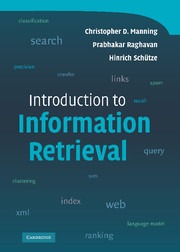
Introduction to information retrieval
Teaches classical and web information retrieval, including web search and the related areas of text classification and text clustering from basic concepts. It gives an up-to-date treatment of all aspects of the design and implementation of systems for gathering, indexing, and searching documents; methods for evaluating systems; and an introduction to the use of machine learning methods on text collections. All the important ideas are explained using examples and figures, making it perfect for introductory courses in information retrieval for advanced undergraduates and graduate students in computer science.
Introduction to finite element analysis : A textbook for engineering students
Covers the basic concepts and applications of finite element analysis. It is specifically aimed at introducing this advanced topic to undergraduate-level engineering students and practicing engineers in a lucid manner. It also introduces a structural and heat transfer analysis software FEASTSMT which has wide applications in civil, mechanical, nuclear and automobile engineering domains.

Introduction to Empirical Processes and Semiparametric Inference
This book provides a self-contained, linear, and unified introduction to empirical processes and semiparametric inference. These powerful research techniques are surprisingly useful for developing methods of statistical inference for complex models and in understanding the properties of such methods. The targeted audience includes statisticians, biostatisticians, and other researchers with a background in mathematical statistics who have an interest in learning about and doing research in empirical processes and semiparametric inference but who would like to have a friendly and gradual introduction to the area. The book can be used either as a research reference or as a textbook. The level of the book is suitable for a second year graduate course in statistics or biostatistics, provided the students have had a year of graduate level mathematical statistics and a semester of probability.

Introduction to Cryptography : Principles and Applications
In the first part, this book covers the key concepts of cryptography on an undergraduate level, from encryption and digital signatures to cryptographic protocols. In the second part, more advanced topics are addressed, such as the bit security of one-way functions and computationally perfect pseudorandom bit generators.
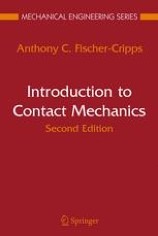
Introduction to Contact Mechanics
Introduction to Contact Mechanics, Second Edition is a gentle introduction to the mechanics of solid bodies in contact for graduate students, post doctoral individuals, and the beginning researcher. This second edition maintains the introductory character of the first with a focus on materials science as distinct from straight solid mechanics theory. Every chapter has been updated to make the book easier to read and more informative. A new chapter on depth sensing indentation has been added, and the contents of the other chapters have been completely overhauled with added figures, formulae and explanations.
