



الصفحة 6
الصفحة 6

Mobile Virtual Work : A New Paradigm?
This is a book about mobile virtual work. It aims at clarifying the basic concepts and showing present practices and future challenges. With this book we realise our intention to present a ‘state of the art’ collection of knowledge on this subject. We very much hope that you will find the discussion about present day reality and future challenges of mobile virtual work as exciting as we do. It is possibly a new paradigm.

Mobile Phone Programming and its Application to Wireless Networking
This book provides a solid overview of mobile phone programming targeting both academia and industry. Mobile Phone Programming covers all commercial realizations of Symbian, Windows Mobile and Linux platforms. Each programming language (JAVA, Python, C/C++) and a set of development environments are introduced “step by step” making developers familiar with current limitations, pitfalls, and challenges. Each chapter contains examples and source code to rapidly make developers familiar with the most important concepts. Examples cover peer to peer networks, cooperative networking, cross layer protocol design, key challenges such as power consumption, and sensor networks for which a full hardware and software implementation is provided. Whether you are an experienced developer or an advanced student Mobile Phone Programming will be your key reference for successfully entering the world of software development for mobile devices.
Mobile Edge Computing
It offers comprehensive, self-contained knowledge on Mobile Edge Computing (MEC), which is a very promising technology for achieving intelligence in the next-generation wireless communications and computing networks. The book starts with the basic concepts, key techniques and network architectures of MEC. Then, we present the wide applications of MEC, including edge caching, 6G networks, Internet of Vehicles, and UAVs. In the last part, we present new opportunities when MEC meets blockchain, Artificial Intelligence, and distributed machine learning (e.g., federated learning). We also identify the emerging applications of MEC in pandemic, industrial Internet of Things and disaster management.

Mobile and Wireless Network Security and Privacy
Mobile and Wireless Network Security and Privacy analyzes important security and privacy problems in the realms of wireless networks and mobile computing. The material includes a report to the National Science Foundation of the United States which will be used by program managers for the foundation in setting priorities for research directions in this area. In the following chapters field experts expand upon the report and provide further information about important research directions in the fields of wireless networks and mobile computing. The chapters are written by the leading international researchers and professionals in thes fields. Each chapter represents state-of-the-art research and includes several influential contributions. A multitude of valuable discussions on relevant concepts, such as the various approaches that define emerging security and privacy in mobile and wireless environment, are featured.
Mixed-Signal Layout Generation Concepts
Mixed-Signal Layout Generation Concepts covers important physical-design issues that exist in contemporary analog and mixed-signal design flows. The fundamental issues in creating a layout are placement and routing.

Missions of universities : Past, present, future
provides an analysis of university missions over time and space. It starts out by presenting a governance framework focusing on the demands on universities set by regulators, market actors and scrutinizers. It examines organizational structures, population development, the fundamental tasks of universities, and internal governance structures. Next, offers a discussion of the idea and role of universities in society, exploring concepts such as autonomy and universality, and the university as a transformative institute. The next four chapters deal with the development of universities from medieval times, through the Renaissance, towards the research universities in the nineteenth century in Europe and the United States.

Misinterpretations about Covid-19 vaccines
Immunization has become a vital part of public health and disease prevention, yet remain Vaccination is the most effective medical intervention ever a controversial topic. introduced, it has eliminated a large part of the infectious diseases that once killed millions of people. Recently, a number of effective vaccines have been manufactured and proved to be effective against the virus, but a rising incidents was observed of refusing people to take COVID-19 (SARS-CoV-2) vaccine because of the wrong myths they hear about the vaccine or its existing and non-existing side effects. The purpose of this research is to clarify information and remove vagueness about the vaccines and definitively convert fake concepts into facts by answering questions in a scientific method.
Middleware 2005 ; ACM/IFIP/USENIX 6th International Middleware Conference, Grenoble, France, November 28 - December 2, 2005, Proceedings
Today, middleware is a key part of almost any application. Gone are the days when middleware was only used in the IT industry for high-end applications. Rather than middleware being part of the IT world, today IT applications r- resent only one aspect of middleware. With the increase in distribution, network capacity, and widespread deployment of computing devices (in homes, auto- biles, mobile phones, etc.), middleware has surpassed the importance of operating systems as the platform where application development and deployment take place. This makes middleware very exciting as a research area but also a very challenging one since it encompasses many different concepts and techniques from a wide varietyof ?elds: networking, distributed systems, softwareengine- ing, performance analysis, computer architecture, and data management. Middleware 2005 in Grenoble, France, was the 6th edition of an increasingly successfulconference.The scope of the conference has been slowly widening with every edition to accommodate new ?elds and applications.

Microwave Engineering : Concepts and Fundamentals
Covers everything from wave propagation to reflection and refraction, guided waves, and transmission lines, providing a comprehensive understanding of the underlying principles at the core of microwave engineering. This encyclopedic text not only encompasses nearly all facets of microwave engineering, but also gives all topics—including microwave generation, measurement, and processing—equal emphasis. Packed with illustrations to aid in comprehension. Describes the mathematical theory of waveguides and ferrite devices, devoting an entire chapter to the Smith chart and its applications Discusses different types of microwave components, antennas, tubes, transistors, diodes, and parametric devices Examines various attributes of cavity resonators, semiconductor and RF/microwave devices, and microwave integrated circuits

Microsurgery in Periodontal and Implant Dentistry : Concepts and Applications
Compiles all relevant information regarding fundamental concepts and advanced techniques related to the applications of minimally invasive procedures in periodontal and implant therapy facilitated with the operating microscope. Microsurgical therapy, wound healing principles as well as biomechanical and design aspects of micro-instruments and suturing armamentarium are discussed. The book offers information that is usually scattered in the dental and medical literature and not only hard to compile but also to frame in the appropriate clinical categories. Its unique emphasis on ergonomics (patient, operator and assistant positioning) and collaboration techniques like four to six hand assisting make this work unique. Each topic is discussed by world renowned experts in the field. The book is a valuable resource for the dental society including general dentists, periodontists, oral surgeons and implantologists.

Microservices : Science and Engineering
This book describes in contributions by scientists and practitioners the development of scientific concepts, technologies, engineering techniques and tools for a service-based society. The focus is on microservices, i.e cohesive, independent processes deployed in isolation and equipped with dedicated memory persistence tools, which interact via messages.
Microprocessor 5 : Software and hardware aspects of development, debugging and testing - the microcomputer
Focuses more particularly on the first two generations of microprocessors, those that handle 4- and 8- bit integers. Microprocessor 5 – the fifth and final volume of this series of books – first presents the hardware and software aspects of the development chain of a microprocessor-based digital system. Finally, to round up the series and offer a historical perspective, the architectures of the first microcomputers are detailed. A comprehensive approach is used, with examples drawn from current and past technologies that illustrate theoretical concepts, making them accessible.

Microprocessor 4 : Core concepts - software aspects
Addresses the software aspects of this component. Coding of an instruction, addressing modes and the main features of the Instruction Set Architecture (ISA) of a generic component are presented. Futhermore, two approaches are discussed for altering the flow of execution using mechanisms of subprogram and interrupt. A comprehensive approach is used, with examples drawn from current and past technologies that illustrate theoretical concepts, making them accessible.
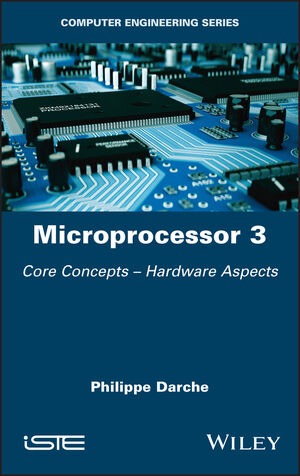
Microprocessor 3 : Core concepts - hardware aspects
Calculation is the main function of a computer. The central unit is responsible for executing the programs. The microprocessor is its integrated form. This component, since the announcement of its marketing in 1971, has not stopped breaking records in terms of computing power, price reduction and integration of functions (calculation of basic functions, storage with integrated controllers). It is present today in most electronic devices. Knowing its internal mechanisms and programming is essential for the electronics engineer and computer scientist to understand and master the operation of a computer and advanced concepts of programming.

Microprocessor 2 : Communication in a digital system
Focuses more particularly on the first generations of microprocessors, that is to say those that handle integers in 4 and 8-bit formats. The first chapter presents the calculation function and reminds the memory function. The following is devoted to notions of calculation model and architecture. The concept of bus is then presented. Chapters 4 and 5 can then address the internal organization and operation of the microprocessor first in hardware and then software. The mechanism of the function call, conventional and interrupted, is more particularly detailed in a separate chapter. The book ends with a presentation of architectures of the first microcomputers for a historical perspective. The knowledge is presented in the most exhaustive way possible with examples drawn from current and old technologies that illustrate and make accessible the theoretical concepts. Each chapter ends if necessary with corrected exercises and a bibliography. The list of acronyms used and an index are at the end of the book.

Microprocessor 1 : Prolegomena - calculation and storage functions - models of computation and computer architecture
Presents the computation function, recalls the memory function and clarifies the concepts of computational models and architecture. A comprehensive approach is used, with examples drawn from current and past technologies that illustrate theoretical concepts, making them accessible.

Micromechanics and Nanosimulation of Metals and Composites : Advanced Methods and Theoretical Concepts
This book provides insight into advanced numerical and experimental investigations of the microstructural aspects of strength and damage of metals and metal-based composites. In particular, atomistic and dislocation models, micromechanical simulations and homogenization techniques, as well as experimental observations in combination with computer simulations, are described. These methods are successfully applied to analyze the mechanical behavior of metals and metal-matrix composites.

Microflows and Nanoflows : Fundamentals and Simulation
This book provides a comprehensive summary of these changes describing fluid flow in micro and nano configurations. Where as in their previous book entitled Microflows: Fundamentals and Simulation. In this new book they discuss length scales from angstroms to microns (and beyond). While still maintaining the emphasis on fundamental concepts with a mix of semianalytical, experimental, and numerical results, this book outlines their relevance to modeling and analyzing functional devices.

Microcontrollers in Practice
Stressing common characteristics and real applications of the most used microcontrollers, this practical guide provides readers with hands-on knowledge of how to implement three families of microcontrollers (HC11, AVR, and 8051). Unlike the rest of the ocean of literature on individual chips, Microcontrollers in Practice supplieS side-by-side comparisons and an overview that treats the systems as resources available for implementation. Packed with hundred of practical examples and exercises to foster mastery of concepts and details, the guide also includes several extended projects. By treating the less expensive 8-bit and RISC microcontrollers, this information-dense manual equips students and home-experimenters with the know-how to put these devices into operation.
Microbes in agri-forestry biotechnology
Explores recent advances on the use of microbes for agri-forestry biotechnological applications. It provides technical concepts and discussions on the use of microorganisms for processes such as bioprocessing, bioremediation, soil enhancement, aquaponics advances, and plant-host symbiosis. The book provides an overview of the microbial approach to the tools and processes used in agriculture and forestry that make or modify products, improve plants for specific uses, and make use of livestock in agricultural systems. The authors discuss the main process conditions that enhance agri-forestry applications with the use of microbes and introduce the use of genetically modified (GM) microbes in agrobiotechnology. Finally, the authors explore the main technological advances in the production of secondary metabolites with potential applications in agri-forestry.
