



الصفحة 56
الصفحة 56
Bioinformatics : Problem Solving Paradigms
This book highlights basic paradigms of problem analysis and algorithm design in the context of core bioinformatics problems. Mathematically demanding themes are put across to the reader by properly chosen representations with the aid of lots of illustrations.
Bioinformatics
In this textbook present mathematical models in bioinformatics and they describe the biological problems that inspire the computer science tools used to handle the enormous data sets involved. The first part of the book covers the mathematical and computational methods, while the practical applications are presented in the second part. The mathematical presentation is descriptive and avoids unnecessary formalism, and yet remains clear and precise. Emphasis is laid on motivation through biological problems and cross applications. Each of the four chapters in the first part is accompanied by exercises and problems to support an understanding of the techniques presented. Each of the six chapters of the second part is devoted to some specific application domain: sequence alignment, molecular phylogenetics and coalescence theory, genomics, proteomics, RNA, and DNA microarrays. Each chapter concludes with a problems and projects section, to deepen the reader's understanding and to allow for the design of derived methods. Many of the projects involve publicly available software and/or Web-based bioinformatics depositories. Finally, the book closes with a thorough bibliography, reaching from classic research results to very recent findings, providing many pointers for future research.Overall, this volume is ideally suited for a senior undergraduate or graduate course on bioinformatics, with a strong focus on its mathematical and computer science background.

Binary Quadratic Forms: An Algorithmic Approach
This book deals with algorithmic problems concerning binary quadratic forms 2 2 f(X,Y)= aX +bXY +cY with integer coe?cients a, b, c, the mathem- ical theories that permit the solution of these problems, and applications to cryptography.
Big Data Recommender Systems ; Vol.1 : Algorithms, Architectures, Big Data, Security and Trust
Combines experimental and theoretical research on big data recommender systems to help computer scientists develop new concepts and methodologies for complex applications. It includes original scientific contributions in the form of theoretical foundations, comparative analysis, surveys, case studies, techniques and tools.
Big Data : An Art of Decision Making
Manipulating and processing masses of digital data is never a purely technical activity. It requires an interpretative and exploratory outlook - already well known in the social sciences and the humanities - to convey intelligible results from data analysis algorithms and create new knowledge. Big Data is based on an inquiry of several years within Proxem, a software publisher specializing in big data processing. The book examines how data scientists explore, interpret and visualize our digital traces to make sense of them, and to produce new knowledge. Grounded in epistemology and science and technology studies, Big Data offers a reflection on data in general, and on how they help us to better understand reality and decide on our daily actions.
Bézier and Splines in image processing and machine vision
Digital image processing and machine vision have grown considerably during the last few decades. Of the various techniques, developed so far splines play a positive and significant role in many of them. This book deals with various image processing and machine vision problems efficiently with splines.

Beyond the Worst-Case Analysis of Algorithms
There are no silver bullets in algorithm design, and no single algorithmic idea is powerful and flexible enough to solve every computational problem. Nor are there silver bullets in algorithm analysis, as the most enlightening method for analyzing an algorithm often depends on the problem and the application. However, typical algorithms courses rely almost entirely on a single analysis framework, that of worst-case analysis, wherein an algorithm is assessed by its worst performance on any input of a given size. The purpose of this book is to popularize several alternatives to worst-case analysis and their most notable algorithmic applications, from clustering to linear programming to neural network training. Forty leading researchers have contributed introductions to different facets of this field, emphasizing the most important models and results, many of which can be taught in lectures to beginning graduate students in theoretical computer science and machine learning.

Best of five MCQs for the endocrinology and diabetes SCE
Including questions based on the latest National Institute for Health & Care Excellence (NICE), Joint British Diabetes Societies (JBDS) & Endocrine Society clinical practice guidelines. Includes 20 more questions on diabetes to reflect the increased weighing given to this subject in the SCE exam. New tables and algorithms have been added to provide specialty trainees useful information relevant to clinical practice
Beginning Java Data Structures and Algorithms : Sharpen your problem solving skills by learning core computer science concepts in a pain-free manner
Teaches you tools that you can use to build efficient applications. It starts with an introduction to algorithms and big O notation, later explains bubble, merge, quicksort, and other popular programming patterns. You’ll also learn about data structures such as binary trees, hash tables, and graphs. The book progresses to advanced concepts, such as algorithm design paradigms and graph theory. By the end of the book, you will know how to correctly implement common algorithms and data structures within your applications.

Beginning deep learning with TensorFlow : Work with Keras, MNIST data sets, and advanced neural networks
Stats with an introduction to AI, where you’ll learn the history of neural networks and what sets deep learning apart from other varieties of machine learning. Discovery the variety of deep learning frameworks and set-up a deep learning development environment. Next, you’ll jump into simple classification programs for hand-writing analysis. Once you’ve tackled the basics of deep learning, you move on to TensorFlow 2 specifically. Find out what exactly a Tensor is and how to work with MNIST datasets. Finally, you’ll get into the heavy lifting of programming neural networks and working with a wide variety of neural network types such as GANs and RNNs. Deep Learning is a new area of Machine Learning research widely used in popular applications, such as voice assistant and self-driving cars. Work through the hands-on material in this book and become a TensorFlow programmer! You will: Develop using deep learning algorithms Build deep learning models using TensorFlow 2 Create classification systems and other, practical deep learning applications
Bayesian reliability
Bayesian Reliability presents modern methods and techniques for analyzing reliability data from a Bayesian perspective. The adoption and application of Bayesian methods in virtually all branches of science and engineering have significantly increased over the past few decades. This increase is largely due to advances in simulation-based computational tools for implementing Bayesian methods. The authors extensively use such tools throughout this book, focusing on assessing the reliability of components and systems with particular attention to hierarchical models and models incorporating explanatory variables. Such models include failure time regression models, accelerated testing models, and degradation models. The authors pay special attention to Bayesian goodness-of-fit testing, model validation, reliability test design, and assurance test planning. Throughout the book, the authors use Markov chain Monte Carlo (MCMC) algorithms for implementing Bayesian analyses--algorithms that make the Bayesian approach to reliability computationally feasible and conceptually straightforward.
Bayesian Networks and Decision Graphs
Probabilistic graphical models and decision graphs are powerful modeling tools for reasoning and decision making under uncertainty. As modeling languages they allow a natural specification of problem domains with inherent uncertainty, and from a computational perspective they support efficient algorithms for automatic construction and query answering. This includes belief updating, finding the most probable explanation for the observed evidence, detecting conflicts in the evidence entered into the network, determining optimal strategies, analyzing for relevance, and performing sensitivity analysis. The book introduces probabilistic graphical models and decision graphs, including Bayesian networks and influence diagrams.It contians two parts. The first part focuses on probabilistic graphical models. Compared with the previous book, the new edition also includes a thorough description of recent extensions to the Bayesian network modeling language, advances in exact and approximate belief updating algorithms, and methods for learning both the structure and the parameters of a Bayesian network. The second part deals with decision graphs, and in addition to the frameworks described in the previous edition, it also introduces Markov decision processes and partially ordered decision problems.
Bayesian computation with R : Introduces Bayesian modeling by use of computation using the R language
R's open source nature, free availability, and large number of contributor packages have made R the software of choice for many statisticians in education and industry. Bayesian Computation with R introduces Bayesian modeling by the use of computation using the R language.

Battery management systems : Accurate state-of-charge indication for battery-powered applications
Builds further on the contents of the first volume in the Philips Research Book Series, Battery Management Systems - Design by Modelling. Since the subject of battery SoC indication requires a number of disciplines, this book covers all important disciplines starting from (electro)chemistry to understand battery behaviour, via mathematics to enable modelling of the observed battery behaviour and measurement science to enable accurate measurement of battery variables and assessment of the overall accuracy, to electrical engineering to enable an efficient implementation of the developed SoC indication system. It will therefore serve as an important source of information for any person working in engineering and involved in battery management.
Autonomous Systems - Self-Organization, Management, and Contro ; Proceedings of the 8th International Workshop held at Shanghai Jiao Tong University, Shanghai, China, October 6–7, 2008
The International Workshop on "Autonomous Systems - Self-Organization, Management, and Control " is the eighth in a successful series of workshops that were established by Shanghai Jiao Tong University and Technische Universitat Berlin. The goal of these workshops is to bring together researchers from both universities in order to present research results to an international community.
Autonomous Robots and Agents
This book deals with the theoretical and methodological aspects of incorporating intelligence in Autonomous Robots and Agents. Challenges faced in the real world to accomplish complex tasks, which require collaborative efforts, and methods to overcome them, are detailed. Several informative articles deal with navigation, localization and mapping of mobile robots, a problem that engineers and researchers are grappling with all the time.This edited volume is targeted to present the latest state-of-the-art methodologies in Robotics. It is a compilation of the extended versions of the very best papers selected from the many that were presented at the 3rd International Conference on Autonomous Robots and Agents (ICARA 2006) which was held at Palmerston North, New Zealand from 11-14 December, 2006. Scientists and engineers who work with mobile robots will find this book very useful and stimulating.
Autonomous intelligent systems : Multi-agents and data mining ; 2nd International workshop, AIS-ADM 2007, St. Petersburg, Russia, June 3-5, 2007, Proceedings
MAS offiers powerful metaphors for information system conceptualization, a range of new techniques, and technologies specifically focused on the design and implementation of lar- scale open distributed intelligent systems. KDD also provides intelligent inf- mation technology with powerful ideas, algorithms, and software means to help cope with the main problem of artificial intelligence, formulated in the we- known question “Where does the knowledge come from?”, thus actually making modern applications intelligent and adaptive. The evident recent trend in both science and industry is to integrate and take advantage of both technologies. The existing experience with combined application of multi-agent technology to design architectures of distributed (- erarchical and peer-to-peer) data mining and KDD systems, as well as the u- lization of data mining and KDD achievements to provide enhanced intelligence of MAS, confirms the fact that both technologies are capable of mutual enri- ment and their integrateduse may result in intelligent information systems with new emergent properties.
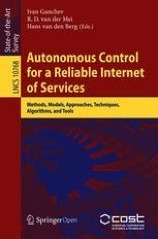
Autonomous control for a reliable internet of services : Methods, models, approaches, techniques, algorithms, and tools
This open access book was prepared as a Final Publication of the COST Action IC1304 “Autonomous Control for a Reliable Internet of Services (ACROSS)”. The book contains 14 chapters and constitutes a show-case of the main outcome of the Action in line with its scientific goals. It will serve as a valuable reference for undergraduate and post-graduate students, educators, faculty members, researchers, engineers, and research strategists working in this field. The objective of this book is, by applying a systematic approach, to assess the state-of-the-art and consolidate the main research results achieved in this area.

Autonomic and Trusted Computing ; 3rd International Conference, ATC 2006, Wuhan, China, September 3-6, 2006
This book constitutes the refereed proceedings of the Third International Conference on Autonomic and Trusted Computing, ATC 2006, held in Wuhan, China in September 2006. The 57 revised full papers presented together with two keynotes were carefully reviewed and selected from 208 submissions. The papers are organized in topical sections.

Automatic video editor
Searching in a large database of videos is one of the challenges faced by the user today as most of the results are inaccurate or correct. In our project, we worked on developing a system that receives the search word from the user and searches for it among a large number of videos using MSR-VTT dataset and COCO data set based on the elements that we see inside the video. Entered by the user. We have also worked on adding other options that the user can benefit from in modifying the videos, such as entering a black and white video clip and returning the result in color. The user can also enter a low-resolution video clip, and the system improves the accuracy of the video and sends it.
