



الصفحة 55
الصفحة 55
Marine Biodiversity : Patterns and Processes, Assessment, Threats, Management and Conservation
Understanding the functioning of Marine Ecosystems is the first step to measure and predict the influence of Man, and to find solutions for the enormous array of problems we face today. This volume is organised according to the four subthemes of the symposium and to issues commonly perceived as relevant by scientists concerned with the study, protection and management of Marine Biodiversity: patterns and processes, assessment, threats and management and conservation.

Marginality : Addressing the Nexus of poverty, exclusion and ecology
In this volume economists, ecology experts, geographers, agronomists, sociologist, and business experts come together to address marginality. The inter-disciplinary research offers conceptual innovations and presents the dimensions of marginality in developing countries. Economic, political, and environmental drivers are assessed and mapped globally and in detail for countries in Africa and Asia, especially Ethiopia, India, Bangladesh, China, Indonesia. Economic growth especially in rural areas remains and farming communities is central to poverty reduction but needs to be complemented with specific actions to reach those at the margins.

MARE-WINT : New Materials and Reliability in Offshore Wind Turbine Technology
This book provides a holistic, interdisciplinary overview of offshore wind energy, and is a must-read for advanced researchers. Topics, from the design and analysis of future turbines, to the decommissioning of wind farms, are covered. The scope of the work ranges from analytical, numerical and experimental advancements in structural and fluid mechanics, to novel developments in risk, safety & reliability engineering for offshore wind. The core objective of the current work is to make offshore wind energy more competitive, by improving the reliability, and operations and maintenance (O&M) strategies of wind turbines.
Map-based Mobile Services : Theories, Methods and Implementations
Divided into three parts - theory, method and implementation, this book starts with a summary of the state-of-the-art in mobile technologies. It also introduces a conceptual framework of mobile cartography with the emphasis on mobile usage context. It is accompanied by a CD-ROM which contains the PDF-Files in colour.
Map-based Mobile Services : Design, Interaction and Usability
It addresses methods and techniques for topics that range from design and rendering, context modelling, personalisation, multimodal interaction to usability test. Instead of striving for a seamless coverage of all essential theoretical and technical issues with an equal depth and extent, we attempt to pinpoint a number of research highlights and representative development activities at universities, research institutions and so- ware industry. The operational prototypes and platforms reported in the book are on the one hand outcome and feasibility proof of various approaches. On the other hand, they serve as a new starting point for the refinement of user interfaces and iterative usability tests.
Map Projections : Cartographic Information Systems
In the context of Geographical Information Systems (GIS) the book offers a timely review of map projections (sphere, ellipsoid, rotational surfaces) and geodetic datum transformations. For the needs of photogrammetry, computer vision, and remote sensing space projective mappings are reviewed.

Manual of Digital Earth
This book offers a summary of the development of Digital Earth over the past twenty years. By reviewing the initial vision of Digital Earth, the evolution of that vision, the relevant key technologies, and the role of Digital Earth in helping people respond to global challenges, this publication reveals how and why Digital Earth is becoming vital for acquiring, processing, analysing and mining the rapidly growing volume of global data sets about the Earth.
Manual for Soil Analysis - Monitoring and Assessing Soil Bioremediation
Reliable methods for monitoring and assessing soil quality are a prerequisite for successful soil bioremediation projects. The fifth volume of Soil Biology presents detailed descriptions of selected methods for evaluating, monitoring and assessing bioremediation treatments of soils contaminated with organic pollutants or heavy metals.

Mantle Plumes : A Multidisciplinary Approach
In this book, a group of experts review these advances in plume research and present a general overview on recent plume studies.
Mangroves and Halophytes : Restoration and Utilisation
Focusing on Venezuela and Mexico, this edited volume from the International Society of Halophyte Utilisation (ISHU) explores the environmental issues facing South and Central America's coastal ecosystems, and discusses the uses of mangrove species and other halophytes in addressing issues of both coastal pollution and upland soil salinisation. The book draws on expertise from Europe and South America to present a series of case studies that detail Venezuela’s saline ecosystems and examine the economic potential of mangrove restoration and halophyte production. It includes cutting-edge research into the establishment of new mangrove stands which could serve as prototypes for the sustainable use of halophytes, including Chenopodium quinoa and Tamarix aphylla. Moreover, the detailed examples from Venezuela and other Caribbean countries provide useful models for comparison with halophyte utilisation in other parts of the world – especially the Mediterranean region, where much of the earlier research of the ISHU had been conducted.

Managing Your Headaches
Frequent headaches seriously affect the lives of millions of sufferers. The result can be lost productivity and income, restrict activity, lower self-esteem, and even social isolation. For many, it takes years to find the appropriate medication to manage your headaches effectively. In Managing Your Headaches, Mark and Leah Green and John Rothrock explain what information you should record for your physician, what a physician is looking for in a neurological examination, and what you should (and should not) do to reduce the frequency and severity of your headaches. They discuss the effects of stress, psychological factors, possible food triggers, and environmental risk factors. The authors explain the symptoms of migraine, cluster, and tension-type headaches as well as less common types. They address common concerns and misconceptions and explain current knowledge about headache causes in understandable terms. The newest, most effective medications and their possible side effects are evaluated. The authors also explain how to prevent rebound headaches from over-medications and how non-medical treatments can be of value. Managing Your Headaches will tell you what you need to know to better control your headaches. Armed with the information in this book, you can be aware of the latest treatment options and can have more productive, informed discussions with your physician.
Managing Weather and Climate Risks in Agriculture
In many parts of the world, weather and climate are one of the biggest production risks and uncertainty factors impacting on agricultural systems performance and management. Both structural and non-structural measures can be used to reduce the impacts of the variability (including extremes) of climate resources on crop production. While the structural measures include strategies such as irrigation, water harvesting, windbreaks etc., the non-structural measures include use of seasonal to interannual climate forecasts, improved application of medium-range weather forecasts and crop insurance. This book based on an International Workshop held in New Delhi, India should be of interest to all organizations and agencies interested in improved risk management in agriculture.
Managing Sustainability : Perspectives From Retailing and Services
Companies and policy makers are prioritizing environmental, social, and governance goals as part of their strategies. Academic research has started to focus on these issues, but many important matters require deeper investigation and reflection, especially in specific sectors. This book focuses on the sustainability issues within the retailing and services sectors.
Managing Socio-ecological Production Landscapes and Seascapes for Sustainable Communities in Asia : Mapping and Navigating Stakeholders, Policy and Action
This book presents up-to-date analyses of community-based approaches to sustainable resource management of SEPLS (socio-ecological production landscapes and seascapes) in areas where a harmonious relationship between the natural environment and the people who inhabit it is essential to ensure community and environmental well-being as well as to build resilience in the ecosystems that support this well-being.
Managing Risk and Information Security : Protect to Enable
Examine the evolving enterprise security landscape and discover how to manage and survive risk. While based primarily on the author’s experience and insights at major companies where he has served as CISO and CSPO, the book also includes many examples from other well-known companies and provides guidance for a management-level audience. Managing Risk and Information Security provides thought leadership in the increasingly important area of enterprise information risk and security. It describes the changing risk environment and why a fresh approach to information security is needed. Because almost every aspect of an enterprise is now dependent on technology not only for internal operations but increasing as a part of product or service creation, the focus of IT security must shift from locking down assets to enabling the business while managing and surviving risk. This edition discusses business risk from a broader perspective, including privacy and regulatory considerations. It describes the increasing number of threats and vulnerabilities and offers strategies for developing solutions. These include discussions of how enterprises can take advantage of new and emerging technologies—such as social media and the huge proliferation of Internet-enabled devices—while minimizing risk.
Managing Protected Areas in Central and Eastern Europe Under Climate Change
Addresses the need for sharing knowledge and experience in the field of biodiversity conservation and climate change. There is an urgent need to build capacity in protected areas to monitor, assess, manage and report the effects of climate change and their interaction with other pressures. The contributors identify barriers to the adaptation of conservation management, such as the mismatch between planning reality and the decision context at site level. Short and vivid descriptions of case studies, drawn from investigation areas all over Central and Eastern Europe, illustrate both the local impacts of climate change and their consequences for future management.
Managing Forest Ecosystems : The Challenge of Climate Change
With climate change now charging up the political agenda, there are three issues commonly making the headlines: carbon budgets, renewable energy, and the anticipated impacts of climate change. Equally important, though currently less well covered, is the issue how these effects might be mitigated. Given the significant role that forests play in the climate system – as sources, sinks, and through carbon trading – this book discusses the current scientific evidence on the relationships between climate, forest resources and forest management practices around the world. Drawing on expertise from forest scientists from several continents, the book presents both in depth analysis of the current knowledge, and a series of case studies which assess the biological and the economic impacts of climate change. It includes sections on forest responses to climate change, monitoring and modeling changes, economic and management implications, and carbon sequestration under specific management systems.

Managing European Coasts : Past, Present and Future
Many coastal areas and human activities are subject to increasing risks from natural and man-induced hazards such as flooding resulting from major changes in hydrology of river systems that has reached a global scale. Changes in the hydrological cycle coupled with changes in land and water management alter fluxes of materials transmitted from river catchments to the coastal zone, which have a major effect on coastal ecosystems. The increasing complexity of underlying processes and forcing functions that drive changes on coastal systems are witnessed at a multiplicity of temporal and spatial scales.

Managing Elevated Risk : Global Liquidity, Capital Flows, and Macroprudential Policy—An Asian Perspective
Discusses the risks and opportunities that arise in Emerging Asia given the context of a new environment in global liquidity and capital flows. It elaborates on the need to ensure financial and overall economic stability in the region through improved financial regulation and other policy measures to minimize the emergent risks. "Managing Elevated Risk: Global Liquidity, Capital Flows, and Macroprudential Policy—An Asian Perspective" also explores the range of policy options that may be deployed to address the impact of global liquidity on domestic financial and socio-economic conditions including income inequality. The book is primarily aimed at policy makers, financial market regulators and supervisory agencies to help them improve national regulatory systems and to promote harmonization of national regulations and practices in line with global standards.
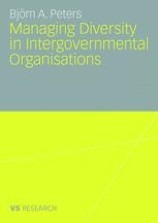
Managing Diversity in Intergovernmental Organisations
Intensifying worldwide environmental changes as well as political, cultural, religious, and economic crises have made intergovernmental organisations (IGOs) important instruments in international and global cooperation. In order to cope with their diverse stakeholders, it is more imperative than ever for intergovernmental organisations to engage in personnel policy on an international scale. Successful diversity management is an essential prerequisite for organisational performance, conflict management, and dynamics of IGOs. Björn A. Peters examines the challenges of diversity and managing diversity in IGOs on the basis of the Mekong River Commission case study.
