



الصفحة 54
الصفحة 54

Histology and cell biology : An introduction to pathology
Helps students build a stronger clinical knowledge base in the challenging area of pathologic abnormalities. This award-winning text presents key concepts in an understandable, easy-to-understand manner, with full-color illustrations, diagrams, photomicrographs, and pathology photos fully integrated on every page.

Hipparcos, the New Reduction of the Raw Data
This book provides overviews of the new reduction as well as on the use of the Hipparcos data in a variety of astrophysical implementations. A range of new results, like cluster distances and luminosity calibrations, is presented. The Hipparcos data provide a unique opportunity for the study of satellite dynamics.

H-infinity control for nonlinear descriptor systems
The authors present a study of the H-infinity control problem and related topics for descriptor systems, described by a set of nonlinear differential-algebraic equations. They derive necessary and sufficient conditions for the existence of a controller solving the standard nonlinear H-infinity control problem considering both state and output feedback. One such condition for the output feedback control problem to be solvable is obtained in terms of Hamilton–Jacobi inequalities and a weak coupling condition; a parameterization of output feedback controllers solving the problem is also provided. All of these results are then specialized to the linear case. The derivation of state-space formulae for all controllers solving the standard H-infinity control problem for descriptor systems is proposed. Among other important topics covered are balanced realization, reduced-order controller design and mixed H2/H-infinity control.

Highway engineering : Planning, design, and operations ; 2nd ed.
Presents a clear and rigorous exposition of highway engineering concepts, including project development and the relationship between planning, operations, safety and highway types. The book includes important topics such as corridor selection and traverses, horizontal and vertical alignment, design controls, basic roadway design, cross section elements, intersection and interchange design, and the integration of new vehicle technologies and trends. It also presents end of chapter exercises to further aid understanding and learning. This edition has been fully updated with the current design policies and reference manuals essential for highway, transportation, and civil engineers who are required to work to these standards.

High-Resolution Sonography of the Peripheral Nervous System
This second, revised edition reflects these ongoing developments in various ways: many state of the art high-resolution images are included, the text has been adapted to reflect the current state of the literature, and information is presented using a more modern layout.
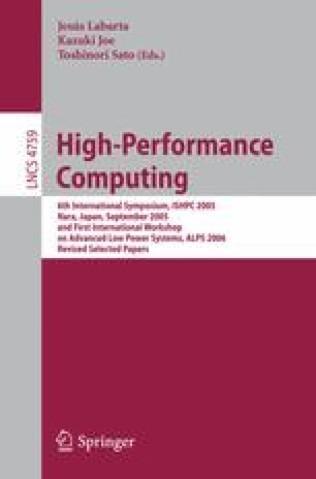
High-Performance Computing ; 6th International Symposium, ISHPC 2005, Nara, Japan, September 7-9, 2005, First International Workshop on Advanced Low Power Systems, ALPS 2006, Revised Selected Papers
This is the joint post-proceedings of the 6th International Symposium on High Performance Computing (ISHPC-VI) and the First International Workshop on Advanced Low Power Systems 2006 (ALPS2006). The post-proceedings also contain the papers presented at the Second HPF International Workshop: - periences and Progress (HiWEP2005) and the Workshop on Applications for PetaFLOPS Computing (APC2005), which are workshops of ISHPC-VI. ISHPC-VI, HiWEP2005 and APC2005 were held in Nara, Japan during September 7–9, 2005. Fifty-eight papers from 11 countries were submitted to ISHPC-VI. After the reviews of the submitted papers, the ISHPC-VI Program Committee selected 15 regular (12-page) papers for oral presentation. In ad- tion, several other papers with favorable reviews were recommended for poster presentation, and 14 short (8-page) papers were also selected.

Highly Sensitive Optical Receivers
Highly Sensitive Optical Receivers primarily treats the circuit design of optical receivers with external photodiodes. Continuous-mode and burst-mode receivers are compared. The monograph first summarizes the basics of III/V photodetectors, transistor and noise models, bit-error rate, sensitivity and analog circuit design, thus enabling readers to understand the circuits described in the main part of the book. In order to cover the topic comprehensively, detailed descriptions of receivers for optical data communication in general and, in particular, optical burst-mode receivers in deep-sub-µm CMOS are presented. Numerous detailed and elaborate illustrations facilitate better understanding.

High-Linearity CMOS RF Front-End Circuits
High-Linearity CMOS RF Front-End Circuits presents some unique techniques to enhance the linearity of both the receiver and transmitter. For example, using harmonic cancellation techniques, the linearity of the receiver front-end can be increased by few tens of dB with only minimal impact on the other circuit parameters. The new parallel class A&B power amplifier can not only increase the transmitter's output power in the linear range, but can also result in significant savings in power consumption. High-Linearity CMOS RF Front-End Circuits can be used as a textbook for graduate courses in RF CMOS design and will also be useful as a reference for the practicing engineer.

Highlights of Spanish Astrophysics IV ; Proceedings of the Seventh Scientific Meeting of the Spanish Astronomical Society (SEA) held in Barcelona, Spain, September 12-15, 2006
This volume documents the contributions presented at the Seventh Scientific Meeting of the Spanish Astronomical Society (Sociedad Española de Astronomía, SEA). Two plenary sessions of the meeting were devoted to the approved entrance of Spain as a full member of the European Southern Observatory (ESO) and to the imminent first light of the greatest telescope in the world, the GTC (Gran Telescopio de Canarias), milestones that will certainly lead the Spanish Astronomy in the next future.

High-Level Synthesis : From Algorithm to Digital Circuit
This book presents an excellent collection of contributions addressing different aspects of high-level synthesis from both industry and academia. High-Level Synthesis: from Algorithm to Digital Circuit should be on each designer’s and CAD developer’s shelf, as well as on those of project managers who will soon embrace high level design and synthesis for all aspects of digital system design.

High-Level Modeling and Synthesis of Analog Integrated Systems
In High-Level Modeling and Synthesis of Analog Integrated Systems, two novel generic behavioral models are described. The first one adopts a time-domain approach and is suited for classes like Delta-Sigma modulators and sampled-data systems. For the second model, a new frequency-domain framework has been developed (the Phase- Frequency Transfer model) which allows the representation of classes of RF systems like front-ends of wireless receivers. To complete the high-level design strategy, the synthesis strategy has been concretized with a new top-down heterogeneous optimization algorithm.

High-Dynamic-Range (HDR) Vision : Microelectronics, Image Processing, Computer Graphics
This first comprehensive account of high-dynamic-range (HDR) vision focusses on HDR real-time, high-speed digital video recording and also systematically presents HDR video transmission and display. The power of the eye-like, logarithmic optoelectronic conversion concept is demonstrated in machine-vision, medical, automotive, surveillance and cinematic applications, and it is extended to HDR sub-retinal implants for the vision impaired. While the book conveys the overall picture of HDR vision, specific knowledge of microelectronics and image processing is not required. It provides a quantitative summary of the major issues to allow the assessment of the state of the art and a glimpse at future developments. Selected experts share their know-how and expectations in this rapidly evolving art related to the single most powerful of our senses.

High-dimensional chaotic and attractor systems : A comprehensive introduction
If we try to describe real world in mathematical terms, we will see that real life is very often a high–dimensional chaos. Sometimes, by ‘pushing hard’, we manage to make order out of it; yet sometimes, we need simply to accept our life as it is. To be able to still live successfully, we need tounderstand, predict, and ultimately control this high–dimensional chaotic dynamics of life. This is the main theme of the present book.

High Thermal Conductivity Materials
High thermal conductivity materials play an important role in addressing thermal management issues. This volume provides readers a basic understanding of the thermal conduction mechanisms in these materials and discusses how the thermal conductivity may be related to their crystal structures as well as microstructures developed as a result of their processing history. The techniques for accurate measurement of these properties on large as well as small scales have been reviewed. Detailed information on the thermal conductivity of diverse materials including aluminum nitride (AlN), silicon carbide (SiC), diamond, as well as carbon nanotubes has been presented. The emphasis is on developing basic understanding of the inter-relationships between thermal conductivity and processing such that the readers can conduct their own research in this exciting field of high thermal conductivity materials.

High Temperature Mechanical Behavior of Ceramic-Matrix Composites
High Temperature Mechanical Behavior of Ceramic-Matrix Composites examines the behavior of CMCs at elevated temperature—outlining the latest developments in the field and presenting the results of recent research on different CMC characteristics, material properties, damage states, and temperatures. This up-to-date resource investigates the high-temperature behavior of CMCs in relation to first matrix cracking, matrix multiple cracking, tensile damage and fracture, fatigue hysteresis loops, stress-rupture, vibration damping, and more.

High Performance Tensegrity-Inspired Metamaterials and Structures
New metamaterials, smart materials and structures, and adaptive systems with adjustable behaviour or which use high performance or 'extremal' materials can be applied to bigger structural systems, such as cellular tensegrity lattices with extremal mechanical properties. Numerical analyses justify tensegrities and discrete and continuum models offer two main approaches to the analysis of tensegrity-based mechanical metamaterials and lattices. Two examples of 2D and 3D tensegrity modules and lattices, and potential applications in civil engineering are presented.

High performance embedded architectures and compilers ; 3rd International Conference, HiPEAC 2008, Göteborg, Sweden, January 27-29, 2008. Proceedings
This book constitutes the refereed proceedings of the Third International Conference on High Performance Embedded Architectures and Compilers, HiPEAC 2008, held in Göteborg, Sweden, January 27-29, 2008. The 25 revised full papers presented together with 1 invited keynote paper were carefully reviewed and selected from 77 submissions. The papers are organized in topical sections on Multithreaded and Multicore Processors, Reconfigurable - ASIP, Compiler Optimizations, Industrial Processors and Application Parallelization, Power-Aware Techniques, High-Performance Processors, Profiles: Collection and Analysis as well as Optimizing Memory Performance.

High performance embedded architectures and compilers ; 2nd International Conference, HiPEAC 2007, Ghent, Belgium, January 28-30, 2007. Proceedings
This book constitutes the refereed proceedings of the Second International Conference on High Performance Embedded Architectures and Compilers, HiPEAC 2007, held in Ghent, Belgium, in January 2007. The 19 revised full papers presented together with one invited keynote paper were carefully reviewed and selected from 65 submissions.

High performance embedded architectures and compilers ; 1st International Conference, HiPEAC 2005, Barcelona, Spain, November 17-18, 2005, Proceedings
The ProgramCommittee received a total of 84 submissions; only 17 were selected for presentation as full-length papers and another one as an invited paper. Each paper was rigorously reviewed by three ProgramCommittee members and at least one external referee. Many reviewers spent a great amount of e?ort to provide detailed feedback. In many cases, such feedback along with constructive shepherding resulted in dramatic improvement in the quality of accepted papers. The names of the Program Committee m- bers and the referees are listed in the proceedings. The net result of this team e?ort is that the symposium proceedings include outstanding contributions by authors from nine countries in three continents. In addition to paper presentations, this ?rst HiPEAC conference featured two keynotes delivered by prominent researchers from industry and academia.

High performance concrete optimal composition design
Presents experimental and theoretical results allowing production of special high-strength rapid hardening concrete and fiber reinforced concrete. It describes a method for effective proportioning of high-strength fast-setting concrete and fiber reinforced concrete with high dynamic strength as well as selecting proper technological parameters, methodology for design of reinforced concrete structures using such concrete. Particular attention is paid to ensuring the early strengthening of concrete within 24 hours after casting and to constructing structures with limited energy resources at the site.
