



الصفحة 54
الصفحة 54

Foundation Flash 8 Video
This book is the ultimate guide to Flash 8 video it offers practical advice, technical guidance, and a full series of creative projects ranging from the dead simple to the complex in a manner that talks to you as an equal and makes only one assumption: basic familiarity with the Flash interface. We start with the basicshow to edit video in some of the most popular packages available (such as iMovie and Movie Maker 2) and create a Flash video file and import it into Flash.

Foundation Expression Blend 2 : Building applications in WPF and silverlight
This book shows you how to take full advantage of Blend's interface, together with and Silverlight's vastly improved designer-developer workflow, guiding you through every step of development from downloading and installing of the development environment through creating finished, functional projects. You'll learn how to create simple drawing applications with the InkCanvas, make tabbed and scrollable interfaces, as well as build fully featured media players, photo galleries, and interactive 3D designs. Each chapter discusses major WPF and Silverlight features, provides a hands-on tutorial, and explains how that feature is implemented in the real world. In the end, you will have a collection of impressive WPF and Silverlight applications that can be added to your portfolio.

Foundation ASP.NET for Flash
If you're a reasonably experienced Flash user who has mastered the basics but wants to empower your SWFs, taking them further toward rich Internet applications, then you've come to the right place! Foundation ASP.NET for Flash will teach you everything you need to know to integrate two of the most exciting technologies used on the Web today. Using Flash and ASP.NET, it's possible to utilize the amazing user interface capabilities of Flash along with the extensive power of ASP.NET to create dynamic, data-driven web applications. In this book, advanced topics are made easy by providing intuitive step-by-step examples. This book covers Flash MX 2004 and Flash 8, ASP.NET 2.0, Visual Studio 2005, and Access and SQL Server 2005. It is an essential part of any Flash or ASP.NET web developer's arsenal.

Foundation ASP for Dreamweaver 8
Dreamweaver 8 takes a lot of the hard work out of performing tasks such as integrating a database into your website, but it can't do everything. That's why this book not only shows you how to use all of Dreamweaver's functions, but also shows you how the underlying code functions, so you can then work around Dreamweaver's shortcomings. There's no attempt to turn you into a code guru, but you'll come away with sufficient knowledge of basic ASP to have the confidence to dive into the Dreamweaver code and tweak it to your own requirements. The emphasis is exclusively on ASP, so you don't waste any time on information that's not relevant to what you want to do.
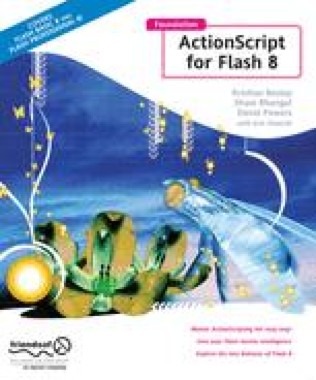
Foundation ActionScript for Flash 8
This book contains all you need to understand and make use of ActionScript, and to have some fun while learning. The Foundation series teaching style is ideal if you're a non-programmer who wants to learn Flash programming quickly and thoroughly. The authors teach the basics, and provide an all-around proficiency in ActionScript, as well as Flash components within Flash 8. You'll gain the practical skills to build ActionScript based Flash projects, including making initial design decisions, structuring code, and testing. An ongoing case study means that by the end of the book, you'll have constructed a cutting-edge Flash site to showcase your newly learned skills.

Forward-backward stochastic differential equations and their applications
This volume is a survey/monograph on the recently developed theory of forward-backward stochastic differential equations (FBSDEs). Basic techniques such as the method of optimal control, the "Four Step Scheme", and the method of continuation are presented in full. Related topics such as backward stochastic PDEs and many applications of FBSDEs are also discussed in detail. The volume is suitable for readers with basic knowledge of stochastic differential equations, and some exposure to the stochastic control theory and PDEs. It can be used for researchers and/or senior graduate students in the areas of probability, control theory, mathematical finance, and other related fields.
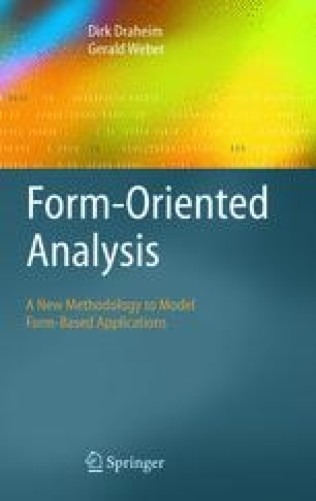
Form-oriented analysis : A new methodology to model form-based applications
Form-based applications range from simple web shops to complex enterprise resource planning systems. Draheim and Weber adapt well-established basic modeling techniques in a novel way to achieve a modeling framework optimized for this broad application domain. They introduce new modeling artifacts, such as page diagrams and form storyboards, and separate dialogue patterns to allow for reuse. In their implementation they have developed new constructs such as typed server pages, and tools for forward and reverse engineering of presentation layers. The methodology is explained using an online bookshop as a running example in which the user can experience the modeling concepts in action. The combination of theoretical achievements and hands-on practical advice and tools makes this book a reference work for both researchers in the areas of software architectures and submit-response style user interfaces, and professionals designing and developing such applications. More information and additional material is also available online.
Formal Techniques for Networked and Distributed Systems - FORTE 2008 ; 28th IFIP WG 6.1 International Conference Tokyo, Japan, June 10-13, 2008 Proceedings
This book constitutes the refereed proceedings of the 28th IFIP WG 6.1 International Conference on Formal Techniques for Networked and Distributed Systems, FORTE 2008, held in Tokyo, Japan, in June 2008 co-located with TestCom/FATES 2008.The 19 revised full papers and 1 revised short paper presented together with 1 invited talk were carefully reviewed and selected from 44 submissions. The papers cover new approaches, concepts and experience in the application of formal methods for the specification and verification of distributed systems and applications.

Formal Methods for Computational Systems Biology ; 8th International School on Formal Methods for the Design of Computer, Communication, and Software Systems, SFM 2008 Bertinoro, Italy, June 2-7, 2008 Advanced Lectures
This volume presents the set of papers accompanying the lectures of the eighth International School on Formal Methods for the Design of Computer, Com- nication, and Software Systems (SFM). This series of schools addresses the use of formal methods in computer science asaprominent approach to theri gorousdesign of computer, communication, and software systems. The main aim of the SFM series is to ofer a good spectrum of current research in foundations as well as applications of formal methods, which can be of help for graduate students and young researchers who intend to approach the feld.
Formal methods applications and technology ; 11th International workshop on formal methods for industrial critical systems, FMICS 2006, and 5th International Workshop on parallel and distributed methods in verification, PDMC 2006, Bonn, Germany, August 26-27, and August 31, 2006, Revised Selected
The workshop program included two invited talks, by Anna Slobodova from Intel on “Challenges for Formal Veri?cation in an Industrial Setting” and by Edward A. Lee from the University of California at Berkeley on “Making C- currency Mainstream.” The former full paper can be found in this volume.

Formal Methods and Software Engineering; 9th International Conference on Formal Engineering Methods, ICFEM 2007, Boca Raton, Florida, USA, November 14-15, 2007, Proceedings
This book constitutes the refereed proceedings of the 9th International Conference on Formal Engineering Methods, ICFEM 2007, held in Boca Raton, Florida, USA, November 14-15, 2007. The papers address all current issues in formal methods and their applications in software engineering.
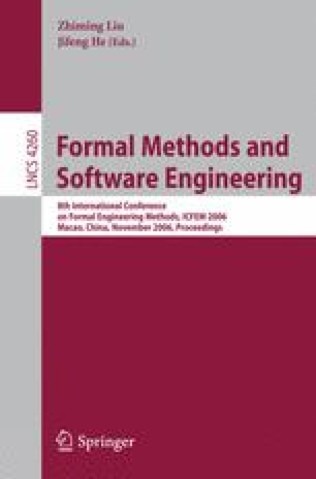
Formal Methods and Software Engineering ; Vol. 4260 ; 8th International Conference on Formal Engineering Methods, ICFEM 2006, Macao, China, November 1-3, 2006, Proceedings
This book constitutes the refereed proceedings of the 8th International Conference on Formal Engineering Methods, ICFEM 2006, held in Macao, China, in November 2006. The papers address all current issues in formal methods and their applications in software engineering.

Formal Methods and Software Engineering ; 10th International Conference on Formal Engineering Methods, ICFEM 2008, Kitakyushu-City, Japan, October 27-31, 2008. Proceedings
This book constitutes the refereed proceedings of the 10th International Conference on Formal Engineering Methods, ICFEM 2008, held in Kitakyushu-City, Japan, October 2008.The 20 revised full papers together with 3 invited talks presented were carefully reviewed and selected from 62 submissions. The papers address all current issues in formal methods and their applications in software engineering. They are organized in topical sections on specification and verification; testing; verification; model checking and analysis; tools; application of formal methods; semantics.
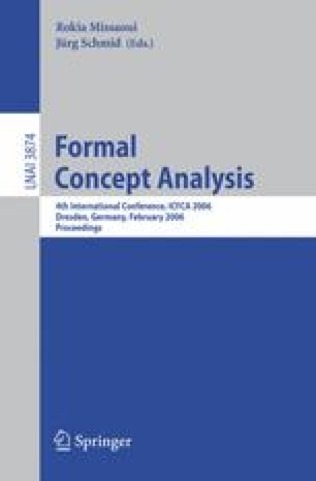
Formal concept analysis ; Vol. 3874 ; 4th International Conference, ICFCA 2006, Dresden, Germany, Feburary 13-17, 2006, Proceedings
This book constitutes the refereed proceedings of the 4th International Conference on Formal Concept Analysis, held in February 2006. The 17 revised full papers presented together with four invited papers were carefully reviewed and selected for inclusion in the book. The papers show advances in applied lattice and order theory and in particular scientific advances related to formal concept analysis and its practical applications: data and knowledge processing including data visualization, information retrieval, machine learning, data analysis and knowledge management.

Formal concept analysis ; Vol. 3403 ; 3rd International Conference, ICFCA 2005, Lens, France, February 14-18, 2005, Proceedings
This book constitutes a comprehensive and systematic presentation of the state of the art of formal concept analysis and its applications. The first part of the book is devoted to foundational and methodological topics. The contributions in the second part demonstrate how formal concept analysis is successfully used outside of mathematics, in linguistics, text retrieval, association rule mining, data analysis, and economics. The third part presents applications in software engineering.
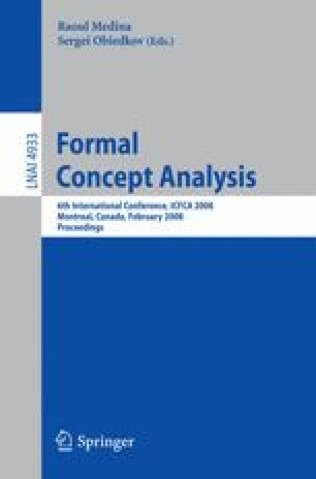
Formal Concept Analysis ; 6th International Conference, ICFCA 2008, Montreal, Canada, February 25-28, 2008. Proceedings
Formal Concept Analysis (FCA) is a mathematical theory of concepts and c- ceptual hierarchyleadingto methods for conceptually analyzing data and kno- edge. The theory itselfstronglyreliesonorder and lattice theory,whichhasbeen studied by mathematicians over decades. FCA proved itself highly relevant in several applications from the beginning , and, over the last years, the range of application shaskept growing. The mainreasonfor this comesfromthe fact that our modern society has turned into an “information” society. After years and years of using computers, companies realized they had stored gigantic amounts of data.

Formal aspects in security and trust ; Vol. 173 ; IFIP TC1 WG1.7 Workshop on Formal Aspects in Security and Trust (FAST), World Computer Congress, August 22-27, 2004, Toulouse, France
The IFIP series publishes state-of-the-art results in the sciences and technologies of information and communication. The scope of the series includes: foundations of computer science; software theory and practice; education; computer applications in technology; communication systems; systems modeling and optimization; information systems; computers and society; computer systems technology; security and protection in information processing systems; artificial intelligence; and human-computer interaction. Proceedings and post-proceedings of referred international conferences in computer science and interdisciplinary fields are featured. These results often precede journal publication and represent the most current research. The principal aim of the IFIP series is to encourage education and the dissemination and exchange of information about all aspects of computing.
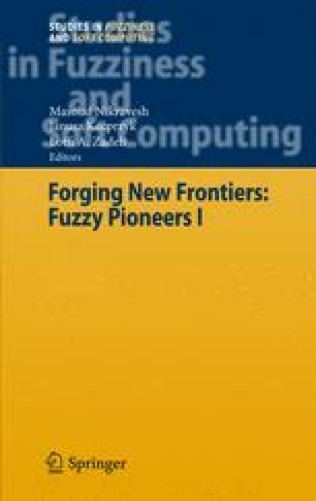
Forging New Frontiers : Fuzzy Pioneers I
The 2005 BISC International Special Event-BISCSE’05 " FORGING THE FRONTIERS" was held in the University of California, Berkeley, “WHERE FUZZY LOGIC BEGAN, from November 3 – 6, 2005. The successful applications of fuzzy logic and it’s rapid growth suggest that the impact of fuzzy logic will be felt increasingly in coming years. Fuzzy logic is likely to play an especially important role in science and engineering, but eventually its influence may extend much farther. In many ways, fuzzy logic represents a significant paradigm shift in the aims of computing - a shift which reflects the fact that the human mind, unlike present day computers, possesses a remarkable ability to store and process information which is pervasively imprecise, uncertain and lacking in categoricity.

Forest Landscape Ecology : Transferring Knowledge to Practice
Forest Landscape Ecology: Transferring Knowledge to Practice is the first book to introduce landscape ecologists to the discipline of knowledge transfer. The book considers knowledge transfer in general, critically examines aspects of transfer that are unique to forest landscape ecology, and reviews several case studies of successful applications for policy developers and forest managers in North America. Readers are encouraged to recognize the value of sharing their knowledge, and to understand their role in active knowledge transfer. The intent is to connect, as seamlessly and effectively as possible, ecological principles to policy and practice.

Forest Inventory : Methodology and Applications
This book has been developed as a forest inventory textbook for students and can also serve as a handbook for practical foresters. The book is divided into four sections. The first section deals mostly with sampling issues. First, we present the basic sampling designs at a fairly non-technical mathematical level. In addition, we present some more advanced sampling issues often needed in forest inventory. Those include for instance problems with systematic sampling, and methods for sampling vegetation or rare populations. Forest inventory also includes issues that are unique to forestry, like problems in measuring sample plots in the field, or utilising sample tree measurements. These issues include highly sophisticated methodology, but we try to present these also such that forestry students can grasp the ideas behind them. Each method is presented with examples. For foresters who need more details, references are given to more advanced scientific papers and books in the fields of statistics and biometrics.
