



الصفحة 53
الصفحة 53
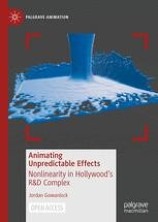
Animating Unpredictable Effects : Nonlinearity in Hollywood’s R&D Complex
Uncanny computer-generated animations of splashing waves, billowing smoke clouds, and characters’ flowing hair have become a ubiquitous presence on screens of all types since the 1980s. This Open Access book charts the history of these digital moving images and the software tools that make them. Unpredictable Visual Effects uncovers an institutional and industrial history that saw media industries conducting more private R&D as Cold War federal funding began to wane in the late 1980s. In this context studios and media software companies took concepts used for studying and managing unpredictable systems like markets, weather, and fluids and turned them into tools for animation. Unpredictable Visual Effects theorizes how these animations are part of a paradigm of control evident across society, while at the same time exploring what they can teach us about the relationship between making and knowing.
ANEMONA : A Mulit-agent Methodology for Holonic Manufacturing Systems
ANEMONA is a multi-agent system (MAS) methodology for holonic manufacturing system (HMS) analysis and design, based on HMS requirements. The development process of ANEMONA provides clear and HMS-specific modeling guidelines for HMS designers, and complete development phases for the HMS life cycle.

Android Essentials
Android Essentials is a no–frills, no–nonsense, code–centric run through the guts of application development on Google's Mobile OS. This book uses the development of a sample application to work through topics, focusing on giving developers the essential tools and examples required to make viable commercial applications work. Covering the entirety of the Android catalog in less than 150 pages is simply impossible. Instead, this book focuses on just four main topics: the application life cycle and OS integration, user interface, location–based services, and networking.
Anatomy ontologies for bioinformatics : Principles and practice
This book provides a timely and first-of-its-kind collection of contributed chapters on anatomy ontologies. It is interdisciplinary in its approach, bringing together relevant expertise from computing and biomedical studies, and covering both theoretical and applied aspects, with an emphasis on newer work relevant to the emerging Semantic Web.
Analyzing uncertainty in civil engineering
This volume addresses the issue of uncertainty in civil engineering from design to construction. Failures do occur in practice. Attributing them to a residual system risk or a faulty execution of the project does not properly cover the range of causes. A closer scrutiny of the adopted design, the engineering model, the data, the soil-construction-interaction and the model assumptions is required. Usually, the uncertainties in initial and boundary conditions are abundant. Current engineering practice often leaves these issues aside, despite the fact that new scientific tools have been developed in the past decades that allow a rational description of uncertainties of all kinds, from model uncertainty to data uncertainty. It is the aim of this volume to have a critical look at current engineering risk concepts in order to raise awareness of uncertainty in numerical computations, shortcomings of a strictly probabilistic safety concept, geotechnical models of failure mechanisms and their implications for construction management, execution, and the juristic question of responsibility. In addition, a number of the new procedures for modelling uncertainty are explained.

Analyzing the availability of fin tech and its role in enhancing the strategic : Performance of Syrian banks using the balanced scorecard
Aims to examine the role of financial technology (FinTech) in enhancing the strategic performance of Syrian banks by analyzing its impact on the four dimensions of the balanced scorecard : financial performance, customer satisfaction, internal process quality, and learning and growth. Amid economic and technological challenges, integrating fintech emerges as a strategic tool to boost operational efficiency, reduce costs, and promote financial inclusion. The study explores the experiences of several Syrian banks in implementing modern financial technologies, such as digital banking and smart payment systems, while evaluating key financial indicators like return on assets (ROA) and return on equity (ROE).

Analytical Methods in Anisotropic Elasticity : with Symbolic Computational Tools
This comprehensive textbook /reference focuses on the mathematical techniques and solution methodologies required to establish the foundations of anisotropic elasticity and provides the theoretical background for composite material analysis. Specific attention is devoted to the potential of modern symbolic computational tools to support highly complex analytical solutions and their contribution to the rigor, analytical uniformity and exactness of the derivation.

Analytic Number Theory : Lectures given at the C.I.M.E. Summer School held in Cetraro, Italy, July 11-18, 2002
The four contributions collected in this volume deal with several advanced results in analytic number theory. Friedlander’s paper contains some recent achievements of sieve theory leading to asymptotic formulae for the number of primes represented by suitable polynomials. Heath-Brown's lecture notes mainly deal with counting integer solutions to Diophantine equations, using among other tools several results from algebraic geometry and from the geometry of numbers. Iwaniec’s paper gives a broad picture of the theory of Siegel’s zeros and of exceptional characters of L-functions, and gives a new proof of Linnik’s theorem on the least prime in an arithmetic progression. Kaczorowski’s article presents an up-to-date survey of the axiomatic theory of L-functions introduced by Selberg, with a detailed exposition of several recent results.
Analysis, Modeling and Simulation of Multiscale Problems
This book reports recent mathematical developments in the Programme "Analysis, Modeling and Simulation of Multiscale Problems", which started as a German research initiative in 2006. Multiscale problems occur in many fields of science, such as microstructures in materials, sharp-interface models, many-particle systems and motions on different spatial and temporal scales in quantum mechanics or in molecular dynamics. The book presents current mathematical foundations of modeling, and proposes efficient numerical treatment.

Analysis, design and construction of foundations
Outlines methods for analysis and design the construction of shallow and deep foundations with particular reference to case studies in Hong Kong and China, as well as a discussion of methods used in other countries. It introduces the main approaches used by geotechnical and structural engineers, and the precautions required for planning and designing foundation structures. Some computational methods and computer programs are reviewed to provide tools for performing more realistic analysis of foundation systems.
Analysis of variance for random models, Vol. 2 : Unbalanced data : Theory, methods, applications, and data analysis
Analysis of variance (ANOVA) models have become widely used tools and play a fundamental role in much of the application of statistics today. In particular, ANOVA models involving random effects have found widespread application to experimental design in a variety of fields requiring measurements of variance, including agriculture, biology, animal breeding, applied genetics, econometrics, quality control, medicine, engineering, and social sciences. This two-volume work is a comprehensive presentation of different methods and techniques for point estimation, interval estimation, and tests of hypotheses for linear models involving random effects. Both Bayesian and repeated sampling procedures are considered. Volume I examines models with balanced data (orthogonal models); Volume II studies models with unbalanced data (nonorthogonal models).

Analysis of phylogenetics and evolution with R
This book integrates a wide variety of data analysis methods into a single and flexible interface: the R language. This open source language is available for a wide range of computer systems and has been adopted as a computational environment by many authors of statistical software. Adopting R as a main tool for phylogenetic analyses will ease the workflow in biologists' data analyses, ensure greater scientific repeatability, and enhance the exchange of ideas and methodological developments.
Analysis and Probability : Wavelets, Signals, Fractals
This book, combining analysis and tools from mathematical probability, focuses on a systematic and novel presentation of recent trends in pure and applied mathematics: the emergence of three fields, wavelets, signals and fractals. The unity of basis constructions and their expansions is emphasized as the starting point for the development of bases that are computationally efficient for use in several areas from wavelets to fractals.the book brings together tools from engineering and math, especially from signal- and image processing, and from harmonic analysis and operator theory. The presentation is aimed at graduate students, as well as users from a diverse spectrum of applications.
Analysis and Design of Information Systems : Third ed.
This third edition of the successful Analysis and Design of Information Systems provides a comprehensive introduction and user-friendly survey to all aspects of business transformation and analysis, and aims to provide the complex set of tools covering all types of systems, including legacy, transactional, database, and web/e-commerce topics.

Analyse asymptotique et couche limite = Asymptotic analysis and boundary layer
The aim of the book is to give teachers and students (from Bac + 4) in applied mathematics and fluid mechanics a teaching and learning tool illustrated by fifty problems accompanied by their detailed correction. This book presents a new method of asymptotic analysis for "boundary layer" problems. This is called MASC "Method of Complementary Successive Approximations". The first half of the book is devoted, in addition to the presentation of the MASC, to organize the knowledge necessary for the asymptotic analysis and to give the keys allowing the understanding of what is a problem called "boundary layer" and the methods allowing. to build an approximation. The second part is devoted to the application of MASC in fluid mechanics and to the comparison with the more traditional methods resulting from the famous MDAR, "Method of Connected Asymptotic Developments".
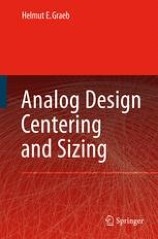
Analog Design Centering and Sizing
This book represents a compendium of fundamental problem formulations of analog design centering and sizing. It provides a differentiated knowledge about the tasks of analog design centering and sizing. In particular the worst-case problem will be formulated. It stands at the interface between process technology and design technology.Analog Design Centering and Sizing wants to point out that and how both process and design technology are required for its solution. The intention is to enable analog and mixed-signal designers to assess CAD solution methods that are presented to them. On the other side, the intention is to enable developers of analog CAD tools to formulate and develop solution approaches for analog design centering and sizing.The structure of Analog Design Centering and Sizing is geared towards a combination of a reference book and a textbook. The formulations of tasks and solution approaches by mathematical means makes the book suitable as well for students dealing with analog design and design methodology.

Analisi matematica II : Teoria ed esercizi con complementi in rete = Mathematical analysis 2 : Theory and exercises with online complements
Intends to support a second teaching of Mathematical Analysis according to the principles of the new Didactic Regulations. It is especially designed for those study courses (such as Engineering, Computer Science, Physics) in which the mathematical tool is a significant part of the training. The fundamental concepts and methods of the differential and integral calculus of several variables, the series of functions and the ordinary differential equations are presented with the primary objective of training the student in their operational but critical use. The didactic setting of the text follows the one used for ANALYSIS I. The method of presentation of the arguments allows a flexible and modular use of the text, in order to respond to the various possible didactic choices in the organization of a Mathematical Analysis course.

Analisi di Rasch e questionari di misura : Applicazioni in medicina e scienze sociali = Rasch analysis and measurement questionnaires: Applications in medicine and social sciences
Evaluation questionnaires are the most used tools nowadays in the field of medicine and the human sciences to evaluate variables such as disability, altruism or pain. However, clinicians are often unfamiliar with these tools. What do they really measure? How are the results to be interpreted? This book tries to answer these questions.

An Undergraduate Primer in Algebraic Geometry
This book consists of two parts. The first is devoted to an introduction to basic concepts in algebraic geometry: affine and projective varieties, some of their main attributes and examples. The second part is devoted to the theory of curves: local properties, affine and projective plane curves, resolution of singularities, linear equivalence of divisors and linear series, Riemann–Roch and Riemann–Hurwitz Theorems.The approach in this book is purely algebraic. The main tool is commutative algebra, from which the needed results are recalled, in most cases with proofs. The prerequisites consist of the knowledge of basics in affine and projective geometry, basic algebraic concepts regarding rings, modules, fields, linear algebra, basic notions in the theory of categories, and some elementary point–set topology.
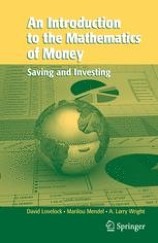
An Introduction to the Mathematics of Money : Saving and Investing
This is an undergraduate textbook on the basic aspects of personal savings and investing with a balanced mix of mathematical rigor and economic intuition. It uses routine financial calculations as the motivation and basis for tools of elementary real analysis rather than taking the latter as given. Proofs using induction, recurrence relations and proofs by contradiction are covered. Inequalities such as the Arithmetic-Geometric Mean Inequality and the Cauchy-Schwarz Inequality are used. Basic topics in probability and statistics are presented.
