



الصفحة 50
الصفحة 50

Beginning Fedora :From novice to professional
Beginning Fedora: From Novice to Professional guides you through the tasks most new Linux users desire to perform, while explaining potentially confusing concepts along the way. It will steer you through system customization opportunities and common tasks like listening to audio CDs and MP3s, watching movies, and performing office- and Internet-related jobs.

Bath planning : Guidelines, codes, standards
The most authoritative resource available on the subject, containing everything a professional needs to know to design a safe, functional, effective, and attractive bath. Based on the National Kitchen and Bath Association's Kitchen and Bathroom Planning Guidelines and the related Access Standards, this book presents the best practices developed by the Association's committee of professionals through extensive research.

Basic guide to dental procedures
Basic Guide to Dental Procedures serves as essential overview of procedures for members of a practice team, whether in general or specialized practice. Readers of the third edition of Basic Guide to Dental Procedures will also find : A new chapter on treatment under conscious sedation, Additional and updated sections on subjects including dietary advice, vitality tests, implants. thermoplastic dentures, and more.

Barry's Introduction to Construction of Buildings ; 4th ed.
Based mainly on domestic and residential buildings—and filled with extensive illustrations throughout—this concise text is the ideal introduction to the subject of building construction. It provides the basic material that readers need in order to understand the construction process for the majority of low rise buildings. The book explains construction technology through the key functional and performance requirements for the main elements common to all buildings. With a strong focus on building efficiency and meeting the challenges posed by limiting the environmental impact of buildings, and new “at a glance” summaries allowing you to grasp the salient points of each chapter, readers will find the text fully up to date with the latest building regulations and construction technology. Deals with design, technology, site assembly, and environmental issues of domestic and residential buildings. Thoroughly updated, with particular attention paid to the concept of building efficiency and improved integration of the topics covered to match current student needs. New “at a glance” summaries at the beginning of each chapter.

Balancing Agility and Formalism in Software Engineering ; 2nd IFIP TC 2 Central and East European Conference on Software Engineering Techniques, CEE-SET 2007, Poznan, Poland, October 10-12, 2007, Revised Selected Papers
This book constitutes the thoroughly refereed post-conference proceedings of the Second IFIP TC 2 Central and East Conference on Software Engineering Techniques, CEE-SET 2007, held in Poznan, Poland, in October 2007.

Bacterial signal transduction : Networks and drug targets
Interactions among different TCSs enable one system to respond to multiple signals, which is important for bacteria to minutely adjust themselves to complex environmental changes. Such interactions are found or predicted in various bacteria in this book. Over the past decade, a vast amount of exciting new information on the signal transduction pathway in bacteria has been brought to light. Reports on these develop› ments have been put together in this book, Bacterial Signal Transduction: Networks andDrug Targets. This book Offers an incentive for graduate students, academic scientists, and researchers in the pharmaceutical industry to further elucidate the TCS networks and apply them in the search for novel drugs.
Autonomous control for a reliable internet of services : Methods, models, approaches, techniques, algorithms, and tools
This open access book was prepared as a Final Publication of the COST Action IC1304 “Autonomous Control for a Reliable Internet of Services (ACROSS)”. The book contains 14 chapters and constitutes a show-case of the main outcome of the Action in line with its scientific goals. It will serve as a valuable reference for undergraduate and post-graduate students, educators, faculty members, researchers, engineers, and research strategists working in this field. The objective of this book is, by applying a systematic approach, to assess the state-of-the-art and consolidate the main research results achieved in this area.
Autonomic principles of IP operations and management ; 6th IEEE International Workshop on IP Operations and Management, IPOM 2006, Dublin, Ireland, October 23-25, 2006, Proceedings
th This volume presents the proceedings of the 6 IEEE International Workshop on IP Operations and Management (IPOM 2006), which was held as part of Manweek 2006 rd th in Dublin, Ireland from October 23 to 25 , 2006. In line with its reputation as one ofthe pre-eminent venues for the discussion and debate of advances of management of IP networks and services, the 2006 iteration of IPOM brought together an international audience of researchers and practitioners from both industry and academia. The overall theme of Manweek 2006 was “Autonomic Component and System Management”,with IPOM taking this to be the application of autonomic principles to the IP operations, administration, maintenance and provisioning.

Autonomic networking ; 1st International IFIP TC6 Conference, AN 2006, Paris, France, September 27-29, 2006, Proceedings
The autonomic communication paradigm has been defined mainly through the Autonomic Communications Forum (ACF) and particularly as follows: Autonomic communication is centered on selfware – an innovative approach to perform known and emerging tasks of a network control plane, both end-to-end and middle box communication-based. Selfware assures the capacity to evolve; however, it requires generic network instrumentation. Selfware principles and technologies borrow largely from well-established research on distributed systems, fault tolerance among others, from emerging research on non-conventional networking (multihop ad hoc, sensor, peer-to-peer, group communication, etc.

Autonomic communication ; Vol. 3854 : 2nd International IFIP Workshop, WAC 2005, Athens, Greece, October 2-5, 2005, Revised Selected Papers
The Second IFIP Workshop on Autonomic Communication (WAC 2005) took place on October 2–5, 2005, IFIP TC6 provided scientific sponsorship through Working Groups IFIP WG6. 6 (Management of Networks and Distributed Systems) and IFIP WG6. 3 (Performance of Communication Systems). The workshop was organized at a time when the – yet to be well defined – field of autonomic communication (AC) is attracting the interest of both the scientific community and the research funding organizations. The latter is manifested, on one hand, by the numerous recent relevant research exploratory forums, workshop panels, preliminary forward-looking position papers, research outlooks and frameworks and, on the other hand, by the commitment of the FET program of the European Commission in Europe to funding long-term research in this area for the next four years.

Autonomic communication ; Vol. 3457 ; 1st International IFIP Workshop, WAC 2004, Berlin, Germany, October 18-19, 2004, Revised Selected Papers
The ?rst IFIP Workshop on Autonomic Communication (WAC 2004) was held 2004 in Berlin, Germany. The purpose of this workshop was to discuss Autonomic Communication—a new communication paradigm to assist the design of the next-generation n- works. WAC 2004 was explicitly focused on the principles that help to achieve purposeful behavior on top of self-organization (self-management, self-healing, self-awareness, etc. ). The workshop intended to derive these common principles from submissions that study network element’s autonomic behavior exposed by innovative (cross-layer optimized, context-aware, and securely programmable) protocol stack (or its middleware emulations) in its interaction with numerous, often dynamic network groups and communities. The goals were to understand how autonomic behaviors are learned, in?uenced or changed, and how, in turn, these a?ect other elements, groups and the network. Panel reports were compiled by panel moderators and conclude this volume.

Autonomic and Trusted Computing ; 5th International Conference, ATC 2008, Oslo, Norway, June 23-25, 2008 Proceedings
This book constitutes the refereed procedings of the 5th International Conference on Autonomic and Trusted Computing, ATC 2008, held in Oslo, Norway, in June 2008, co-located with UIC 2008, the 5th International Conference on Ubiquitous Intelligence and Computing.

Autonomic and Trusted Computing ; 4th International Conference, ATC 2007, Hong Kong, China, July 11-13, 2007, Proceedings
To cope with the growing and ubiquitous complexity, autonomic computing (AC) focuses on se- manageable computing and communication systems that exhibit self-awareness, self-configuration, self-optimization, self-healing, self-protection and other self-x operations to the maximum extenteven without human interventionor guidance. Organiccomputing(OC)additionally emphasizes natural-analogueconceptslike self-organization and controlled emergence. Any autonomic ororganic system must be trus tworthy to avoid the risk of l- ing control and to retain confidence that the system will not fail. Trust and/or distrust relationships on the Internet and in pervasive infrastructures are key factors to enable dynamic interaction and cooperation of various users, systems and services. Trusted/trustworthy computing (TC) aims at making computing and communication systems as well as services available, predictable, traceable, controllable, assessable, sustainable, dependable, persist-able, security/privacy protect-able, etc.

Autonomic and Trusted Computing ; 3rd International Conference, ATC 2006, Wuhan, China, September 3-6, 2006
This book constitutes the refereed proceedings of the Third International Conference on Autonomic and Trusted Computing, ATC 2006, held in Wuhan, China in September 2006. The 57 revised full papers presented together with two keynotes were carefully reviewed and selected from 208 submissions. The papers are organized in topical sections.

Automatic customizable e-commerce mobile app generator
Our project would give anyone who would like to start an E-business to Customize their app and generate their own E-market without the need of any programming skills with just a button click and within some hours, the generating process is based on three main steps, First our customer can login to our main website and start customizing his app the customized data is sent through an Api to the generator database, Second ,the generation process takes customer choices and apply some CMD commands to open specific dart files inside our and product and change the values of design attributes based on user choices, third, the generation process uses patch scripts and ends by generating an empty database for the App and returning the app as an Apk file that the user can install on his device in addition to an app dashboard to manage the app database.
Automated deduction – CADE 28 ; 28th International Conference on automated deduction, Virtual Event, July 12–15, 2021, Proceedings
This book constitutes the proceeding of the 28th International Conference on Automated Deduction, CADE 28, held virtually in July 2021. The 29 full papers and 7 system descriptions presented together with 2 invited papers were carefully reviewed and selected from 76 submissions. CADE is the major forum for the presentation of research in all aspects of automated deduction, including foundations, applications, implementations, and practical experience. The papers are organized in the following topics: Logical foundations; theory and principles; implementation and application; ATP and AI; and system descriptions.

Automata, languages and programming ; Vol. 4052 : 33rd International Colloquium, ICALP 2006, Venice, Italy, July 10-14, 2006, Proceedings, Part II
a series of annual conferences of the European Association for Theoretical Computer Science (EATCS) which frsttookplacein 1972.Thisyear,. ICALP 2006 consisted of four invited lectures and the contributed papers. This volume of the proceedings contains all contributed papers presented at the conference in Track A, together with the paper by the invited speaker Noga Alon , A companion volume contains all contributed papers presented inTrack Band TrackCtogetherwiththepapersbytheinvited speakers Cynthia Dwork (Microsoft Research, USA) and Prakash Panangaden (Mc Gill University, Canada). The programhad an additional invited lecture by Simon Peyton Jones (Microsoft Research, UK), which does not appear in the proceedings.
Automata, languages and programming ; Vol. 4051 : 33rd International Colloquium, ICALP 2006, Venice, Italy, July 10-14, 2006, Proceedings, Part I
ICALP is a series of annual conferences of the European Association for Theoretical Computer Science (EATCS) which frsttookplacein1972 .Thisyear, ICALP 2006 consisted of four invited lectures and the contributed papers. This volume of the proceedings contains all contributed papers presented at the conference in Track A, together with the paper by the invited speaker Noga Alon (Tel Aviv University, Israel). A companion volume contains all contributed paper spresentedinTrackBandTrackCtogetherwiththepapersbytheinvited speakers Cynthia Dwork (Microsoft Research, USA) and Prakash Panangaden (Mc Gill University, Canada).

Auditory signal processing : Physiology, psychoacoustics, and models
The volume includes a total of 62 invited papers, organized into 12 broad thematic areas: cochlear signal processing; brainstem signal processing; pitch; frequency modulation; streaming; amplitude modulation; responses to complex sounds; speech; comodulation masking release; binaural hearing; temporal coding; and plasticity
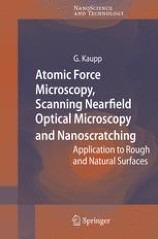
Atomic Force Microscopy, Scanning Nearfield Optical Microscopy and Nanoscratching : Application to Rough and Natural Surfaces
Making a clear distinction is made between nano- and micro-mechanical testing for physical reasons, this monograph describes the basics and applications of the supermicroscopies AFM and SNOM, and of the nanomechanical testing on rough and technical natural surfaces in the submicron range down to a lateral resolution of a few nm. New or improved instrumentation, new physical laws and unforeseen new applications in all branches of natural sciences (around physics, chemistry, mineralogy, materials science, biology and medicine) and nanotechnology are covered as well as the sources for pitfalls and errors.
