



الصفحة 5
الصفحة 5

Model Reduction and Coarse-Graining Approaches for Multiscale Phenomena
Model reduction and coarse-graining are important in many areas of science and engineering. How does a system with many degrees of freedom become one with fewer? How can a reversible micro-description be adapted to the dissipative macroscopic model? These crucial questions, as well as many other related problems, are discussed in this book. Specific areas of study include dynamical systems, non-equilibrium statistical mechanics, kinetic theory, hydrodynamics and mechanics of continuous media, (bio)chemical kinetics, nonlinear dynamics, nonlinear control, nonlinear estimation, and particulate systems from various branches of engineering. The generic nature and the power of the pertinent conceptual, analytical and computational frameworks helps eliminate some of the traditional language barriers, which often unnecessarily impede scientific progress and the interaction of researchers between disciplines such as physics, chemistry, biology, applied mathematics and engineering. All contributions are authored by experts, whose specialities span a wide range of fields within science and engineering.
mODa 8 - Advances in Model-Oriented Design and Analysis ; Proceedings of the 8th International Workshop in Model-Oriented Design and Analysis held in Almagro, Spain, June 4–8, 2007
The volume contains the proceedings of the 8th Workshop on Model-Oriented Design and Analysis. This book offers leading and pioneering work on optimal experimental designs, both from a mathematical/statistical point of view and with regard to real applications. Scientists from all over the world, from Eastern and Western Europe, the USA, Latin-America, Asia and Africa, have contributed to this volume. Primary topics are designs for nonlinear models and applications to experimental medicine.

Mixed Finite Elements, Compatibility Conditions, and Applications : Lectures given at the C.I.M.E. Summer School held in Cetraro, Italy June 26–July 1, 2006
Since the early 70's, mixed finite elements have been the object of a wide and deep study by the mathematical and engineering communities. The fundamental role of this method for many application fields has been worldwide recognized and its use has been introduced in several commercial codes. An important feature of mixed finite elements is the interplay between theory and application. Discretization spaces for mixed schemes require suitable compatibilities, so that simple minded approximations generally do not work and the design of appropriate stabilizations gives rise to challenging mathematical problems.

Metric Structures for Riemannian and Non-Riemannian Spaces
The first stages of the new developments were presented in Gromov's course in Paris, which turned into the famous "Green Book" by Lafontaine and Pansu (1979). The present English translation of that work has been enriched and expanded with new material to reflect recent progress. Additionally, four appendices—by Gromov on Levy's inequality, by Pansu on "quasiconvex" domains, by Katz on systoles of Riemannian manifolds, and by Semmes overviewing analysis on metric spaces with measures—as well as an extensive bibliography and index round out this unique and beautiful book.

Metric Spaces
This volume provides a complete introduction to metric space theory for undergraduates. It covers the topology of metric spaces, continuity, connectedness, compactness and product spaces, and includes results such as the Tietze-Urysohn extension theorem, Picard's theorem on ordinary differential equations, and the set of discontinuities of the pointwise limit of a sequence of continuous functions.

Methods of nonlinear analysis : Applications to differential equations
In this book, fundamental methods of nonlinear analysis are introduced, discussed and illustrated in straightforward examples. Every method considered is motivated and explained in its general form, but presented in an abstract framework as comprehensively as possible. Applications and generalizations are shown. In particular, a large number of methods is applied to boundary value problems for partial differential equations.
Methods of Celestial Mechanics: Vol. I: Physical, Mathematical, and Numerical Principles
G. Beutler's Methods of Celestial Mechanics is a coherent textbook for students in physics, mathematics and engineering as well as an excellent reference for practitioners. This Volume I gives a thorough treatment of celestial mechanics and presents all the necessary mathematical details that a professional would need. After a brief review of the history of celestial mechanics, the equations of motion (Newtonian and relativistic versions) are developed for planetary systems (N-body-problem), for artificial Earth satellites, and for extended bodies (which includes the problem of Earth and lunar rotation). Perturbation theory is outlined in an elementary way from generally known mathematical principles without making use of the advanced tools of analytical mechanics. The variational equations associated with orbital motion - of fundamental importance for parameter estimation (e.g., orbit determination), numerical error propagation, and stability considerations - are introduced and their properties discussed in considerable detail. Numerical methods, especially for orbit determination and orbit improvement, are discussed in considerable depth. The algorithms may be easily applied to objects of the planetary system and to Earth satellites and space debris.
Methods in Nonlinear Analysis
Nonlinear analysis has developed rapidly in the last three decades. Theories, techniques and results in many different branches of mathematics have been combined in solving nonlinear problems. This book collects and reorganizes up-to-date materials scattered throughout the literature from the methodology point of view, and presents them in a systematic way. It contains the basic theories and methods with many interesting problems in partial and ordinary differential equations, differential geometry and mathematical physics as applications.There are five chapters that cover linearization, fixed-point theorems based on compactness and convexity, topological degree theory, minimization and topological variational methods. Each chapter combines abstract, classical and applied analysis. Particular topics included are bifurcation, perturbation, gluing technique, transversality, Nash–Moser technique, Ky Fan's inequality and Nash equilibrium in game theory, setvalued mappings and differential equations with discontinuous nonlinear terms, multiple solutions in partial differential equations, direct method, quasiconvexity and relaxation, Young measure, compensation compactness method and Hardy space, concentration compactness and best constants, Ekeland variational principle, infinite-dimensional Morse theory, minimax method, index theory with group action, and Conley index theory.

Methods for Constructing Exact Solutions of Partial Differential Equations: Mathematical and Analytical Techniques with Applications to Engineering
The book is primarily designed to present both fundamental theoretical and algorithmic aspects of these methods. The description of algorithms contains illustrative examples which are typically taken from continuum mechanics. Some sections of the book introduce new applications and extensions of these methods.

Methods and Applications of Singular Perturbations : Boundary Layers and Multiple Timescale Dynamics
Perturbation theory, one of the most intriguing and essential topics in mathematics, and its applications to the natural and engineering sciences.In a systematic introductory manner, this unique book deliniates boundary layer theory for ordinary and partial differential equations, multi-timescale phenomena for nonlinear oscillations, diffusion and nonlinear wave equations. The book provides analysis of simple examples in the context of the general theory, as well as a final discussion of the more advanced problems.

Méthodes Numériques : Algorithmes, analyse et applications = Numerical Methods : Algorithms, Analysis and Applications
This book aims to present the theoretical and methodological foundations of numerical analysis. Particular attention is paid to the concepts of stability, precision and complexity of algorithms. Modern methods relating to the following topics are presented and analyzed in detail: solving linear and nonlinear systems, polynomial approximation, optimization, numerical integration, orthogonal polynomials, rapid transformations, ordinary differential equations. The techniques presented are illustrated by numerous tables and figures. Many examples and counter-examples are offered to allow the reader to develop his critical sense.

Méthodes mathématiques en chimie quantique : Une introduction = Mathematical methods in quantum chemistry : An introduction
This book presents the mathematical foundations of several models of quantum chemistry. It is intended for graduate students in mathematics (and possibly also for scientists from physics or chemistry interested in understanding the formal underpinnings of their models), and introduces techniques and methods from several mathematical fields, in particular variational techniques, nonlinear analysis, spectral theory and partial differential equations theory.
Meshfree Methods for Partial Differential Equations IV
The numerical treatment of partial differential equations with particle methods and meshfree discretization techniques is a very active research field both in the mathematics and engineering community. Due to their independence of a mesh, particle schemes and meshfree methods can deal with large geometric changes of the domain more easily than classical discretization techniques. Furthermore, meshfree methods offer a promising approach for the coupling of particle models to continuous models. This volume of LNCSE is a collection of the proceedings papers of the Fourth International Workshop on Meshfree Methods held in September 2007 in Bonn. The articles address the different meshfree methods (SPH, PUM, GFEM, EFGM, RKPM, etc.) and their application in applied mathematics, physics and engineering. The volume is intended to foster this very active and exciting area of interdisciplinary research and to present recent advances and results in this field.

Meshfree Methods for Partial Differential Equations III
Meshfree methods for the numerical solution of partial differential equations are becoming more and more mainstream in many areas of applications. Their flexiblity and wide applicability are attracting engineers, scientists, and mathematicians to this very dynamic research area. This volume represents the state of the art in meshfree methods. It consists of articles which address the different meshfree techniques, their mathematical properties and their application in applied mathematics, physics and engineering.

Meshfree Methods for Partial Differential Equations II
A Particle Strategy for Solving the Fokker-Planck Equation Modelling the Fiber Orientation Distribution in Steady Recirculating Flows Involving Short Fiber Suspensions.- Extended Meshfree Method for Elastic and Inelastic Media.- Meshfree Petrov-Galerkin Methods for the Incompressible Navier-Stokes Equations.- The ?-shape Based Natural Element Method in Solid and Fluid Mechanics.- A Particle-Partition of Unity Method Part VI: A p-robust Multilevel Solver.- Enriched Reproducing Kernel Approximation: Reproducing Functions with Discontinuous Derivatives.- Reproducing Kernel Element Interpolation: Globally Conforming I m/C n/P k Hierarchies.- Multi-scale Analysis Using Two Influence Radii in EFGM.- Solution of a Dynamic Main Crack Interaction with a System of Micro-Cracks by the Element Free Galerkin Method.- Finite Cover Method for Physically and Geometrically Nonlinear Problems.- A Numerical Scheme for Solving Incompressible and Low Mach Number Flows by the Finite Pointset Method.- SPH Renormalized Hybrid Methods for Conservation Laws: Applications to Free Surface Flows.- Discontinuous Radial Basis Function Approximations for Meshfree Methods.- Treating Moving Interfaces in Thermal Models with the C-NEM.- Bridging Scale Particle and Finite Element Methods.

Mechatronics : Dynamics of Electromechanical and Piezoelectric Systems
Deals with Lagrange equations for electromechanical systems, including piezoelectric transducers and selected applications. Intended for the research community and graduate students at the MSc and PhD level, this book is an extension to piezoelectric systems of the work, ""Dynamics of Mechanical and Electromechanical Systems"", published in 1968.

Mechanics of Structural Elements : Theory and Applications
The book systematically presents variational principles and methods of analysis for applied elasticity and structural mechanics. The variational approach is used consistently for both, constructing numerical procedures and deriving basic governing equations of applied mechanics of solids; it is the derivation of equations where this approach is most powerful and best grounded by mathematics. The book is oriented towards experts in civil engineering, researchers, developers of software for mechanical strength, stability, and oscillation analysis; it can be used by practical engineers who employ software tools to do their job and who want to know more about the theoretical background of the strength analysis. The book will be useful to senior and postgraduate students of engineering, to professors of structural analysis at civil or mechanical engineering departments of technical universities.

Mechanics of Elastic Structures with Inclined Members : Analysis of vibration, buckling and Bending of X-Braced Frames and Conical Shells
This monograph presents the mechanics of vibration, buckling and bending of elastic structures with inclined members such as x-braced high rise frames and conical shells. More than giving detailed derivations of basic equations.

Mechanics : From Newton's Laws to Deterministic Chaos
This updated and revised fourth edition covers all topics in mechanics from elementary Newtonian mechanics, canonical and rigid body mechanics to relativistic mechanics and nonlinear dynamics. In particular, symmetries and invariance principles, geometrical structures and continuum mechanics play an important role. This book will enable the reader to develop general principles from which equations of motions may be derived, to understand the importance of symmetries as a basis for quantum mechanics and to get practice in using theoretical tools and concepts that are essential for all branches of physics. The book contains numerous problems with complete solutions, and some practical examples.This will be appreciated in particular by students using the text to accompnay lectures on mechanics. The book ends with some historical remarks on important pioneers in mechanics.
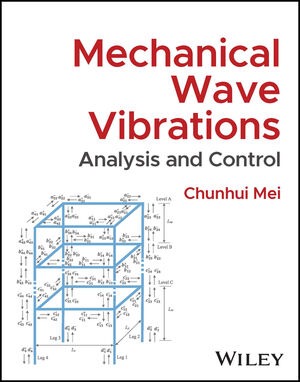
Mechanical Wave Vibrations: Analysis and Control
Delivers an expert discussion of the wave analysis approach (as opposed to the modal-based approach) to mechanical vibrations in structures. The book begins with deriving the equations of motion using the Newtonian approach based on various sign conventions before comprehensively covering the wave vibration analysis approach. It concludes by exploring passive and active feedback control of mechanical vibration waves in structures.
