



الصفحة 5
الصفحة 5

National Systems of Innovation in Comparison : Structure and Performance Indicators for Knowledge Societies
The book documents major elements of the joint work of eight leading German institutes, elaborated in the context of a regular annual report on Germany's technological performance. It provides much more than the pure compilation of quantitative indicators for international benchmarking, but gives support to an appropriate interpretation of the referring results and suggests relevant conclusions for innovation policy. A special focus is on Germany; so the book also aims at non-German readers interested in specific features of the German innovation system.

Nanotechnology in Catalysis 3
This book is the third volume of Nanotechnology in Catalysis. Although has been only 2 years since the Volumes 1 and 2 were published, many new contributions and breakthroughs have been made by researchers all over the world, showing the dynamic of nanotechnology in catalysis area. The topics in the book are the most up-to-date information on the forefront of nanotechnology development in catalysis field. They include the new concept and applications of nanotechnology for catalysis, the preparation and characterization of nanoparticle and nanostructure catalysts, and the examples of the superior activity and selectivity achieved by using such nanocatalysts. This book provides an in-depth understanding of how nanotechnology can affect the future generation of catalyst development.

Nanotechnology for Smart Concrete
Nanomaterials can markedly improve the mechanical properties of concrete, as well as reduce the porosity and enhance the durability of concrete. The application of nanotechnology in concrete is still in its infancy. However, an ever-growing demand for ultra-high-performance concrete and recurring environmental pollution caused by ordinary Portland cement has encouraged engineers to exploit nanotechnology in the construction industry. Nanotechnology for Smart Concrete discusses the advantages and applications of nanomaterials in the concrete industry, including high-strength performance, microstructural improvement, self-healing, energy storage, and coatings. The book: Analyses the linkage of concrete materials with nanomaterials and nanostructures / Discusses the applications of nanomaterials in the concrete industry, including energy storage in green buildings, anti-corrosive coatings, and inhibiting pathogens and viruses / Covers self-healing concrete / Explores safety considerations, sustainability, and environmental impact of nanoconcrete / Includes an appendix of solved questions

Nanotechnology and nanoelectronics : Materials, devices, measurement techniques
This book provides a concise and didactically structured presentation of nanotechnology as matters stand.nanotechnology. Based on known facts, an evaluation of nanotechnology, its further development, and its future prospects are attempted.

Nanotechnology : Science and Computation
This book offers a unique and authoritative perspective on current research in nanoscale science, engineering and computing. Leading researchers cover the topics of DNA self-assembly in two-dimensional arrays and three-dimensional structures, molecular motors, DNA word design, molecular electronics, gene assembly, surface layer protein assembly, and membrane computing.

Nanostructures : Fabrication and Analysis
The main theme of this book is the exploration the underlying physical laws that permit the fabrication of nanometer-scale structures. As researchers attempt to fabricate nanometer-scale structures which do not exist per se, they must still employ the natural laws to fabricate them through processes such as self-assembly. So it turns out that our techniques for fabrication of nanometer-scale structures are not artificial but actually rely on the natural laws. We even find that nanometer-scale structures, e.g. fullerenes, are fabricated in nature beneath the surface of the Earth. This fact may be called the ubiquity of the nanometer-scale structures. The topics presented in the book include: scanning probe-related and near-field techniques, nanolithography, self assembling and design of novel nanostructures, as well as new nanodevices and their application.

Nanostructured Soft Matter : Experiment, Theory, Simulation and Perspectives
This book provides an interdisciplinary overview of a new and broad class of materials under the unifying name Nanostructured Soft Matter. It covers materials ranging from short amphiphilic molecules to block copolymers, proteins, colloids and their composites, microemulsions and bio-inspired systems.

Nanostructured Materials by High-Pressure Severe Plastic Deformation
Recently, it was reported that nanostructured materials processed under high pressure by HPT and ECAP have an extraordinary combination of both high strength and high ductility, which are two desirable, but rarely co-existing properties. These findings indicate that high-pressure is a critical factor that can be employed to process nanostructured materials with superior mechanical, and possibly also physical, properties. It is the objective of this workshop to review our current knowledge, identify issues for future research, and discuss future directions on the processing and properties of nanostructured materials via SPD techniques, with a special emphasis on high-pressure effects.

Nanostructured Coatings
Controlling the performance of structures and components of all sizes and shapes through the use of engineered coatings has long been a key strategy in materials processing and technological design. The ever-increasing sophistication of en- neered coatings and the rapid trend toward producing increasingly smaller devices with greater demands on their fabrication, properties and performance have led to signicant progress in the science and technology of coatings, particularly in the last decade or two. Nanostructured coatings constitute a major area of sci- ti?c exploration and technological pursuit in this development.Nanostructured coatings demand study in a highly interdisciplinary research arena which encompasses: surface and interface science study of defects modern characterization methodologies cutting-edge experimental developments to deposit.

Nanostructured and advanced materials for applications in sensor, optoelectronic and photovoltaic technology ; Proceedings of the NATO Advanced Study Institute on nanostructured and advanced materials for applications in sensors, optoelectronic and photovoltaic technology ; Sozopol, Bulgaria, 6-17 September 2004
Nanotechnology is an emerging scientific field receiving significant worldwide attention. On a nanometer scale, materials or structures may possess new and unique physical properties. Some of these are now known to the scientific community, but there may well be many properties not yet known to us, rendering it as a fascinating area of research and a suitable subject for a NATO ASI. Yet another aspect of the field is the possibility for creating meta-stable phases with unconventional properties and the ultra-miniaturization of current devices, sensors, and machines. Such nanotechnological and related advanced materials have an extremely wide range of potential applications, viz. nanoscale electronics, sensors, optoelectronics, photonics, nano-biological systems, na- medicine, energy storage systems, etc. This is a wide-ranging subject area and therefore requires the formation of multi-disciplinary teams of physicists, chemists, materials scientists, engineers, molecular biologists, pharmacologists, and others to work together on the synthesis and processing of materials and structures, the understanding of their physical properties, the design and fabrication of devices.

Nanoscaled Semiconductor-on-Insulator Structures and Devices
This proceedings volume constitutes an archive of the contributions of the key-speakers who attended the NATO Advanced Research Workshop on “Nanoscaled Semiconductor-On-Insulator Structures and devices” held in the Tourist and Recreation Centre “Sudak” (Crimea, Ukraine) from 15 to 19 October 2006. The semiconductor industry has sustained a very rapid growth during the last three decades through impressive technological developments which have resulted in products with higher performance and lower cost per function. After many years of development it is now confidently predicted that semiconductor-on-insulator materials will enter and increasingly be used by manufacturing industry. The wider use of semiconductor (es- cially silicon) on insulator materials will not only enable the benefits of these materials to be demonstrated but, also, will drive down the cost of substrates which, in turn, will stimulate the development of other novel devices and applications.

Nanoscale Phenomena : Basic Science to Device Applications
Nanotechnology is the result of the continuing technological trend toward device miniaturization and the characterization, manipulation, and fine control of structure and function at diminishing length scales. A large class of nanoscale materials can be stable even though they are far from the lowest-energy thermodynamic state, and many possess novel properties unattainable in bulk. These trends are supported by the increasing sophistication of characterization and fabrication tools such as the scanning tunneling microscope and the transmission electron microscope, which allow the resolution and manipulation of single atoms and molecules.

Nanoscale Devices - Fundamentals and Applications
This book contains a collection of papers giving insight into the fundamentals and applications of nanoscale devices. The main focus is on the synthesis and characterization of nanoscale magnetic materials, the fundamental physics and materials aspects of solid-state nanostructures, the development of novel device concepts and design principles for nanoscale devices, as well as on applications in electronics with special emphasis on defence against the threat of terrorism.

Nanoscale Assembly : Chemical Techniques
Recent advances have pushed the limits of lithography firmly into the sub-100 nm domain, with smallest feature sizes around 10 nm. However, compared to living organisms, devices fabricated using nanolithography are not nearly as complex, as they are essentially 2D and contain only a limited number of chemical elements. For centuries, Nature has been a major inspiration for science. First of all to learn how Life functions at cellular level, but increasingly, as a blueprint for designing non-natural devices where the building blocks and their assembly are inspired by biological examples. The key tool in translating these examples into the domain of engineering, has been self-assembly or self-organization. This book gathers a spectrum researchers who have not only furthered our knowledge of self-assembly using small molecules, polymers and colloidal particles as building blocks, but who have also shown it to be a practical tool in the assembly of an astonishing variety of devices, ranging from molecular electronics to biosensors.
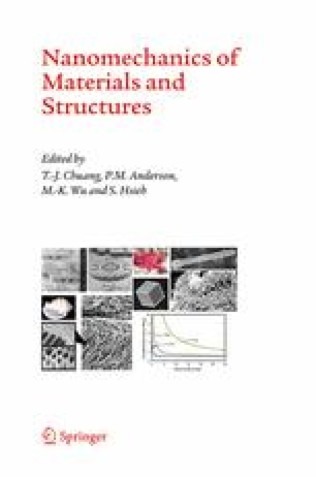
Nanomechanics of Materials and Structures
This book is derived from the proceedings of the International Workshop on Nanomechanics held at Asilomar Conference Grounds in Pacific Grove, California on July 14-17, 2004. The main objective was to convene leading researchers in the nanotechnology community to assess the current state-of-the-art and disseminate recent progress, critical issues, barriers to applications, and directions for future research in nanomechanics.

Nanomaterials in clinical therapeutics : Synthesis and applications
Nanotechnology-based applications is a rapidly growing field encompassing a diverse range of disciplines that impact our daily lives. Nanotechnology is being used to carry out large-scale reactions in practically every field of biotechnology and healthcare. The incredible progress being made in these applications is particularly true for the healthcare sector, where they are used in cancer detection and treatment, medical implants, tissue engineering, and so forth. Expansions in this discipline are expected to continue in the future, resulting in the creation of a variety of life-saving medical technology and treatment procedures.

Nanomaterials and nanotechnology in medicine
The use of nanotechnology and nanomaterials more generally is an emerging field that has generated a lot of interest in the last few years. To this point, there have been few books that deal with the recent advances in nanomaterials or nanocomposites in the medical discipline. Intended as a one-stop reference, Nanomaterials and Nanotechnology in Medicine provides the reader with the most-up-to-date and comprehensive exploration of the field of nanomedicine. The scope of the topic is huge, with nano applications in every medical specialization—from diagnostics to pharmaceuticals, from biological therapies to surgical devices, and from regenerative therapies to gene therapy. As such, this volume provides the most comprehensive coverage of this intriguing field of study.

Nanoinformatics
Brings out the state of the art on how informatics-based tools are used and expected to be used in nanomaterials research. There has been great progress in the area in which “big-data” generated by experiments or computations are fully utilized to accelerate discovery of new materials, key factors, and design rules. Data-intensive approaches play indispensable roles in advanced materials characterization. "Materials informatics" is the central paradigm in the new trend. "Nanoinformatics" is its essential subset, which focuses on nanostructures of materials such as surfaces, interfaces, dopants, and point defects, playing a critical role in determining materials properties. There have been significant advances in experimental and computational techniques to characterize individual atoms in nanostructures and to gain quantitative information. The collaboration of researchers in materials science and information science is growing actively and is creating a new trend in materials science and engineering.
Nanofillers : Fabrication, characterization and applications of organic nanofillers
Explores the modifying effects of various nanofillers on mechanical and physical properties of polymer nanocomposites. Looking at the four basic aspects of processing, characterization, properties, and applications, it analyzes how their features can allow for innovative multifunction within industry. Covering design, production, and manufacture, this book focuses on meeting end-use requirements and the fabrication of materials. The importance of mindful design and the use of an appropriate synthesis method is the primary lens through which theory and practice are discussed. This volume looks at the various synthesis methods available for organic nanofillers and what characterizes them. Properties including mechanical, thermal, electrical, and tribological are thoroughly examined, along with the various computational techniques used to determine them. With important sustainable properties, nanofillers are essential to meeting the increasing demand for biodegradable and environmentally friendly materials. This book details the role nanofillers have to play in sustainability, alongside economic factors such as efficient manufacturing processes.

NanoBiotechnology : BioInspired Devices and Materials of the Future
NanoBioTechnology: BioInspired Devices and Materials of the Future is a groundbreaking text that will assist scientists and students in learning the fundamentals and cutting-edge nature of this new and emerging science. Focusing on materials and building blocks for nanotechnology, leading scientists from around the world share their knowledge and expertise in this authoritative volume. The volume is broken into five sections. The first section presents an overview of nanotechnology and describes the many aspects of the field. Section 2 details biological materials serving as nanotemplates for bottom-up fabrication. Section 3 covers the use of biological macromolecules for electron transfer and computation. Section 4 presents a brief overview of the extensive and rapidly growing field of nanomedicine. Finally, Section 5 details de-novo designed structures and the various approaches different scientific groups take with molecular level training and language
