



الصفحة 5
الصفحة 5

General Equilibrium and Welfare Economics : An Introduction
A good basic understanding of general equilibrium theory is a fundamental and indispensable background for advanced work in virtually any sub-field of economics; and a thorough understanding of the methods of welfare economics, particularly in a general equilibrium context, is indispensable for investigators undertaking applied policy analysis. This book addresses these needs and requirements by emphasizing the basic underpinnings of general equilibrium and welfare economics. In particular, the theory of choice, which is fundamental to both areas, is developed in a very comprehensive and rigorous fashion. Moreover, extensive use is made of examples, both of the simple type intended to bolster the student’s understanding of the basic concepts, and those illustrating the application of the material to field areas in economics.

Fuzzy Quantifiers : A Computational Theory
Almost all", "many", "some": fuzzy quantifiers are vital for effective communication in natural language (NL). This monograph pursues an axiomatic method to achieve a reliable interpretation of these quantifiers in technical applications of fuzzy quantification. Unlike existing work in this area, it targets a much broader class of quantificational phenomena which includes all cases usually considered in linguistics. The topics addressed in the monograph run the gamut from the introduction of the theoretical framework for analysing fuzzy quantification, the formalization of semantical requirements on models of fuzzy quantification, the construction and detailed study of prototypical models which conform to the linguistic desiderata, the development of algorithms for implementing the main types of quantifiers in these models, and finally a preview to fuzzy branching quantifications which might be necessary for modelling NL sentences involving more than one quantifier.

Fuzzy database modeling with XML
Fuzzy Database Modeling with XML aims to provide a single record of current research and practical applications in the fuzzy databases. This volume is the outgrowth of research the author has conducted in recent years. Fuzzy Database Modeling with XML introduces state of the art information to the database research, while at the same time serving the information technology professional faced with a non-traditional application that defeats conventional approaches. The research on fuzzy conceptual models and fuzzy object-oriented databases is receiving increasing attention, in addition to fuzzy relational database models. With rapid advances in network and internet techniques as well, the databases have been applied under the environment of distributed information systems. It is essential in this case to integrate multiple fuzzy database systems. Since databases are commonly employed to store and manipulate XML data, additional requirements are necessary to model fuzzy information with XML. Second, this book maps fuzzy XML model to the fuzzy databases. Very few efforts at investigating these issues have thus far occurred.

Furnishing - Zoning
Deals with the relationships between building typology and building structure, and between spatial composition and interior design. The relationship between the briefing and the catalogue of requirements, and between shell construction and fit-out, is elucidated. Connections at walls, ceilings and floors are explained in detail and illustrated with case studies of selected projects. In addition, the authors demonstrate how a well-designed sequence of spaces can create added value by means, for example, of the choice of materials and the lighting scheme, or adaptability to accommodate new functions.

Funds, Flows and Time : An Alternative Approach to the Microeconomic Analysis of Productive Activities
The subject of this book is production, which is an important and extensive field in economic science. In fact, production, distribution and consump tion were long considered the three federated kingdoms which together formed the great empire of the economy. According to other slightly dif ferent traditions, production also held pride of place, specifically as a basic link in the long chain of social reproduction. Today, whatever the theoreti cal approach, production is a fundamental requirement for human survival. This was not, however, always the case. For much of the history of man kind hominids were hunter, scavenger and gatherers, with very little con trol over their environment, and extremely little in the way of artefacts with which to work. However, since the Neolithic revolution, productive processes have constituted an essential mechanism, providing human soci ety with goods and services to satisfy its needs and cravings.

Fundamental approaches to software engineering ; Vol. 3922 ; 9th International Conference, FASE 2006, Held as Part of the Joint European Conferences on Theory and Practice of Software, ETAPS 2006, Vienna, Austria, March 27-28, 2006, Proceedings
ETAPS 2006 was the ninth instance of the European Joint Conferences on Theory and Practice of Software. ETAPS is an annual federated conference that was established in 1998 by combining a number of existing and new conferences. The events that comprise ETAPS address various aspects of the system devel- ment process, including speci?cation, design, implementation, analysis and impro- ment. The languages, methodologies and tools which support these activities are all well within its scope. Di?erent blends of theory and practice are represented, with an inclination towards theory with a practical motivation on the one hand and soundly based practice on the other. Many of the issues involved in software design apply to systems in general, including hardware systems, and the emphasis on software is not intended to be exclusive.
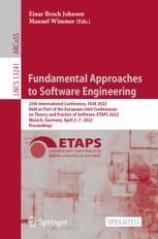
Fundamental approaches to software engineering ; 25th International Conference, FASE 2022, Held as Part of the European Joint Conferences on Theory and Practice of Software, ETAPS 2022, Munich, Germany, April 2–7, 2022, Proceedings
The papers deal with the foundations on which software engineering is built, including topics like software engineering as an engineering discipline, requirements engineering, software architectures, software quality, model-driven development, software processes, software evolution, AI-based software engineering, and the specification, design, and implementation of particular classes of systems, such as (self-)adaptive, collaborative, AI, embedded, distributed, mobile, pervasive, cyber-physical, or service-oriented applications.

Fundamental approaches to software engineering ; 23rd International Conference, FASE 2020, Held as Part of the European Joint Conferences on Theory and Practice of Software, ETAPS 2020, Dublin, Ireland, April 25–30, 2020, Proceedings
This book constitutes the proceedings of the 23rd International Conference on Fundamental Approaches to Software Engineering, FASE 2020, which took place in Dublin, Ireland, in April 2020, and was held as Part of the European Joint Conferences on Theory and Practice of Software, ETAPS 2020. The 23 full papers, 1 tool paper and 6 testing competition papers presented in this volume were carefully reviewed and selected from 81 submissions.

Fundamental approaches to software engineering ; 22nd International Conference, FASE 2019, Held as Part of the European Joint Conferences on Theory and Practice of Software, ETAPS 2019, Prague, Czech Republic, April 6–11, 2019, Proceedings
This book cover software verification; model-driven development and model transformation; software evolution and requirements engineering; specification, design, and implementation of particular classes of systems; and software testing.

Fundamental approaches to software engineering ; 11th International Conference, FASE 2008, Held as Part of the Joint European conferences on theory and practice of software, ETAPS 2008, Budapest, Hungary, March 29-April 6, 2008. Proceedings
The fve main conferences received 571 submissions, 147 of which were accepted, giving an overall acceptance rate of less than 26%, with each conference below 27%.Congratulationsthereforetoallthe authorswhomadeittothe alprogramme! I hope that most of the other authors will still have found a way of participating in this exciting event, and that you will all continue submitting to ETAPS and contributing to make of it the best conference in the area،The events that comprise ETAPS address various aspects of the system velopment process,including specifcation, design, implementation, analysis and improvement.

Full-Chip Nanometer Routing Techniques
From a manufacturability standpoint, nanometer routers must explicitly deal with the ever increasing design complexity, and be capable of adapting to the constraint requirements of timing, signal integrity, process antenna effect, and new interconnect architecture such as X-architecture. In the nanometer era, we must look into new-generation routing technologies that combine high performance and capacity with the integration of congestion, timing, SI prevention, and DFM algorithms as the best means of getting to design closure quickly. In this book, we present a novel multilevel full-chip router, namely mSIGMA for SIGnal-integrity and MAnufacturability optimization. And these routing technologies will ensure faster time-to-market and time-to-profitability

Fuel Cell Electronics Packaging
Today's commercial, medical and military electronics are becoming smaller and smaller. At the same time, these devices are packed with more functions and demand more power. This power requirement is currently met almost exclusively by battery power. A fuel cell is like a battery converting chemical energy directly to electricity. The convergence of fuel cell technology and microelectronics is enabling the new design and manufacturing of fuel cells.Fuel Cell Electronics Packaging presents the latest developments in the technology convergence of microelectronics and fuel cells. Using the well established manufacturing methods used in microelectronics packaging, fuel cells can be further fabricated in smaller sizes with higher energy density, at a faster pace and lower cost.

Freelancing platform = منصة للأعمال الحرة
The digital era has seen a significant rise in freelancing, providing a flexible and accessible employment model for professionals worldwide. This project introduces an advanced freelancing platform designed to enhance the interaction between freelancers and clients. By employing a microservices architecture, the platform ensures a seamless, efficient, and secure environment for managing project collaborations, communications, and payment processes. The platform supports three primary user roles: Administrators, Freelancers, and Users. Administrators oversee comprehensive system management, including user accounts, service categories, platform settings, and financial transactions. Freelancers can create detailed profiles showcasing their skills, experiences, and portfolios, and publish services with clear descriptions, pricing, and Service Level Agreements (SLAs). Users can post service requests, outlining project requirements and budgets, enabling freelancers to apply and engage in these projects.

Foundations of security analysis and design III : FOSAD 2004/2005 tutorial lectures
The increasing relevance of security to real-life applications, such as electronic commerce and Internet banking, is attested by the fast-growing number of - search groups, events, conferences, and summer schools that address the study of foundations for the analysis and the design of security aspects. The “Int- national School on Foundations of Security Analysis and Design” (FOSAD, see http://www.sti.uniurb.it/events/fosad/)has been one of the foremost events - tablishedwiththegoalofdisseminatingknowledgeinthiscriticalarea,especially for young researchers approaching the ?eld and graduate students coming from less-favoured and non-leading countries. The FOSAD school is held annually at the Residential Centre of Bertinoro (http://www.ceub.it/), in the fascinating setting of a former convent and ep- copal fortress that has been transformed into a modern conference facility with computing services and Internet access. Since the ?rst school, in 2000, FOSAD hasattractedmorethan250participantsand50lecturersfromallovertheworld.

Foundation PHP for Dreamweaver 8
In this book, we look specifically at using Dreamweaver's built-in server behaviors to build dynamic web sites using PHP and MySQL, the world's most popular open source server-side language and database server combination, which are both reliable, powerful, and open source (and therefore free to use). This version of Dreamweaver includes more powerful support for PHP and MySQL than ever before, and we'll show you how to make this work for you. No previous experience of PHP or MySQL is necessary to use this book. Examples built throughout the book include a content management system, and an online image gallery. All examples are designed to meet modern usability requirements and be web standards-compliant.

Foundation ASP for Dreamweaver 8
Dreamweaver 8 takes a lot of the hard work out of performing tasks such as integrating a database into your website, but it can't do everything. That's why this book not only shows you how to use all of Dreamweaver's functions, but also shows you how the underlying code functions, so you can then work around Dreamweaver's shortcomings. There's no attempt to turn you into a code guru, but you'll come away with sufficient knowledge of basic ASP to have the confidence to dive into the Dreamweaver code and tweak it to your own requirements. The emphasis is exclusively on ASP, so you don't waste any time on information that's not relevant to what you want to do.

Formal Methods and Software Engineering ; Vol. 3785 ; 7th International Conference on Formal Engineering Methods, ICFEM 2005, Manchester, UK, November 1-4, 2005, Proceedings
This volume contains papers presented at the 7th International Conference on Formal Engineering Methods (ICFEM 2005), 1-4 November 2005, Manchester, UK. Formal engineering methods are changing the way that systems are dev- oped. With language and tool support, these methods are being used for se- automatic code generation, and for the automatic abstraction and checking of implementations. In the future, they will be used at every stage of development: requirements, speci?cation, design, implementation, testing, anddocumentation. The aim of ICFEM 2005 was to bring together those interested in the - plication of formal engineering methods to computer systems. Researchers and practitioners, from industry, academia, and government, were encouraged to - tend, and to help advance the state of the art. The conference was supported by sponsorships from Microsoft Research, USA, the Software Engineers Association of Japan, the University of Man- ester, Manchester City Council, FormalMethods Europe (FME) and the British Computer Society FormalAspects ofComputing Specialist Group(BCS-FACS). We wish to thank these sponsors for their generosity. The ?nal programme consisted of 3 invited talks and 30 technical papers selected from a total of 74 submissions. The invited speakers were: Anthony Hall, independent consultant, UK; Egon B] orger, University of Pisa, Italy; John Rushby, SRI, USA. Their talks were sponsored by BCS-FACS, Microsoft - search and FME respectively. We wish to thank the invited speakers for their inspiring talks.

Fine needle aspiration cytology : Diagnostic principles and dilemmas
Histopathologists all over the world have to report cytopathology during the course of their work and it is then that they find themselves facing diagnostic dilemmas. This practical, well-illustrated book, explicitly dedicated to this readership will serve their needs and meets their requirements in daily practice.

Field-Based Coordination for Pervasive Multiagent Systems
Software systems involve autonomous and distributed software components that have to execute and interact in open and dynamic environments, such as in pervasive, autonomous, and mobile applications. The requirements with respect to dynamics, openness, scalability, and decentralization call for new approaches to software design and development, capable of supporting spontaneous configuration, tolerating partial failures, or arranging adaptive reorganization of the whole system.

Field Measurements for Forest Carbon Monitoring : A Landscape-Scale Approach
This volume is a comprehensive guide to the methods and techniques employed in forest carbon inventory and monitoring. Since forest carbon research is interdisciplinary, it is unlikely that any one investigator will possess expertise in all of the types of measurements needed to conduct forest carbon research at scales larger than a forest stand. Techniques used to characterize standing stocks of carbon in a forest, measure key carbon fluxes, and collect related data (such as forest canopy nitrogen concentrations and meteorological measurements) that are required to drive process models, develop predictive relationships, and link to remote sensing data are described in detail. In addition to the measurement methods, the chapters include background information, necessary calculations, and equipment requirements.
