



الصفحة 5
الصفحة 5

Image Processing Using Pulse-Coupled Neural Networks
This is the first book to explain and demonstrate the tremendous ability of Pulse-Coupled Neural Networks (PCNNs) when applied to the field of image processing. PCNNs and their derivatives are biologically inspired models that are powerful tools for extracting texture, segments, and edges from images.

Image and video processing and recognition based on artificial intelligence (Vol. II)
Focuses on challenging issues in the field of AI-based image and video processing and recognition, including the topics of AI-based image processing, understanding, recognition, compression, and reconstruction; AI-based video processing, understanding, recognition, compression, and reconstruction; computer vision based on AI; AI-based biometrics; AI-based object detection and tracking; approaches that combine AI techniques and conventional methods for image and video processing and recognition; explainable AI (XAI) for image and video processing and recognition; generative adversarial network (GAN)-based image and video processing and recognition; and approaches that combine AI techniques and blockchain methods for image and video processing and recognition.

Image and Signal Processing ; 3rd International Conference, ICISP 2008. Cherbourg-Octeville, France, July 1 - 3, 2008. Proceedings
This book constitutes the refereed proceedings of the Third International Conference on Image and Signal Processing, ICISP 2008, held in Cherbourg-Octeville, France, in July 2008.The 48 revised full papers and 22 revised poster papers presented were carefully reviewed and selected from 193 submissions. The papers are organized in topical sections on image filtering, image segmentation, computer vision, feature extraction, pattern recognition, graph-based representations, motion detection and estimation, new interfaces, document processing, and signal processing.

Image Analysis and Recognition ; Vol. 4142 ; 3rd International Conference, ICIAR 2006, Póvoa de Varzim, Portugal, September 18-20, 2006, Proceedings, Part II
ICIAR 2006, the International Conference on Image Analysis and Recognition, was the third ICIAR conference, and was held in P´ ovoa de Varzim, Portugal. ICIARisorganizedannually,andalternatesbetweenEuropeandNorthAmerica. ICIAR 2004 was held in Porto, Portugal and ICIAR 2005 in Toronto, Canada. The idea of o?ering these conferences came as a result of discussion between researchers in Portugal and Canada to encourage collaboration and exchange, mainlybetweenthesetwocountries,butalsowiththeopenparticipationofother countries, addressing recent advances in theory, methodology and applications. The response to the call for papers for ICIAR 2006 was higher than the two previous editions. From 389 full papers submitted, 163 were ?nally accepted (71 oral presentations, and 92 posters). The review process was carried out by the Program Committee members and other reviewers; all are experts in various image analysis and recognition areas. Each paper was reviewed by at least two reviewers, and also checked by the conference Co-chairs. The high quality of the papers in these proceedings is attributed ?rst to the authors, and second to the quality of the reviews provided by the experts.

Image Analysis and Recognition ; Vol. 4141 ; 3rd International Conference, ICIAR 2006, Póvoa de Varzim, Portugal, September 18-20, 2006, Proceedings, Part I
ICIAR 2006, the International Conference on Image Analysis and Recognition, was the third ICIAR conference, and was held in P´ ovoa de Varzim, Portugal. ICIARisorganizedannually,andalternatesbetweenEuropeandNorthAmerica. ICIAR 2004 was held in Porto, Portugal and ICIAR 2005 in Toronto, Canada. The idea of o?ering these conferences came as a result of discussion between researchers in Portugal and Canada to encourage collaboration and exchange, mainlybetweenthesetwocountries,butalsowiththeopenparticipationofother countries, addressing recent advances in theory, methodology and applications. The response to the call for papers for ICIAR 2006 was higher than the two previous editions. From 389 full papers submitted, 163 were ?nally accepted (71 oral presentations, and 92 posters). The review process was carried out by the Program Committee members and other reviewers; all are experts in various image analysis and recognition areas. Each paper was reviewed by at least two reviewers, and also checked by the conference Co-chairs. .

Image Analysis and Recognition ; Vol. 3656 ; 2ond International Conference, ICIAR 2005, Toronto, Canada, September 28-30, 2005, Proceedings
ICIAR 2005, the International Conference on Image Analysis and Recognition, was the second ICIAR conference, and was held in Toronto, Canada. ICIAR is organized annually, and alternates between Europe and North America. ICIAR 2004 was held in Porto, Portugal. The idea of o?ering these conferences came as a result of discussion between researchers in Portugal and Canada to encourage collaboration and exchange, mainly between these two countries, but also with the open participation of other countries, addressing recent advances in theory, methodology and applications. TheresponsetothecallforpapersforICIAR2005wasencouraging.From295 full papers submitted, 153 were ?nally accepted (80 oral presentations, and 73 posters). The review process was carried out by the Program Committee m- bers and other reviewers ; all are experts in various image analysis and recognition areas. Each paper was reviewed by at least two reviewers, and also checked by the conference co-chairs. The high quality of the papers in these proceedings is attributed ?rst to the authors,and second to the quality of the reviews provided by the experts. We would like to thank the authors for responding to our call, andwewholeheartedlythankthe reviewersfor theirexcellentwork,andfortheir timely response. It is this collective e?ort that resulted in the strong conference program and high-quality proceedings in your hands.

Image Analysis and Recognition ; 5th International Conference, ICIAR 2008, Póvoa de Varzim, Portugal, June 25-27, 2008. Proceedings
The 110 revised full papers presented together with 2 invited papers were carefully reviewed and selected from 226 submissions. The papers are organized in topical sections on image restoration and enhancement, image and video segmentation, non-linear image processing, image and video coding and encryption, indexing and retrieval, computer vision, feature extraction and classification, shape representation and matching, object recognition, character recognition, texture and motion analysis, tracking, biomedical image analysis, biometrics, face recognition, and a special session on recent advances in multimodal biometric systems and applications.

Image Analysis and Recognition ; 4th International Conference, ICIAR 2007, Montreal, Canada, August 22-24, 2007, Proceedings
These papers cover image restoration and enhancement, image and video processing and analysis, image segmentation, computer vision, pattern recognition for image analysis, shape and matching, motion analysis, tracking, and more.

Image Analysis and Recognition ; 17th International Conference, ICIAR 2020, Póvoa de Varzim, Portugal, June 24–26, 2020, Proceedings, Part II
This two-volume set LNCS 12131 and LNCS 12132 constitutes the refereed proceedings of the 17th International Conference on Image Analysis and Recognition, ICIAR 2020, held in Póvoa de Varzim, Portugal, in June 2020. The 54 full papers presented together with 15 short papers were carefully reviewed and selected from 123 submissions. The papers are organized in the following topical sections: image processing and analysis; video analysis; computer vision; 3D computer vision; machine learning; medical image and analysis; analysis of histopathology images; diagnosis and screening of ophthalmic diseases; and grand challenge on automatic lung cancer patient management.

Image Analysis and Recognition ; 17th International Conference, ICIAR 2020, Póvoa de Varzim, Portugal, June 24–26, 2020, Proceedings, Part I
This two-volume set LNCS 12131 and LNCS 12132 constitutes the refereed proceedings of the 17th International Conference on Image Analysis and Recognition, ICIAR 2020, held in Póvoa de Varzim, Portugal, in June 2020. The 54 full papers presented together with 15 short papers were carefully reviewed and selected from 123 submissions. The papers are organized in the following topical sections: image processing and analysis; video analysis; computer vision; 3D computer vision; machine learning; medical image and analysis; analysis of histopathology images; diagnosis and screening of ophthalmic diseases; and grand challenge on automatic lung cancer patient management.

Image Analysis and Processing – ICIAP 2005 ; 13th International Conference, Cagliari, Italy, September 6-8, 2005, Proceedings
This volume contains the Proceedings of the 13th International Conference on Image Analysis and Processing (ICIAP 2005), held in Cagliari, Italy, at the conference centre “Centro della Cultura e dei Congressi”, on September 6–8, 2005. ICIAP 2005 was the thirteenth edition of a series of conferences organized every two years by the Italian group of researchersa?liated to the International Association for Pattern Recognition (GIRPR) with the aim to bring together researchers in image processing and pattern recognition from around the world. As for the previous editions, conference topics concerned the theory of image analysis and processing and its classical and Internet-driven applications. The central theme of ICIAP 2005 was “Pattern Recognition in the Internet and Mobile Communications Era”. The interest for such a theme was con?rmed by the large number of papers dealing with it, the special session devoted to pattern recognition for computer network security, and the emphasis of two invited talks on Internet and mobile communication issues. ICIAP 2005 received 217 paper submissions. Fifteen papers were collected into the two special sessions dealing with Pattern Recognition for Computer Network Security and Computer Vision for Augmented Reality and Augmented Environments.

Image Analysis ; 15th Scandinavian Conference, SCIA 2007, Aalborg, Denmark, June 10-24, 2007, Proceedings
The present volume contains the proceedings of the Scandinavian Conference on Image Analysis, SCIA 2007, held at Hotel Hvide Hus, Aalborg, Denmark, June 10–14, 2007. Initiated in 1979 by Torleiv Orhaug in Sweden, SCIA 2007 represented the 15th in the biennial series of conferences.

Image Analysis ; 14th Scandinavian Conference, SCIA 2005, Joensuu, Finland, June 19-22, 2005, Proceedings
This proceedings volume collects the scienti?c presentations of the Scandinavian Conference on Image Analysis, SCIA 2005, which was held at the University of Joensuu, Finland, June 19–22, 2005. The conference was the fourteenth in the series of biennial conferences started in 1980. The name of the series re?ects the fact that the conferences are organized in the Nordic (Scandinavian) countries, following the cycle Sweden, Finland, Denmark, and Norway. The event itself has always been international in its participants and presentations. Today there are many conferences in the ?elds related to SCIA. In this s- uation our goal is to keep up the reputation for the high quality and friendly environment of SCIA. We hope that participants feel that it’s worth attending the conference. Therefore, both the scienti?c and social program were designed to support the best features of a scienti?c meeting: to get new ideas for research and to have the possibility to exchange thoughts with fellow scientists.

Identifying, Assessing, and Treating Autism at School
As the rate of autism diagnosis continues to escalate, awareness and recognition of this developmental brain disorder - as well as a demand for services - are also mushrooming. School districts, already struggling under the weight of withering budgets and increasing enrollments, are now scrambling to strike a balance between the types of services and treatments parents want for their children and what the school system can afford to provide. Consequently, a broad cross-section of professionals and parents are searching for the means and methods by which to identify and address the wide-ranging.

Hybrid Intelligent Systems for Pattern Recognition Using Soft Computing : An Evolutionary Approach for Neural Networks and Fuzzy Systems
This monograph describes new methods for intelligent pattern recognition using soft computing techniques including neural networks, fuzzy logic, and genetic algorithms. Hybrid intelligent systems that combine several soft computing techniques are needed due to the complexity of pattern recognition problems.

Human–computer interaction ; International Workshop, HCI 2007 Rio de Janeiro, Brazil, October 20, 2007 Proceedings
Constitutes the refereed proceedings of the International Workshop on Human Computer Interaction, HCI 2007, held in Rio de Janeiro, Brazil, October 20, 2007. This book covers such topics as: Affective detection and recognition, Smart interfaces, Human motion tracking, Gesture recognition, and Multimedia data modeling and visualization.

Human-computer interaction - HCI Intelligent Multimodal interaction environments ; 12th International Conference, HCI International 2007, Beijing, China, July 22-27, 2007, Proceedings, Part III
The 12th International Conference on Human-Computer Interaction, HCI Inter- tional 2007, was held in Beijing, P.R. This volume, edited by Julie A. Jacko, contains papers in the thematic area of Human-Computer Interaction, addressing the following major topics: • Multimodality and Conversational Dialogue • Adaptive, Intelligent and Emotional User Interfaces • Gesture and Eye Gaze Recognition • Interactive TV and Media.

Human-centered software engineering - Integrating usability in the software development lifecycle
Human-CenteredSoftwareEngineering: BridgingHCI,UsabilityandSoftwareEngineering From its beginning in the 1980’s, the ?eld of human-computer interaction (HCI) has beende?nedasamultidisciplinaryarena. BythisImeanthattherehas beenanexplicit recognition that distinct skills and perspectives are required to make the whole effort of designing usable computer systems work well. Thus people with backgrounds in Computer Science (CS) and Software Engineering (SE) joined with people with ba- grounds in various behavioral science disciplines (e. g. , cognitive and social psych- ogy, anthropology) in an effort where all perspectives were seen as essential to creating usable systems. But while the ?eld of HCI brings individuals with many background disciplines together to discuss a common goal - the development of useful, usable, satisfying systems - the form of the collaboration remains unclear.

Human motion : Understanding, modeling, capture and animation ; 2nd Workshop, HumanMotion 2007, Rio de Janeiro, Brazil, October 20, 2007, Proceedings
This LNCS volume contains the papers presented at the second Workshop on Human Motion Understanding, Modeling, Capture and Animation. The accepted papers re?ect the state of the art in the ?eld and cover various topicsrelatedto humanmotiontrackingandanalysis.Thepapersinthisvolume have been classi?ed into three categories based on the topics they cover: human motion capture and pose estimation, body and limb tracking and segmentation, and activity recognition.
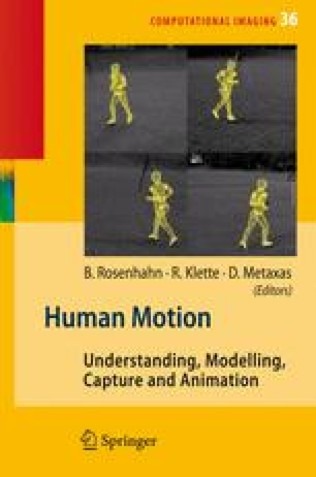
Human motion : Understanding, modeling, capture and animation
Edward Muybridge (1830–1904) is known as the pioneer in motion capt- ing with his famous experiments in 1887 called “Animal Locomotion”. Since then, the feld of animal or human motion analysis has grown in many dir- tions. However, research and results that involve human-like animation and the recovery of motion is still far from being satisfactory. Progress in human motion analysis depends on empirically anchored and grounded research in computer vision, computer graphics, and biomechanics. This book is based on a June 2006 workshop held in Dagstuhl, Germany. This workshop brought together for the frst time researchers from the afo- mentioned disciplines.
