



الصفحة 5
الصفحة 5

Computational Granular Dynamics : Models and Algorithms
Computer simulations not only belong to the most important methods for the theoretical investigation of granular materials, but also provide the tools that have enabled much of the expanding research by physicists and engineers. The present book is intended to serve as an introduction to the application of numerical methods to systems of granular particles. Accordingly, emphasis is placed on a general understanding of the subject rather than on the presentation of the latest advances in numerical algorithms. Although a basic knowledge of C++ is needed for the understanding of the numerical methods and algorithms in the book, it avoids usage of elegant but complicated algorithms to remain accessible for those who prefer to use a different programming language. While the book focuses more on models than on the physics of granular material, many applications to real systems are presented.

Computational Fluid Dynamics 2004 ; Proceedings of the Third International Conference on Computational Fluid Dynamics, ICCFD3, Toronto, 12-16 July 2004
The International Conference on Computational Fluid Dynamics (ICCFD) is the merger of the International Conference on Numerical Methods in Fluid Dynamics (ICNMFD) and the International Symposium on Computational Fluid Dynamics (ISCFD). It is held every two years and brings together physicists, mathematicians and engineers to review and share recent advances in mathematical and computational techniques for modeling fluid dynamics. The proceedings of the 2004 conference held in Toronto, Canada, contain a selection of refereed contributions and are meant to serve as a source of reference for all those interested in the state of the art in computational fluid dynamics.

Computational Engineering : Introduction to Numerical Methods
This book is an introduction to modern numerical methods in engineering. It covers applications in fluid mechanics, structural mechanics, and heat transfer as the most relevant fields for engineering disciplines such as computational engineering, scientific computing, mechanical engineering as well as chemical and civil engineering. The content covers all aspects in the interdisciplinary field which are essential for an ''up-to-date'' engineer.

Computational Electromagnetics
Computational Electromagnetics is a young and growing discipline, expanding as a result of the steadily increasing demand for software for the design and analysis of electrical devices. This book introduces three of the most popular numerical methods for simulating electromagnetic fields: the finite difference method, the finite element method and the method of moments. In particular it focuses on how these methods are used to obtain valid approximations to the solutions of Maxwell's equations, using, for example, "staggered grids" and "edge elements." The main goal of the book is to make the reader aware of different sources of errors in numerical computations, and also to provide the tools for assessing the accuracy of numerical methods and their solutions. To reach this goal, convergence analysis, extrapolation, von Neumann stability analysis, and dispersion analysis are introduced and used frequently throughout the book. Another major goal of the book is to provide students with enough practical understanding of the methods so they are able to write simple programs on their own. To achieve this, the book contains several MATLAB programs and detailed description of practical issues such as assembly of finite element matrices and handling of unstructured meshes.
Mathematical Modeling, Simulation, Visualization and e-Learning ; Proceedings of an International Workshop held at Rockefeller Foundation' s Bellagio Conference Center, Milan, Italy, 2006
This book is a collection of articles written by some of the most prominent leading applied mathematicians, as well as articles from young and promising scientists from Africa, Asia and Europe. The common objective of these articles is to present an important issue which is currently widely discussed in scientific investigation with major human, economic or ecological implications. One main feature of the series, which the current book exemplifies, is that each article is as deep as an expert lecture but is also self-contained, so that even isolated scientists with limited resources can profit greatly from it. Another feature of this book is that each article is meant to present a collection of open questions which can fuel undergraduate or graduate research activities even in smaller or more isolated scientific communities.

Mathematical Methods for Mechanics : A Handbook with MATLAB Experiments
The interaction between mathematics and mechanics is a never ending source of new developments. Today, challenging problems like space flight, gyroscope motions and tidal currents, can be studied on a laptop, feats that people still in the 1950’s dreamed of accomplishing. The present textbook addresses such problems and moreover, a wide-ranging spectrum of topics from bifurcation theory, optimization and control to rigid-body motion and continuum mechanics of elastic bodies and fluids. It fully encompasses the provision of mathematical tools up to their technical application. Because verifiability is a main element of science and numerical mathematics remain lackluster without demonstrations, a portion of the book is dedicated purely to computations.
Market-Conform Valuation of Options
we will investigate the 'market-conform' pricing of newly issued contingent claims. A contingent claim is a derivative whose value at any settlement date is determined by the value of one or more other underlying assets, e. g. , forwards, futures, plain-vanilla or exotic options with European or American-style exercise features. Market-conform pricing means that prices of existing actively traded securities are taken as given, and then the set of equivalent martingale measures that are consistent with the initial prices of the traded securities is derived using no-arbitrage arguments.

Light and Light Sources : High-Intensity Discharge Lamps
Light and Light Sources gives an introduction to the working principles of high-intensity discharge (HID) lamps and points out challenges and problems associated with the development and operation of HID lamps. The state-of-the-art in electrode and plasma diagnostics as well as numerical methods used for the understanding of HID lamps are described. This volume addresses students as well as scientists and researchers at universities and in industry.
Le choix bayésien: Principes et pratique
Covers the so-called Bayesian approach to statistical inference and in particular its decision-making aspects. The bases of this axiomatics (choice of the a priori, optimal decisions, tests and regions of confidence) are discussed in detail, as well as more recent openings of Bayesian analysis such as the choice of models, the use of numerical methods. Stochastic approximation (MCMC), the theory of noninformative laws (Berger-Bernardo axioms) and the relation to the classical theory of admissibility. Each chapter is completed by an extensive series of exercises of increasing difficulty and by bibliographical notes on the themes addressed. This book can be used in a Master's program in Applied Mathematics, Biometrics, Econometrics or any other program that uses quantitative information processing techniques. It only requires a basic course in probability theory and mathematical statistics as a preliminary.

Large-Scale Scientific Computing ; 6th International Conference, LSSC 2007, Sozopol, Bulgaria, June 5-9, 2007. Revised Papers
The 6th International Conference on Large-Scale Scienti?c Computations (LSSC 2007) was held in Sozopol, Bulgaria, June 5–9, 2007. The conference was organized by the Institute for Parallel Processing at the Bulgarian Academy of Sciences in cooperation with SIAM (Society for Industrial and Applied Ma- ematics). Partial support was also provided from project BIS-21++ funded by the European Commission in FP6 INCO via grant 016639/2005. The conference was devoted to the 60th anniversary of Richard E. Professor Ewing is internati- ally well known with his contributions in applied mathematics, mathematical modeling, and large-scale scientific computations.

Large-Scale Scientific Computing ; 5th International Conference, LSSC 2005, Sozopol, Bulgaria, June 6-10, 2005, Revised Papers
The 5th International Conference on Large-Scale Scientific Computations (LSSC 2005) was held in Sozopol, Bulgaria, June 6–10, 2003. The conference was organized and sponsored by the Institute for Parallel Processing at the Bulgarian Academy of Sciences. Partial support was also provided from project BIS-21++ funded by the European Commission in FP6 INCO via grant 016639/2005. More than 120 participants from all over the world attended the conference representing some of the strongest research groups in the field of advanced largescale scientific computing. This volume contains 80 papers submitted by authors from over 20 countries. The 6th International Conference, LSSC 2007, will be organized in June 2007
Large-Scale Nonlinear Optimization
Large-Scale Nonlinear Optimization reviews and discusses recent advances in the development of methods and algorithms for nonlinear optimization and its applications, focusing on the large-dimensional case, the current forefront of much research.The chapters of the book including theoretical analysis, algorithmic development, implementation issues and applications.
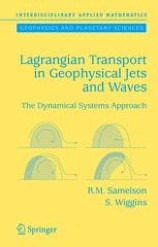
Lagrangian Transport in Geophysical Jets and Waves : The Dynamical Systems Approach
This book provides an accessible introduction to a new set of methods for the analysis of Lagrangian motion in geophysical flows. These methods were originally developed in the abstract mathematical setting of dynamical systems theory, through a geometric approach to differential equations. Despite the recent developments in this field and the existence of a substantial body of work on geophysical fluid problems in the dynamical systems and geophysical literature, this is the first introductory text that presents these methods in the context of geophysical fluid flow. The book is organized into seven chapters; the first introduces the geophysical context and the mathematical models of geophysical fluid flow that are explored in subsequent chapters. The second and third cover the simplest case of steady flow, develop basic mathematical concepts and definitions, and touch on some important topics from the classical theory of Hamiltonian systems. The fundamental elements and methods of Lagrangian transport analysis in time-dependent flows that are the main subject of the book are described in the fourth, fifth, and sixth chapters. The seventh chapter gives a brief survey of some of the rapidly evolving research in geophysical fluid dynamics that makes use of this new approach. Related supplementary material, including a glossary and an introduction to numerical methods, is given in the appendices.
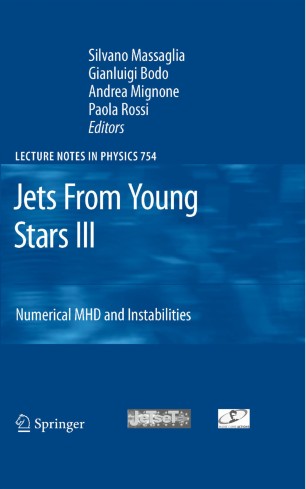
Jets From Young Stars III : Numerical MHD and Instabilities
This volume contains the lecture notes of the Third JETSET School on Jets from Young Stars focussing on Numerical MHD and Instabilities. The introductory lectures presented here cover the basic concepts of the numerical methods for the integration of hydrodynamic and magnetohydrodynamic equations and of the applications of these methods to the treatment of the instabilities relevant for the physics of stellar jets. The first part of the book contains an introduction to the finite difference and finite volume methods for computing the solutions of hyperbolic partial differential equations and a discussion of approximate Riemann solvers for both hydrodynamic and magnetohydrodynamic problems. The second part is devoted to the discussion of some of the main instability processes that may take place in stellar jets, namely: the Kelvin-Helmholtz, the radiative shock, the pressure driven and the thermal instabilities.
Java Methods for Financial Engineering : Applications in Finance and Investment
This book is structured around the main theories and models used by practitioners to engineer finance and investment tools. The methods developed and implemented in the text are organized as chapters which cover the core areas.
IUTAM Symposium on Multiscale Modelling of Damage and Fracture Processes in Composite Materials ; Proceedings of the IUTAM Symposium held in Kazimierz Dolny, Poland, 23-27 May 2005
This volume constitutes the Proceedings of the IUTAM Symposium. The main aim of the Symposium was to discuss the basic principles of damage growth and fracture processes in different types of composites: ceramic, polymer and metal matrix composites, cement and bituminous composites and wood. Nowadays, it is widely recognized that important macroscopic properties like the macroscopic stiffness and strength, are governed by processes that occur at one to several scales below the level of observation starting from nanoscale.
Computational Acoustics of Noise Propagation in Fluids - Finite and Boundary Element Methods
Among numerical methods applied in acoustics, the Finite Element Method (FEM) is normally favored for interior problems whereas the Boundary Element Method (BEM) is quite popular for exterior ones. That is why this valuable reference provides a complete survey of methods for computational acoustics, namely FEM and BEM. It demonstrates that both methods can be effectively used in the complementary cases. The chapters by well-known authors are evenly balanced: 10 chapters on FEM and 10 on BEM. An initial conceptual chapter describes the derivation of the wave equation and supplies a unified approach to FEM and BEM for the harmonic case. A categorization of the remaining chapters and a personal outlook complete this introduction. In what follows, both FEM and BEM are discussed in the context of very different problems.
Composites with micro- and nano-structure : Computational modeling and experiments
The book contains atomistic and continuum numerical methods and experimental validation for composite materials reinforced with particles or fibres, porous materials, homogenization and other important topics for research in this field.

Cálculo científico con MATLAB y Octave = Scientific computing with MATLAB and Octave
This textbook is an introduction to Scientific Calculus, illustrating various numerical methods for the computer solution of certain classes of mathematical problems. The authors show how to compute the zeros or integrals of continuous functions, solve linear systems, approximate functions by polynomials, and construct precise approximations for the solution of differential equations. To make the presentation concrete and attractive, the MATLAB programming environment has been adopted as a faithful companion.
Cálculo científico com MATLAB e Octave = Scientific calculus with MATLAB and Octave
Its objective is to present various numerical methods for solving certain mathematical problems on the computer that cannot be treated in a simpler way. Classical issues such as the computation of zeros or integrals of continuous functions, the solving of linear systems, the approximation of functions by polynomials and the construction of precise approximations for solutions of differential equations are addressed. All algorithms are presented in the programming languages MATLAB and Octave, whose main commands and instructions are introduced gradually, aiming in particular at their compatibility in both languages.
