



الصفحة 5
الصفحة 5

Developing Tsunami-Resilient Communities : The National Tsunami Hazard Mitigation Program
Tsunamis remain an ever-present threat to lives and property along the coasts of most of the world’s oceans. Because of the geographical extent of U.S. coastlines, an earthquake in Alaska can generate a local tsunami for Alaskans and, hours later, a distant tsunami for communities in Hawaii and along the Pacific Coast . This volume chronicles the development and accomplishments of a joint State/Federal partnership that was forged to reduce tsunami hazards along U.S. coastlines – the National Tsunami Hazard Mitigation Program. By integrating hazard assessment, warning guidance, and mitigation activities, the program has created a roadmap and a set of tools to develop communities more resilient to local and distant tsunamis. Among the set of tools are tsunami forecasting, educational experiments, early alerting systems, and design guidance for tsunami-resilient communities. Part of this book has already been published in a recent journal issue.

Corporate Sustainability Management in the Energy Sector : An Empirical Contigency Approach
Corporate social responsibility, sustainability, and citizenship are terms that often evoke considerable scepticism and cynicism, particularly in civil society. Much needed sector-specific and comparative research, which could facilitate a more fact-oriented debate, is still missing from the literature. The present study aims to fill this gap by presenting data collected from two groups of managers, namely sustainability experts and non-sustainability experts, from two different industry sectors (integrated oil and gas vs. electric utilities) and several geographical regions. Oliver Salzmann provides a comprehensive view on corporate sustainability management in companies such as Shell and RWE and investigates the key social and environmental issues driving the energy sector. The author analyses the influence which stakeholder pressure exercises on energy companies and their efforts to become more responsive. Moreover, he develops a model for strategic, thus profit-oriented, corporate sustainability management.

Cooperative Information Agents XI ; Matthias Klusch, Koen V. Hindriks, Mike P. Papazoglou, Leon Sterling
In today’s world of ubiquitously connected heterogeneous information systems and computing devices, the intelligent coordination and provision of relevant added-value information at any time, anywhere is of key importance to a va- ety of applications. This challenge is envisioned to be coped with by means of appropriate intelligent and cooperative information agents. An information agent is a computational software entity that has access to one or multiple heterogeneous and geographically dispersed data and infor- tion sources. It pro-actively searches for and maintains information on behalf of its human users, or other agents preferably just in time. In other words, it is managing and overcoming the di?culties associated with information overload in open, pervasive information and service landscapes. Each component of a modern cooperative information system is represented by an appropriate intelligent information agent capable of resolving system and semantic heterogeneities in a given context on demand. Cooperative infor- tion agents are supposed to accomplish both individual and shared joint goals depending on the actual user preferences in line with given or deduced limits of time, budget and resources available.

Computational earthquake physics ; Part II
Exciting developments in earthquake science have benefited from new observations, improved computational technologies, and improved modeling capabilities. Designing realistic supercomputer simulation models for the complete earthquake generation process is a grand scientific challenge due to the complexity of phenomena and range of scales involved from microscopic to global. The present volume - Part II - incorporates computational environment and algorithms, data assimilation and understanding, model applications and iSERVO. Topics covered range from iSERVO and QuakeSim: implementing the international solid earth research virtual observatory by integrating computational grid and geographical information web services; LURR (Load-Unload Response Ratio) described in six papers involving this promising earthquake forecasting model; pattern informatics and phase dynamics and their applications, which was also a highlight in the Workshop; computational algorithms, including continuum damage models and visualization and analysis of geophysical datasets; evolution of mantle material; the state vector approach; and assimilation of data such as geodetic data, GPS data, and seismicity and laboratory experimental data.

Clusia : A woody neotropical genus of remarkable plasticity and diversity
Clusia is the only dicotyledonous tree genus with crassulacean acid metabolism (CAM), and in some cases all variants of CAM can be expressed in one given species. These unique features as well as Clusia's extreme flexibility have put it in the limelight of international research. The studies presented in this volume embrace anatomy, morphology and plant architecture, phytogeographical distribution and community ecology, phylogeny and genetic diversity, physiology and metabolism, physiological ecology and functional diversity, circadian rhythmicity and biological timing. Covering all aspects of tree biology, this richly illustrated volume is an invaluable source of information for any plant scientist.

Cloud-Resolving Modeling of Convective Processes
Introduces the framework of cloud-resolving model, methodologies for analysis of modeling outputs, and validation of simulations with observations. The book details important scientific findings in the aspects of surface rainfall processes, precipitation efficiency, dynamic and thermodynamic processes associated with tropical convection, diurnal variations, radiative and cloud microphysical processes associated with development of cloud clusters, air-sea coupling on convective scales, climate equilibrium states, and remote sensing applications.

Martin Waldseemüller’s 'Carta marina' of 1516 : Study and transcription of the long legends
This book presents the first detailed study of one of the most important masterpieces of Renaissance cartography, Martin Waldseemüller’s Carta marina of 1516. By transcribing, translating into English, and detailing the sources of all of the descriptive texts on the map, as well as the sources of many of the images, the book makes the map available to scholars in a wholly unprecedented way.
Maritime Spatial Planning : past, present, future
This book is the first comprehensive overview of maritime spatial planning. Situated at the intersection between theory and practice, the volume draws together several strands of interdisciplinary research, reflecting on the history of MSP as well as examining current practice and looking towards the future. The authors and contributors examine MSP from disciplines as diverse as geography, urban planning, political science, natural science, sociology and education; reflecting the growing critical engagement with MSP in many academic fields. This innovative and pioneering volume will be of interest and value to students and scholars of maritime spatial planning, as well as planners and practitioners.
Map-based Mobile Services : Design, Interaction and Usability
It addresses methods and techniques for topics that range from design and rendering, context modelling, personalisation, multimodal interaction to usability test. Instead of striving for a seamless coverage of all essential theoretical and technical issues with an equal depth and extent, we attempt to pinpoint a number of research highlights and representative development activities at universities, research institutions and so- ware industry. The operational prototypes and platforms reported in the book are on the one hand outcome and feasibility proof of various approaches. On the other hand, they serve as a new starting point for the refinement of user interfaces and iterative usability tests.
Map Projections : Cartographic Information Systems
In the context of Geographical Information Systems (GIS) the book offers a timely review of map projections (sphere, ellipsoid, rotational surfaces) and geodetic datum transformations. For the needs of photogrammetry, computer vision, and remote sensing space projective mappings are reviewed.

Light Scattering Reviews 3 : Light Scattering and Reflection
Ddevoted to modern knowledge and milestones in both experimental and theoretical techniques related to light scattering and radiative transport problems. It will consist of 3 parts comprising 11 contributions written by world leading experts in their respective fields. The general focus of the book will be on remote sensing of geophysical media. The first part will be devoted exclusively to studies of single light scattering by particles of different shapes and chemical compositions. The first chapter will review in situ measurements of cloud optical characteristics like cloud extinction and phase function, with the emphasis on ice clouds. Chapter 2 will cover opitcally soft particles common in marine environments and bio-suspensions while Chapter 3 will describe numerical techniques applicable not only to isotropic but also to chiral and anisotropic mdia. The final chapter in this part will deal with spatial symmetries in light scattering problems.

Lewis Fry Richardson : His Intellectual Legacy and Influence in the Social Sciences
A pioneer in meteorology and peace research and remains a towering presence in both fields. This edited volume reviews his work and assesses its influence in the social sciences, notably his work on arms races and their consequences, mathematical models, the size distribution of wars, and geographical features of conflict
Learning from clusters : A critical assessment from an economic-geographical perspective
Edited volumes run the danger of being a hotchpotch of contributions on a wide variety of topics. Here, we have explicitly focused on a central theme in contemporary economic geography and regional science, namely the relationship between learning, innovation and clustering. Internationally renowned scientists made both theoretical and empirical contributions to this volume. We think this book constitutes a broad palette of contemporary thinking and research on the relationship between spatial concentration and innovation and hope it will play a significant role in future debates on this issue.
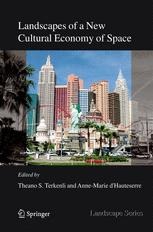
Landscapes of a New Cultural Economy of Space
Aims to tie together various perspectives, insights and constructions pertaining to landscapes and landscape representations from different theoretical and methodological positions as well as from diverse geographical and historical contexts in order to elucidate and illustrate processes of cultural transformation inscribed in space.
Landscape Analysis and Visualisation : Spatial Models for Natural Resource Management and Planning
This book presents a collection and synthesis of many of these perspectives — perhaps it could only be produced in a land urb- ised in the tiniest of pockets, and yet so daunting with respect to the way non-populated landscapes dwarf its cities. Many travel to Australia to its cities and never see the landscapes — but it is these that give the country its power and imagery. It is the landscapes that so impress on us the need to consider how our intervention, through activities ranging from resource exploitation and settled agriculture to climate change, poses one of the greatest crises facing the modern world. In this sense, Australia and its landscape provide a mirror through which we can glimpse the extent to which our intervention in the world threatens its very existence.
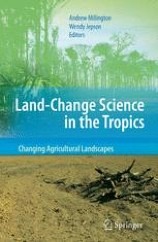
Land-Change Science in the Tropics : Changing Agricultural Landscapes
Land use and land-cover change research over the past decade has focused mainly on contemporary primary land-cover conversions in the tropics and sub-tropics, with considerable resources dedicated to the explanation and prediction of tropical deforestation and often ignoring the dynamism in the world’s agro-pastoral landscapes. This collection integrates cutting-edge research in the social, biogeophysical, and geographical information sciences to understand the human and environmental dynamics that change the type, magnitude and location of land uses and land covers in the changing countryside.This book describes the monitoring of land-cover changes, explains the processes through which land is altered, and describes the development of spatially-explicit models to predict land change. This book illustrates how practitioners have integrated knowledge from the three scientific realms - social, biophysical, and GIScience - that underpin land-change science.

Knowledge-Based Intelligent Information and Engineering Systems ; Vol.3684 : 9th International Conference, KES 2005, Melbourne, Australia, September 14-16, 2005, Proceedings, Part IV
The KES conference series has been established for almost a decade, and it cont- ues each year to attract participants from all geographical areas of the world, including Europe, the Americas, Australasia and the Paci?c Rim. The KES conferences cover a wide range of intelligent systems topics. The broad focus of the conference series is the theory and applications of intelligent systems. From a pure research ?eld, intel- gent systems have advanced to the point where their abilities have been incorporated into many business and engineering application areas. KES 2005 provided a valuable mechanism for delegates to obtain an extensive view of the latest research into a range of intelligent-systems algorithms, tools and techniques. The conference also gave de- gates the chance to come into contact with those applying intelligent systems in diverse commercial areas. The combination of theory and practice represented a unique opp- tunity to gain an appreciation of the full spectrum of leading-edge intelligent-systems activity. The papers for KES 2005 were either submitted to invited sessions, chaired and organized by respected experts in their ?elds, or to a general session, managed by an extensive International Program Committee, or to the Intelligent Information Hiding and Multimedia Signal Processing (IIHMSP) Workshop, managed by an International Workshop Technical Committee.

Knowledge-Based Intelligent Information and Engineering Systems ; Vol.3683 : 9th International Conference, KES 2005, Melbourne, Australia, September 14-16, 2005, Proceedings, Part III
The KES conference series has been established for almost a decade, and it cont- ues each year to attract participants from all geographical areas of the world, including Europe, the Americas, Australasia and the Paci?c Rim. The KES conferences cover a wide range of intelligent systems topics. The broad focus of the conference series is the theory and applications of intelligent systems. From a pure research ?eld, intel- gent systems have advanced to the point where their abilities have been incorporated into many business and engineering application areas. KES 2005 provided a valuable mechanism for delegates to obtain an extensive view of the latest research into a range of intelligent-systems algorithms, tools and techniques. The conference also gave de- gates the chance to come into contact with those applying intelligent systems in diverse commercial areas. The combination of theory and practice represented a unique opp- tunity to gain an appreciation of the full spectrum of leading-edge intelligent-systems activity. The papers for KES 2005 were either submitted to invited sessions, chaired and organized by respected experts in their ?elds, or to a general session, managed by an extensive International Program Committee, or to the Intelligent Information Hiding and Multimedia Signal Processing (IIHMSP) Workshop, managed by an International Workshop Technical Committee.
Knowledge-Based Intelligent Information and Engineering Systems ; Vol.3682 : 9th International Conference, KES 2005, Melbourne, Australia, September 14-16, 2005, Proceedings, Part II
The KES conference series has been established for almost a decade, and it cont- ues each year to attract participants from all geographical areas of the world, including Europe, the Americas, Australasia and the Paci?c Rim. The KES conferences cover a wide range of intelligent systems topics. The broad focus of the conference series is the theory and applications of intelligent systems. rom a pure research ?eld, intel- gent systems have advanced to the point where their abilities have been incorporated into many business and engineering...
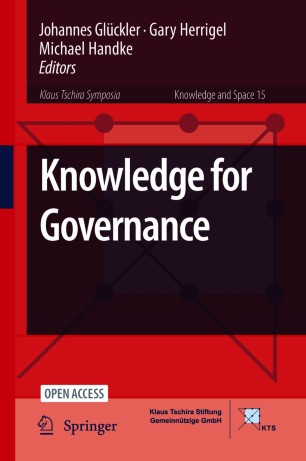
Knowledge for Governance
Focuses on theoretical and empirical intersections between governance, knowledge and space from an interdisciplinary perspective. The contributions elucidate how knowledge is a prerequisite as well as a driver of governance efficacy, and conversely, how governance affects the creation and use of knowledge and innovation in geographical context.
