



الصفحة 5
الصفحة 5

Evolutionary computation in combinatorial optimization ; Vol. 3448 ; 5th European Conference, EvoCOP 2005, Lausanne, Switzerland, March 30 - April 1, 2005, Proceedings
This volume contains the proceedings of EvoCOP 2005, the 5th European Conference on Evolutionary Computation in Combinatorial Optimization. It was held in Lausanne, Switzerland, on 30 March-1 April 2005

Evolutionary Computation for Modeling and Optimization
Evolutionary Computation for Optimization and Modeling is an introduction to evolutionary computation, a field which includes genetic algorithms, evolutionary programming, evolution strategies, and genetic programming. The text is a survey of some application of evolutionary algorithms. It introduces mutation, crossover, design issues of selection and replacement methods, the issue of populations size, and the question of design of the fitness function. It also includes a methodological material on efficient implementation. Some of the other topics in this book include the design of simple evolutionary algorithms, applications to several types of optimization, evolutionary robotics, simple evolutionary neural computation, and several types of automatic programming including genetic programming. The book gives applications to biology and bioinformatics and introduces a number of tools that can be used in biological modeling, including evolutionary game theory. Advanced techniques such as cellular encoding, grammar based encoding, and graph based evolutionary algorithms are also covered.
Evaluation of text summaries based on linear optimization of content metrics
Covers both theoretical contributions and practical applications in security system design by applying the Internet of Things (IoT) and CI. It further explains the application of IoT in the design of modern security systems and how IoT blended with computational intel- ligence can make any security system improved and realizable. Key features: Focuses on the computational intelligence techniques of security system design Covers applications and algorithms of discussed computational intelligence techniques Includes convergence-based and enterprise integrated security systems with their applications Explains emerging laws, policies, and tools affecting the landscape of cyber security Discusses application of sensors toward the design of security systems This book will be useful for graduate students and researchers in electrical, computer engineering, security system design and engineering

European Robotics Symposium 2008
These monothematic proceedings represent a collection of papers presented at the 2nd European Robotics Symposium, held in Prague, March 26-27, 2008. The goal of the given selection of papers is to provide a comprehensive overview of the recent status in robotics research world-wide in the key areas of cognition, autonomy, adaptation and robustness in robotics.
Entertainment computing – ICEC 2007 ; 6th International Conference, Shanghai, China, September 15-17, 2007, Proceedings
This book are organized in topical sections on augmented, virtual and mixed reality, computer games, image processing, mesh and modeling, digital storytelling and interactive systems, sound, music and creative environments, video processing, rendering, computer animation and networks, game based interfaces, as well as robots and cyber pets.

Engineering Evolutionary Intelligent Systems
This edited volume 'Engineering Evolutionary Intelligent Systems' deals with the theoretical and methodological aspects, as well as various evolutionary algorithm applications to many real world problems originating from science, technology, business or commerce.

Embedded Robotics : Mobile Robot Design and Applications with Embedded Systems
This book presents a unique examination of mobile robots and embedded systems, from introductory to intermediate level. It is structured in three parts, dealing with Embedded Systems (hardware and software design, actuators, sensors, PID control, multitasking), Mobile Robot Design (driving, balancing, walking, and flying robots), and Mobile Robot Applications (mapping, robot soccer, genetic algorithms, neural networks, behavior-based systems, and simulation).

Embedded Robotics : Mobile Robot Design and Applications with Embedded Systems
The EyeBot controller and mobile robots have evolved over more than a decade. This book gives an in-depth introduction to embedded systems and autonomous mobile robots, using the EyeBot controller (EyeCon) and the EyeBot mobile robot family as application examples. This book combines teaching and research material and can be used for courses in Embedded Systems as well as in Robotics and Automation.

Embedded robotics : From mobile robots to autonomous vehicles with Raspberry Pi and Arduino
Presents a unique examination of mobile robots and autonomous vehicles using embedded systems, from introductory to advanced level. It is structured in four parts, dealing with Embedded Systems (processors, sensors, actuators, control, multitasking and communication), Robot Hardware (driving and walking robots, autonomous boats and planes, as well as robot manipulators), Robot Software (localization, navigation, image processing and automotive systems), and Artificial Intelligence (neural networks, genetic algorithms and deep learning). The book is organized for ease of use, with numerous figures, photographs, and worked example programs. The book is written as a text for courses in computer science, computer engineering, IT, electronics engineering, and mechatronics, as well as a guide for robot hobbyists and researchers.

Efficient Learning Machines : Theories, Concepts, and Applications for Engineers and System Designers
Machine learning techniques provide cost-effective alternatives to traditional methods for extracting underlying relationships between information and data and for predicting future events by processing existing information to train models. Efficient Learning Machines explores the major topics of machine learning, including knowledge discovery, classifications, genetic algorithms, neural networking, kernel methods, and biologically-inspired techniques.

Dynamic pricing and automated resource allocation for complex information services : Reinforcement learning and combinatorial auctions
This book develops allocation mechanisms that aim to ensure an efficient resource allocation in modern IT-services. The author presents two methods, both of which using the users’ willingness-to-pay to control the allocation process. The author generates a method to calculate dynamic resource prices.
DNA computing ; Vol. 3384 10th International workshop on DNA computing, DNA10, Milan, Italy, June 7-10, 2004, Revised Selected Papers
This book constitutes the thoroughly refereed postproceedings of the 10th International Workshop on DNA Based Computers, DNA10, held in Milano, Italy in June 2004. The 39 revised full papers presented were carefully selected during two rounds of reviewing and improvement from an initial total of 94 submissions. The papers address all current issues in DNA based computing and biomolecular computing ranging from theoretical and methodological issues to implementations and experimental aspects.

Distributed computing in sensor systems ; 3rd IEEE International Conference, DCOSS 2007, Santa Fe, NM, USA, June 18-20, 2007, Proceedings
The book covering the areas of algorithms, applications, and systems, thus bridging the gap between theory and practice and between the broader field of distributed computing and the specific issues arising in sensor networks and related systems.

Differential Evolution : A Practical Approach to Global Optimization
Problems demanding globally optimal solutions are ubiquitous, yet many are intractable when they involve constrained functions having many local optima and interacting, mixed-type variables. The differential evolution (DE) algorithm is a practical approach to global numerical optimization which is easy to understand, simple to implement, reliable, and fast. Packed with illustrations, computer code, new insights, and practical advice, this volume explores DE in both principle and practice. It is a valuable resource for professionals needing a proven optimizer and for students wanting an evolutionary perspective on global numerical optimization.

Device Applications of Nonlinear Dynamics
This edited book is devoted specifically to the applications of complex nonlinear dynamic phenomena to real systems and device applications. While in the past decades there has been significant progress in the theory of nonlinear phenomena under an assortment of system boundary conditions and preparations, there exist comparatively few devices that actually take this rich behavior into account. "Device Applications of Nonlinear Dynamics" applies and exploits this knowledge to make devices which operate more efficiently and cheaply, while affording the promise of much better performance. Given the current explosion of ideas in areas as diverse as molecular motors, nonlinear filtering theory, noise-enhanced propagation, stochastic resonance and networked systems, the time is right to integrate the progress of complex systems research into real devices.

Data mining with computational intelligence
Finding information hidden in data is as theoretically difficult as it is practically important. With the objective of discovering unknown patterns from data, the methodologies of data mining were derived Wang and Fu present in detail the state of the art on how to utilize fuzzy neural networks, multilayer perceptron neural networks, radial basis function neural networks, genetic algorithms, and support vector machines in such applications. They focus on three main data mining tasks: data dimensionality reduction, classification, and rule extraction. The book is targeted at researchers in both academia and industry, while graduate students and developers of data mining systems will also profit from the detailed algorithmic descriptions.
Current aopics in artificial intelligence ; 12th Conference of the Spanish Association for Artificial Intelligence, CAEPIA 2007, Salamanca, Spain, November 12-16, 2007, Selected Papers
The book presented address all current issues of artificial intelligence ranging from methodological and foundational aspects to advanced applications in various fields.
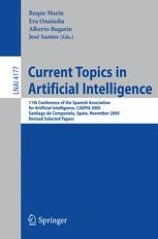
Current aopics in artificial intelligence ; 11th Conference of the Spanish Association for Artificial Intelligence, CAEPIA 2005, Santiago de Compostela, Spain, November 16-18, 2005, Revised Selected Papers
This book constitutes the thoroughly refered post-proceedings of the 11th Conference of the Spanish Association for Artificial Intelligence, CAEPIA 2005, held in Santiago de Compostela, Spain in November 2005.

Control of Traffic Systems in Buildings
Control of Traffic Systems in Buildings presents the state of the art in the analysis and control of transportation systems in buildings focusing primarily on elevator groups. The theory and design of passenger traffic and cargo transport systems are covered, together with actual operational examples and topics of special current interest such as: • noisy, on-line and algorithmic optimization; • simulation-based modeling of passengers and goods; • control of cooperative agent-oriented systems; • proposal for a benchmark to compare new control methods; • deployment and testing of transportation systems.

Computer Music Modeling and Retrieval ; Vol. 3310
This volume contains the final proceedings for the 2004 Computer Music Model-ing and Retrieval Symposium (CMMR 2004). CMMR is an annualevent focusing on important aspects of computer music. CMMR 2004 is the sec-ond event in this series. The use of computers in music is well established. CMMR 2004 provided aunique opportunity to meet and interact with peers concerned with the cross-influence of the technological and creative in computer music. The field of com-puter music is interdisciplinary by nature and closely related to a number of com-puter science and engineering areas such as information retrieval, programming,human computer interaction, digital libraries, hypermedia, artificial intelligence,acoustics, signal processing, etc. The event gathered many interesting people(researchers, educators, composers, performers, and others). There were manyhigh-quality keynote and paper presentations, that fostered inspiring discussions.
