



الصفحة 5
الصفحة 5

Declarative agent languages and technologies IV ; 4th International Workshop, DALT 2006, Hakodate, Japan, May 8, 2006, Selected, Revised and Invited Papers
Constitutes the thoroughly refereed post-proceedings of the 4th International Workshop on Declarative Agent Languages and Technologies, DALT 2006, held in Japan in May 2006. This was an associated event of AAMAS 2006, the main international conference on autonomous agents and multi-agent systems. The 12 revised full papers presented together with one invited talk and three invited papers were carefully selected for inclusion in the book.

Declarative agent languages and technologies II ; 2nd international workshop, DALT 2004, New York, NY, USA, July 19, 2004, revised selected papers
Nearly 40 research groups worldwide were motivated to contribute to this event by submitting their most recent research achievements, covering a wide variety of the topics listed in the call for papers. More than 30 top researchers agreed to join the Program Committee, which then collectively faced the hard task of selecting the one-day event program. The fact that research in multi-agent systems is no longer only a novel and promising research horizon at dawn is, in our opinion, the main reason behind DALT’s (still short) success story. On the one hand, agent theories and app- cations are mature enough to model complex domains and scenarios, and to successfully address a wide range of multifaceted problems, thus creating the urge to make the best use of this expressive and versatile paradigm, and also pro?t from all the important results achieved so far. On the other hand, bui- ing multi-agent systems still calls for models and technologies that could ensure system predictability, accommodate ?exibility, heterogeneity and openness, and enable system veri?cation.

Database theory - ICDT 2005 ; 10th international conference, Edinburgh, UK, January 5-7, 2005, Proceedings
This volume collects the papers presented at the 10th International Conference on Database Theory, ICDT 2005, held during January 5–7, 2005, in Edinburgh, UK. ICDT (http://alpha.luc.ac.be/~lucp1080/icdt/) has now a long tra- tion of international conferences, providing a biennial scienti?c forum for the communication of high-quality and innovative research results on theoretical - pects of all forms of database systems and database technology. The conference usually takes place in Europe, and has been held in Rome (1986), Bruges (1988), Paris (1990), Berlin (1992), Prague (1995), Delphi (1997), Jerusalem (1999), London (2001), and Siena (2003) so far. ICDT has merged with the Sym- sium on Mathematical Fundamentals of Database Systems (MFDBS), initiated in Dresden in 1987, and continued in Visegrad in 1989 and Rostock in 1991. ICDT had a two-stage submission process. First, 103 abstracts were subm- ted, which were followed a week later by 84 paper submissions. From these 84 submissions, the ICDT Program Committee selected 24 papers for presentation at the conference. Most of these papers were “extended abstracts” and preli- nary reports on work in progress. It is anticipated that most of these papers will appear in a more polished form in scienti?c journals.

Coordination, organizations, institutions, and norms in agent system ; AAMAS 2005 International Workshops on Agents, Norms, and Institutions for Regulated Multiagent Systems, ANIREM 2005 and on organizations in multi-agent systems, OOOP 2005, Utrecht, The Netherlands, July 25-26, 2005, Revised Selected Papers
This book constitutes the refereed post-proceedings of the International Workshop on Agents, Norms and Institutions for Regulated Multiagent Systems, ANIREM 2005, and the International Workshop on Organizations in Multi-Agent Systems, OOOP 2005, held in Utrecht, The Netherlands, July 2005.
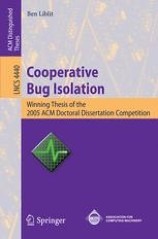
Cooperative Bug Isolation : Winning Thesis of the 2005 ACM Doctoral Dissertation Competition
Efforts to understand and predict the behavior of software date back to the earliest days of computer programming,over half a century ago. In the intervening decades, the need for effective methods of understanding software has only increased; so- ware has spread to become the underpinning of much of modern society, and the potentially disastrous consequences of broken or poorly understood software have become all too apparent.

Construction and Analysis of Safe, Secure, and Interoperable Smart Devices ; Vol. 3956 ; Second International Workshop, CASSIS 2005, Nice, France, March 8-11, 2005, Revised Selected Papers
This book constitutes the refereed post-proceedings of the Second International Workshop on Construction and Analysis of Safe, Secure, and Interoperable Smart Devices, CASSIS 2005. The 9 revised full papers presented were carefully selected during two rounds of reviewing and improvement from about 30 workshop talks. The papers are organized in topical sections on research trends in smart devices, Web services, virtual machine technology, security, validation and formal methods, proof-carrying code, and embedded devices.

Constructing Correct Software
Central to Formal Methods is the so-called Correctness Theorem which relates a specification to its correct Implementations. This theorem is the goal of traditional program testing and, more recently, of program verification (in which the theorem must be proved). Proofs are difficult, though even with the use of powerful theorem provers. This volume explains and illustrates an alternative method, which allows the construction of (necessarily correct) algorithms from a specification using algebraic transformations and refinement techniques which prevent the introduction of errors. Based on teaching material used extensively at Loughborough University, John Cooke introduces the basics, using simple examples and lots of detailed working (which can often be re-used). Constructing Correct Software will provide invaluable reading for students and practitioners of Computer Science and Software Engineering to whom correctness of software is of prime importance.

Constraint-Based Verification
Constraint-Based Verifcation covers the emerging field in functional verification of electronic designs thats is now commonly referred to by this name. Topics are developed in the context of a wide range of dynamic and static verification approaches including stimulation, emulation and formal methods. The goal is to show how constraints, or assertions, can be used toward automating the generation of testbenches, resulting in a seamless verifcation flow. Topics such as verification coverage, and connection with assertion-based verification are also covered.

Concurrency Theory : Calculi an Automata for Modelling Untimed and Timed Concurrent Systems
Concurrency Theory is a synthesis of one of the major threads of theoretical computer science research focusing on languages and graphical notations for describing collections of simultaneously evolving components that interact through synchronous communication. The main specification notation focused on in this book is LOTOS. An extensive introduction to this particular process calculus is given, highlighting how the approach differs from competitor techniques, such as CCS and CSP.
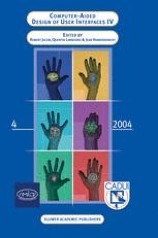
Computer-Aided Design of User Interfaces IV
Computer-Aided Design of User Interfaces IV gathers the latest research of experts, research teams and leading organisations involved in computer-aided design of user interactive applications supported by software, with specific attention for platform-independent user interfaces and context-sensitive or aware applications. This includes: innovative model-based and agent-based approaches, code-generators, model editors, task animators, translators, checkers, advice-giving systems and systems for graphical and multimodal user interfaces. It also addresses User Interface Description Languages. This books attempts to emphasize the software tool support for designing user interfaces and their underlying languages and methods, beyond traditional development environments offered by the market. It will be of interest to software development practitioners and researchers whose work involves human-computer interaction, design of user interfaces, frameworks for computer-aided design, formal and semi-formal methods, web services and multimedia systems, interactive applications, and graphical user and multi-user interfaces.

Computer Aided Verification; 31st International Conference, CAV 2019, New York City, NY, USA, July 15-18, 2019, Proceedings, Part II
The volume cover logics, decision procedures; and solvers; numerical programs; verification; distributed systems and networks; verification and invariants; and concurrency.

Computer Aided Verification ; Vol. 3576 ; 17th International Conference, CAV 2005, Edinburgh, Scotland, UK, July 6-10, 2005, Proceedings
This volume contains the proceedings of the International Conference on Computer Aided Veri?cation (CAV), held in Edinburgh, Scotland, 2005. CAV 2005 was the seventeenth in a series of conferences dedicated to the advancement of the theory and practice of computer-assisted formal an- ysis methods for software and hardware systems. The conference covered the spectrum from theoretical results to concrete applications, with an emphasis on practical veri?cation tools and the algorithms and techniques that are needed for their implementation.

Computer Aided Verification ; 33rd International Conference, CAV 2021, Virtual Event, July 20–23, 2021, Proceedings, Part II
This two-volume set LNCS 12759 and 12760 constitutes the refereed proceedings of the 33rd International Conference on Computer Aided Verification, CAV 2021, held virtually in July 2021. The 63 full papers presented together with 16 tool papers and 5 invited papers were carefully reviewed and selected from 290 submissions. The papers were organized in the following topical sections: Part I: invited papers; AI verification; concurrency and blockchain; hybrid and cyber-physical systems; security; and synthesis. Part II: complexity and termination; decision procedures and solvers; hardware and model checking; logical foundations; and software verification.

Computer Aided Verification ; 33rd International Conference, CAV 2021, Virtual Event, July 20–23, 2021, Proceedings, Part I
This two-volume set LNCS 12759 and 12760 constitutes the refereed proceedings of the 33rd International Conference on Computer Aided Verification, CAV 2021, held virtually in July 2021. The 63 full papers presented together with 16 tool papers and 5 invited papers were carefully reviewed and selected from 290 submissions. The papers were organized in the following topical sections: Part I: invited papers; AI verification; concurrency and blockchain; hybrid and cyber-physical systems; security; and synthesis. Part II: complexity and termination; decision procedures and solvers; hardware and model checking; logical foundations; and software verification.

Computer Aided Verification ; 31st International Conference, CAV 2019, New York City, NY, USA, July 15-18, 2019, Proceedings, Part I
This volume presented automata and timed systems; security and hyperproperties; synthesis; model checking; cyber-physical systems and machine learning; probabilistic systems, runtime techniques; dynamical, hybrid, and reactive systems.

Computer aided verification ; 30th International Conference, CAV 2018, Held as Part of the Federated Logic Conference, FloC 2018, Oxford, UK, July 14-17, 2018, Proceedings, Part II
Constitutes the refereed proceedings of the 30th International Conference on Computer Aided Verification, CAV 2018, held in Oxford, UK, in July 2018.The 52 full and 13 tool papers presented together with 3 invited papers and 2 tutorials were carefully reviewed and selected from 215 submissions. The papers cover a wide range of topics and techniques, from algorithmic and logical foundations of verication to practical applications in distributed, networked, cyber-physical, and autonomous systems. They are organized in topical sections on model checking, program analysis using polyhedra, synthesis, learning, runtime verification, hybrid and timed systems, tools, probabilistic systems, static analysis, theory and security, SAT, SMT and decisions procedures, concurrency, and CPS, hardware, industrial applications.

Computer Aided Verification ; 30th International Conference, CAV 2018, Held as Part of the Federated Logic Conference, FloC 2018, Oxford, UK, July 14-17, 2018, Proceedings, Part I
This open access two-volume set LNCS 10980 and 10981 constitutes the refereed proceedings of the 30th International Conference on Computer Aided Verification, CAV 2018, held in Oxford, UK, in July 2018. The papers cover a wide range of topics and techniques, from algorithmic and logical foundations of verication to practical applications in distributed, networked, cyber-physical, and autonomous systems. They are organized in topical sections on model checking, program analysis using polyhedra, synthesis, learning, runtime verification, hybrid and timed systems, tools, probabilistic systems, static analysis, theory and security, SAT, SMT and decisions procedures, concurrency, and CPS, hardware, industrial applications.

Computer Aided Verification ; 20th International Conference, CAV 2008 Princeton, NJ, USA, July 7-14, 2008 Proceedings
This book constitutes the refereed proceedings of the 20th International Conference on Computer Aided Verification, CAV 2008, held in Princeton, NJ, USA, in July 2008.

Computer Aided Verification ; 19th International Conference, CAV 2007, Berlin, Germany, July 3-7, 2007, Proceedings
This volume contains advancement of the theory and practice of computer-assisted formal analysis methods for software and hardware systems. covers the spectrum from theoretical - sults to concrete applications, with an emphasis on practical verification tools and the algorithms and techniques that are needed for their implementation.
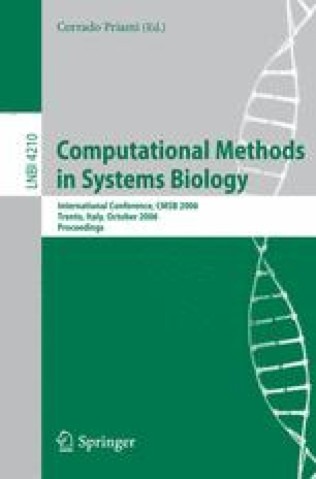
Computational methods in systems biology ; Vol. 4210 ; International Conference, CMSB 2006, Trento, Italy, October 18-19, 2006, Proceedings
This book constitutes the refereed proceedings of the International Conference on Computational Methods in Systems Biology, CMSB 2006, held in Trento, Italy, in October 2006. The papers present a variety of techniques from computer sciences, such as language design, concurrency theory, software engineering, and formal methods.
