



الصفحة 5
الصفحة 5

Hearing faces
Our project aims to aid deaf-mute people by tracking hand movements of the deaf-mute person for word level American Sign Language using WLASL model that include 2D CNN -3D CNN and RNN networks training on WLASL large video dataset, then generating the corresponding text and analyzing the person's facial gestures to generate information related to the tone of voice that is most appropriate to the person's age, gender, and race through MTCNN network algorithm that training on generated dataset by us depending on blending VOXCELEB dataset and VGGFACE dataset .

Hardware Verification with SystemVerilog : An Object-Oriented Framework
Verification is increasingly complex, and SystemVerilog is one of the languages that the verification community is turning to. However, no language by itself can guarantee success without proper techniques. Object-oriented programming (OOP), with its focus on managing complexity, is ideally suited to this task. With this handbook—the first to focus on applying OOP to SystemVerilog—we’ll show how to manage complexity by using layers of abstraction and base classes. By adapting these techniques, you will write more "reasonable" code, and build efficient and reusable verification components. Both a learning tool and a reference, this handbook contains hundreds of real-world code snippets and three professional verification-system examples.

Hardware and software : Verification and testing ; 1st International Haifa Verification Conference, Haifa, Israel, November 13-16, 2005, Revised Selected Papers
The First Haifa Verification Conference was held at the IBM Haifa Research Lab and at the Haifa University in Israel from November 13 to16, 2005. The conference incorporated three different workshops that took place separately in previous years. The IBM Verification Workshop is now its sixth year, the IBM Software Testing Workshop is now in its fourth year, and the PADTAD Workshop on testing and debugging multi-threaded and parallel software was held for the third time. The Verification Conference was a three-day, single-track conference followed by a one-day tutorial on the testing and review of multi-threaded code. The conference presented a unique combination of fields that brought together the hardware and software testing communities. Merging the different communities under a single roof gave the conference a distinctive flavor and provided the participants with added benefits. While the applications in these separate fields are different, the techniques used are often very similar. By offering lectures in these disparate but related disciplines, the conference engendered an environment of collaboration and discovery.

Hands-on question answering systems with BERT : Applications in neural networks and natural language processing
Begins with an overview of the technology landscape behind BERT. It takes you through the basics of NLP, including natural language understanding with tokenization, stemming, and lemmatization, and bag of words. Next, you’ll look at neural networks for NLP starting with its variants such as recurrent neural networks, encoders and decoders, bi-directional encoders and decoders, and transformer models. Along the way, you’ll cover word embedding and their types along with the basics of BERT. After this solid foundation, you’ll be ready to take a deep dive into BERT algorithms such as masked language models and next sentence prediction. You’ll see different BERT variations followed by a hands-on example of a question answering system. You will: Examine the fundamentals of word embeddings / Apply neural networks and BERT for various NLP tasks / Develop a question-answering system from scratch / Train question-answering systems for your own data

Hands-On Design Patterns with Java : Learn Design Patterns That Enable the Building of Large-Scale Software Architectures
Java design patterns are reusable and proven solutions to software design problems. This book covers over 60 battle-tested design patterns used by developers to create functional, reusable, and flexible software. Hands-On Design Patterns with Java starts with an introduction to the Unified Modeling Language (UML), and delves into class and object diagrams with the help of detailed examples. You'll study concepts and approaches to object-oriented programming (OOP) and OOP design patterns to build robust applications. As you advance, you'll explore the categories of GOF design patterns, such as behavioral, creational, and structural, that help you improve code readability and enable large-scale reuse of software. You’ll also discover how to work effectively with microservices and serverless architectures by using cloud design patterns, each of which is thoroughly explained and accompanied by real-world programming solutions. By the end of the book, you’ll be able to speed up your software development process using the right design patterns, and you’ll be comfortable working on scalable and maintainable projects of any size.
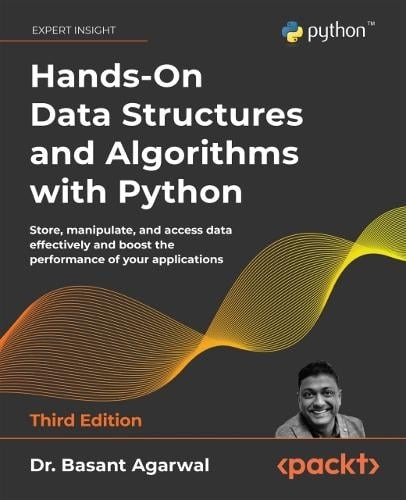
Hands-On Data Structures and Algorithms with Python : Store, manipulate, and access data effectively ; 3rd ed.
Expands your understanding of key structures, including stacks, queues, and lists, and also show you how to apply priority queues and heaps in applications. You'll learn how to analyze and compare Python algorithms, and understand which algorithms should be used for a problem based on running time and computational complexity. You will also become confident organizing your code in a manageable, consistent, and scalable way, which will boost your productivity as a Python developer. By the end of this Python book, you'll be able to manipulate the most important data structures and algorithms to more efficiently store, organize, and access data in your applications

Handbook Of Mathematical Models For Languages And Computation
Introduces a variety of concepts in discrete mathematics and mathematical modeling for languages and computation. The authors pay special attention to the implementation of mathematical concepts to explain clearly how to encode them in computational practice. All computer programs are written in C#. The theory of computation is used to address challenges arising in many computer science areas such as artificial intelligence, language processors, compiler writing, information and coding systems, programming language design, computer architecture and more. To grasp topics concerning this theory readers need to familiarize themselves with its computational and language models, based on concepts of discrete mathematics including sets, relations, functions, graphs and logic.

Handbook for Building Construction : Administration, Materials, Design, and Safety
Shows, step-by-step, how to work through the many stages of a building construction project―from planning and material selection through compliance, safety, and quality assurance. Written by a pair of highly respected experts in the industry, Handbook for Building Construction: Administration, Materials, Design, and Safety contains best practices, real-world examples, and practical applications. You will discover how to develop design specifications, understand complex codes and regulations, and apply the best methods for building construction jobs of all sizes.

GUI design for android apps
GUI Design for Android Apps is the perfect—and concise—introduction for mobile app developers and designers. Through easy-to-follow tutorials, code samples, and case studies, the book shows the must-know principles for user-interface design for Android apps running on the Intel platform, including smartphones, tablets and embedded devices.

Graphs, networks and algorithms ; 3rd ed.
The third edition of this standard textbook contains additional material: two new application sections (on graphical codes and their decoding) and about two dozen further exercises (with solutions, as throughout the text). Moreover, recent developments have been discussed and referenced, in particular for the travelling salesman problem. The presentation has been improved in many places (for instance, in the chapters on shortest paths and on colorings), and a number of proofs have been reorganized, making them more precise or more transparent.

Graph-based representations in pattern recognition ; 5th IAPR International Workshop, GbRPR 2005, Poitiers, France, April 11-13, 2005, Proceedings
Many vision problems have to deal with di?erent entities (regions, lines, line junctions, etc.) and their relationships. These entities together with their re- tionships may be encoded using graphs or hypergraphs. The structural inf- mation encoded by graphs allows computer vision algorithms to address both the features of the di?erent entities and the structural or topological relati- ships between them. Moreover, turning a computer vision problem into a graph problem allows one to access the full arsenal of graph algorithms developed in computer science. The Technical Committee (TC15, http://www.iapr.org/tcs.html) of the IAPR (International Association for Pattern Recognition) has been funded in order to federate and to encourage research work in these ?elds. Among its - tivities, TC15 encourages the organization of special graph sessions at many computer vision conferences and organizes the biennial workshop GbR.

GPS : Theory, algorithms and applications
This reference and handbook describes Global Positioning System (GPS) theory, algorithms and applications. It is primarily based upon source-code descriptions of the KSGSoft program developed by author at the GFZ in Potsdam. The theory and algorithms are revised and extended for a new development of a multiple functional GPS software. New concepts such as the unified GPS data processing method and ambiguity-ionospheric algorithm, as well as general ambiguity search criteria, are reported for the first time. Mathematically rigorous, the book begins with the basics of coordinate and time systems and satellite orbits, as well as GPS observables, and deals with topics such as physical influences, observation equations, adjustment and filtering, ambiguity resolution, data processing, kinematic positioning, and the determination of perturbed orbits.

Global RFID : The Value of the EPCglobal Network for Supply Chain Management
At the same time, I was a junior Brand Manager at Procter & Gamble w- ried about a much more mundane problem: how to keep my products on the shelf. Embedding RFID tags in the products, and RFID readers in the shelf, seemed like the perfect – indeed the only – way to do this. But I needed RFID to be cheaper, better, and standardized in an open system. In early 1999, by sheer chance, I met Brock and Sarma. The result was a potent meeting of minds. I was looking to fund research, and Brock, Sarma and Siu were looking for research funding. Working with Alan Haberman of the Uniform Code Council, one of the founding fathers of the UPC bar code, and Allan Boath of the Gillette C- pany, we developed a plan for a new industry funded research consortium at MIT.

Giving Death a Helping Hand : Physician-Assisted Suicide and Public Policy. An International Perspective
The volume focuses on public policy issues related to physician-assisted suicide. It offers a detailed analysis of the current legal standing and practice of physician-assisted suicide in various countries and discusses the ethical principles underlying its legal and professional regulation.

GeoSpatial semantics ; 2nd International Conference, GeoS 2007, Mexico City, Mexico, November 29-30, 2007
This paper reports a simple case study of extracting the two types of such hierarchies from formal texts of traffic code. Problems of concurrent use of both hierarchies for ontology reasoning are dis-cussed, particularly, in context of the different views on geospatial ontologies.
Generative programming and component engineering ; 4th International conference, GPCE 2005, Tallinn, Estonia, September 29 - October 1, 2005, Proceedings
Generative Programming and Component Engineering (GPCE) is a leading - searchconferenceonautomaticprogrammingandcomponentengineering.These approaches to software engineering have the potential to revolutionize software development as automation and components revolutionized manufacturing. The conference brings together researchers and practitioners interested in adva- ing automation for software development. It is also a premier forum for cro- fertilization between the programming language and software engineering - search communities. GPCEaroseasajointconference, mergingthepriorconferenceonGenerative and Component-Based Software Engineering (GCSE) and the Workshop on - mantics, Applications, andImplementationofProgramGeneration(SAIG). The proceedingsofthepreviousGPCEconferenceswerepublishedintheLNCSseries of Springer as volumes2487,2830, and 3286.In 2005 GPCE wasco-locatedwith the International Conference on Functional Programming (ICFP) and the s- posium on Trends in Functional Programming (TFP), re?ecting the vigorous interaction between the functional programming and generative programming research communities. GPCE and ICFP are both sponsored by the Association for Computing Machinery. The quality and breadth of the papers submitted to GPCE 2005 was impr- sive. All 86 papers, including 5 papers for tool demonstrations, were rigorously reviewed by 17 highly quali?ed Program Committee members. The members of the Program Committee ?rst provided in-depth individual reviews of the s- mitted papers, and then debated the merits of the papers through an extended electronicProgramCommitteemeeting.After much(friendly) argument,25r- ular papers and 2 tool demonstration papers were selected for publication. The ProgramCommittee provided extensive technical feedback to the authors of the submittedpapers.Theconferenceprogramwascomplementedwiththreeinvited talks, three extended tutorials, and three all-day workshops.
General Theory of Information Transfer and Combinatorics
This book constitutes the thoroughly refereed research papers contributed to a research project on the `General Theory of Information Transfer and Combinatorics' that was hosted from 2001-2004 at the Center for Interdisciplinary Research (ZIF) of Bielefeld University and also papers of several incorporated meetings thereof. The 63 revised full papers presented were carefully reviewed and selected for inclusion in the book. The papers are organized in topical sections on probabilistic models, cryptology, pseudo random sequences, quantum models, statistics, probability theory, information measures, error concepts, performance criteria, search, sorting, ordering, planning, language evolution, pattern discovery, reconstructions, network coding, combinatorial models, and a problem section.

Fundamentals of Taxation ; 15th ed.
1. Organized to closely follow the IRS tax forms. 2. Proper reporting of tax issues are illustrated. 3. Integration of an individual income tax software package (TaxACT). 4. The authors supplement the text with citations of relevant tax authorities, such as the Internal Revenue Code, Treasury Regulations, Revenue Rulings, Revenue Procedures, and court cases.

Fundamentals of Structural Dynamics : Theory and Computation
Emphasizes numerical methods, nonlinear response of structures, and the analysis of continuous systems (e.g., wave propagation). Fundamentals of Structural Dynamics: Theory and Computation builds the theory of structural dynamics from simple single-degree-of-freedom systems through complex nonlinear beams and frames in a consistent theoretical context supported by an extensive set of MATLAB codes that not only illustrate and support the principles, but provide powerful tools for exploration. The book is designed for students learning structural dynamics for the first time but also serves as a reference for professionals throughout their careers.
Fundamentals of manufacturing engineering using digital visualization
Offers a guide to core principles and practices of manufacturing engineering. It covers the design of, together with technological and measurement issues for, technical systems. Locating charts and setup schemes describing different machining processes are included. Concepts of product quality, with a focus on accuracy indicators, machining accuracy, roughness, and the impact of surface quality on exploitation properties are also explained. Furthermore, key machining methods, including turning, milling, hole machining, grinding, and gear machining, are analyzed in depth, covering their principles, applications, and techniques. The book is enriched by QR codes, linking to a mobile application presenting additional information about the content, for an interactive and extended learning experience. It also uses illustrations visualized with digital tools to promote a better understanding of the concepts.
