



الصفحة 5
الصفحة 5

MICAI 2007 : Advances in artificial intelligence ; 6th Mexican International Conference on Artificial Intelligence, Aguascalientes, Mexico, November 4-10, 2007, Proceedings
The Mexican International Conference on Artificial Intelligence (MICAI), a yearly international conference series organized by the Mexican Society for Artificial Intelligence (SMIA), is a major international AI forum and the main event in the academic life of the country’s growing AI community.
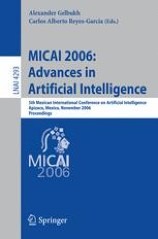
MICAI 2006 : Advances in Artificial Intelligence ; 5th Mexican International Conference on Artificial Intelligence, Apizaco, Mexico, November 13-17, 2006, Proceedings
This volume contains the papers presented during the oral session of the 5 Mexican International Conference on Artificial Intelligence, held on November 13–17, 2006, at the Technologic Institute of Apizaco, Mexico. The conference received for evaluation 448 submissions by 1207 authors from 42 different countries

MICAI 2005 : Advances in Artificial Intelligence ; 4th Mexican International Conference on Artificial Intelligence, Monterrey, Mexico, November 14-18, 2005, Proceedings
Constitutes the refereed proceedings of the 4th Mexican International Conference on Artificial Intelligence, MICAI 2005, held Mexico, in November 2005. This book is organized in topical sections on knowledge representation and management, logic and constraint programming, uncertainty reasoning, multiagent systems and distributed AI, and others.

Methods and Procedures for the Verification and Validation of Artificial Neural Networks
Methods and Procedures for the Verification and Validation of Artificial Neural Networks is the culmination of the first steps in that research. This volume introduces some of the more promising methods and techniques used for the verification and validation (V&V) of neural networks and adaptive systems. A comprehensive guide to performing V&V on neural network systems, aligned with the IEEE Standard for Software Verification and Validation, will follow this book. The NASA IV&V and the Institute for Scientific Research, Inc. are working to be at the forefront of software safety and assurance for neural network and adaptive systems.

Methodological Investigations in Agent-Based Modelling : With Applications for the Social Sciences
Examines the methodological complications of using complexity science concepts within the social science domain. The opening chapters take the reader on a tour through the development of simulation methodologies in the fields of artificial life and population biology, then demonstrates the growing popularity and relevance of these methods in the social sciences. Following an in-depth analysis of the potential impact of these methods on social science and social theory, the text provides substantive examples of the application of agent-based models in the field of demography. This work offers a unique combination of applied simulation work and substantive, in-depth philosophical analysis, and as such has potential appeal for specialist social scientists, complex systems scientists, and philosophers of science interested in the methodology of simulation and the practice of interdisciplinary computing research.

Metalearning : Applications to Automated Machine Learning and Data Mining
This book as one of the fastest-growing areas of research in machine learning, metalearning studies principled methods to obtain efficient models and solutions by adapting machine learning and data mining processes. This adaptation usually exploits information from past experience on other tasks and the adaptive processes can involve machine learning approaches. As a related area to metalearning and a hot topic currently, automated machine learning (AutoML) is concerned with automating the machine learning processes. Metalearning and AutoML can help AI learn to control the application of different learning methods and acquire new solutions faster without unnecessary interventions from the user.

Metaheuristics : Progress as Real Problem Solvers
Metaheuristics: Progress as Real Problem Solvers is a peer-reviewed volume of eighteen current, cutting-edge papers by leading researchers in the field. Included are an invited paper by F. Glover and G. Kochenberger, which discusses the concept of Metaheuristic agent processes, and a tutorial paper by M.G.C. Resende and C.C. Ribeiro discussing GRASP with path-relinking. Other papers discuss problem-solving approaches to timetabling, automated planograms, elevators, space allocation, shift design, cutting stock, flexible shop scheduling, colorectal cancer and cartography. A final group of methodology papers clarify various aspects of Metaheuristics from the computational view point

Metaheuristic Procedures for Training Neural Networks
Metaheuristic Procedures For Training Neural Networks provides successful implementations of metaheuristic methods for neural network training. Apart from Chapter 1, which reviews classical training methods, the chapters are divided into three main categories. The first one is devoted to local search based methods, including Simulated Annealing, Tabu Search, and Variable Neighborhood Search.

Metaheuristic Optimization Algorithms in Civil Engineering : New Applications
Discusses the application of metaheuristic algorithms in a number of important optimization problems in civil engineering. Advances in civil engineering technologies require greater accuracy, efficiency and speed in terms of the analysis and design of the corresponding systems. As such, it is not surprising that novel methods have been developed for the optimal design of real-world systems and models with complex configurations and large numbers of elements.

MEGAFLOW - Numerical Flow Simulation for Aircraft Design ; Results of the second phase of the German CFD initiative MEGAFLOW, presented during its closing symposium at DLR, Braunschweig, Germany, December 10 and 11, 2002
This volume contains results of the German CFD initiative MEGAFLOW which combines many of the CFD development activities from DLR, universities and aircraft industry. It highlights recent improvements and enhancements of the MEGAFLOW software system.

Mediclica
The main objective of the project here is to show the ability to book online in Syria. And show the interdependence between the patient and follow-up in the correct manner... by entering the data, blood tests, and x-rays required of the patient in shortening his time and effort

Medical Imaging and Informatics ; 2nd International Conference, MIMI 2007, Beijing, China, August 14-16, 2007 Revised Selected Papers
This book constitutes the thoroughly refeered post-conference proceedings of the Second Interational Conference on Medical Imaging and Informatics, MIMI 2007, held in Beijing, China, in August 2007.The 40 revised full papers presented together with 4 keynote talks were carefully reviewed and selected from 110 submissions. The papers are organized in topical sections on medical image segmentation and registration, medical informatics, PET, fMRI, ultrasound and thermal imaging, 3D reconstruction and visualization. The volume is rounded off by 4 papers from 2 workshops on legal, ethical and social issues in medical imaging and informatics, as well as on computer-aided diagnosis (CAD).

Medical Imaging and Augmented Reality ; 4th International Workshop Tokyo, Japan, August 1-2, 2008 Proceedings
Constitutes the refereed proceedings of the 4th International Workshop on Medical Imaging and Augmented Reality, MIAR 2008, held in Tokyo, Japan, in August 2008.The 44 revised full papers presented together with 3 invited papers were carefully reviewed and selected from 90 submissions. The papers are organized in topical sections on surgical planning and simulation, medical image computing, image analysis, shape modeling and morphometry, image-guided robotics, image-guided intervention, interventional imaging, image registration, augmented reality, and image segmentation.

Medical Image Computing and Computer-Assisted Intervention - MICCAI 2008 ; 11th International Conference, New York, NY, USA, September 6-10, 2008, Proceedings, Part II
The program committee carefully selected 258 revised papers from numerous submissions for presentation in two volumes, based on rigorous peer reviews. The first volume includes 127 papers related to medical image computing, segmentation, shape and statistics analysis, modeling, motion tracking and compensation, as well as registration. The second volume contains 131 contributions related to robotics and interventions, statistical analysis, segmentation, intervention, modeling, and registration.

Medical data processing and analysis
Medical data can be defined as obtaining information from patients (such as signals, images, sounds, chemical components and their concentration, body temperature, respiratory rate, blood pressure, and different treatment measurements) to quantify the patient’s status and disease stage. Computer-aided diagnostic (CAD) systems use classical image processing, computer vision, machine learning, and deep learning methods for image analysis. Using image classification or segmentation algorithms, they find a region of interest (ROI) pointing to a specific location within the given image or an outcome of interest in the form of a label pointing to a diagnosis or prognosis. Computer science, with the evolution of artificial intelligence and machine learning techniques, facilitates the modeling and interpretation of results—from carrying out measurements to experiments and observations.

Medical Biometrics ; 1st International Conference, ICMB 2008, Hong Kong, China, January 4-5, 2008, Proceedings
Medical biometrics primarily refers to the usage of beh- ioral and physiological characteristics of humans for medical diagnosis and body care. Thus the goal of medical biometrics is to explore solutions to the open problems in medicine using biometric measurements, technologies and systems.

Media Theory : Interdisciplinary Applied Mathematics
The focus of this book is a mathematical structure modeling a physical or biological system that can be in any of a number of `states.' Each state is characterized by a set of binary features, and differs from some other neighbor state or states by just one of those feature. A simple example of a `state’ is a partial solution of a jigsaw puzzle, which can be transformed into another partial solution or into the final solution just by adding or removing a single adjoining piece. The evolution of such a system over time is considered. Such a structure is analyzed from algebraic and probabilistic (stochastic) standpoints.

Mechanizing Mathematical Reasoning : Essays in Honor of Jörg H. Siekmann on the Occasion of His 60th Birthday
By presenting state-of-the-art results in logical reasoning and formal methods in the context of artificial intelligence and AI applications, this book commemorates the 60th birthday of Jörg H. Siekmann. The 30 revised reviewed papers are written by former and current students and colleagues of Jörg Siekmann; also included is an appraisal of the scientific career of Jörg Siekmann entitled "A Portrait of a Scientist: Logics, AI, and Politics." The papers are organized in four parts on logic and deduction, applications of logic, formal methods and security, and agents and planning.

MDATA : A New Knowledge Representation Model: Theory, Methods and Applications
This book introduces a new knowledge representation model called MDATA (Multi-dimensional Data Association and inTelligent Analysis). By modifying the representation of entities and relations in knowledge graphs, dynamic knowledge can be efficiently described with temporal and spatial characteristics. The MDATA model can be regarded as a high-level temporal and spatial knowledge graph model, which has strong capabilities for knowledge representation. This book introduces some key technologies in the MDATA model, such as entity recognition, relation extraction, entity alignment, and knowledge reasoning with spatiotemporal factors. The MDATA model can be applied in many critical applications and this book introduces some typical examples, such as network attack detection, social network analysis, and epidemic assessment.

IOT control and surveillance system
An automated system is a combination of both software and hardware which is designed and programmed to work automatically without the need of any human operator to provide inputs and instructions for each operation. The Internet of Things (IoT) is a network of connected things. These ‘things’ (devices) communicate with each other using machine to machine communication (M2M). Information is traversed between devices so that processes can be automated, without the need for human intervention. By reducing the number of people involved in a business process, several advantages arise, including improved accuracy and up-time. We will build an IoT automated system to control access of humans and vehicles to a warehouse based on biometrics and image recognition techniques.
