



الصفحة 49
الصفحة 49

Launching & Building a Brand For Dummies
In Launching & Building a Brand For Dummies, Amy Will—who launched her first business at just 24-years-old and has been the brains behind four strong and buzzworthy brands—covers everything from crafting a powerful brand identity and planning that all-important launch to being prepared to scale up as you begin to take off. She reveals crucial lessons from her personal experience in launching five companies, as well as detailing case studies from some of the strongest brands out there, accompanied by insights and advice from successful founders and branding experts.

Large-scale group decision-making : State-to-the-art clustering and consensus paths
The proposed consensus models focus on the treatment of non-cooperative behaviors in the consensus-reaching process and explores the influence of trust loss on the consensus-reaching process.The logic behind is as follows: firstly, a clustering algorithm is adopted to reduce the dimension of decision-makers, and then, based on the clusters’ opinions obtained, a consensus-reaching process is carried out to obtain a decision result acceptable to the majority of decision-makers.

Large scale management of distributed systems ; 17th IFIP/IEEE International Workshop on distributed systems: operations and management, DSOM 2006, Dublin, Ireland, October 23-25, 2006, Proceedings
Presents the proceedings of the 17 IFIP/IEEE International Workshop on Distributed Systems : Operations and Management (DSOM 2006), which was held rd th in Dublin, Ireland during October 23 to 25 , 2006. In line with its reputation as one of the pre-eminent fora for the discussion and debate of advances of distributed systems management, the 2006 iteration of DSOM brought together an international audience of researchers and practitioners from both industry and academia. th DSOM 2006 was the 17 in a series of annual workshops, and it followed the footsteps of highly successful previous meetings, the most recent of which were held in Barcelona, Spain (DSOM 2005), Davis, USA (DSOM 2004), Heidelberg, Germany (DSOM 2003), Montreal, Canada (DSOM 2002) and Nancy, France (DSOM 2001). The goal of the DSOM workshops is to bring together researchers in the areas of networks, systems and services management, from both industry and academia, to discuss recent advances and foster future growth in these ?elds. In contrast to the larger management symposia, such as Integrated Management (IM) and Network Operations and Management (NOMS), the DSOM workshops are organised as sing- track programmes in order to stimulate interaction among participants.

Knowledge-Based Intelligent Information and Engineering Systems ; Vol.3684 : 9th International Conference, KES 2005, Melbourne, Australia, September 14-16, 2005, Proceedings, Part IV
The KES conference series has been established for almost a decade, and it cont- ues each year to attract participants from all geographical areas of the world, including Europe, the Americas, Australasia and the Paci?c Rim. The KES conferences cover a wide range of intelligent systems topics. The broad focus of the conference series is the theory and applications of intelligent systems. From a pure research ?eld, intel- gent systems have advanced to the point where their abilities have been incorporated into many business and engineering application areas. KES 2005 provided a valuable mechanism for delegates to obtain an extensive view of the latest research into a range of intelligent-systems algorithms, tools and techniques. The conference also gave de- gates the chance to come into contact with those applying intelligent systems in diverse commercial areas. The combination of theory and practice represented a unique opp- tunity to gain an appreciation of the full spectrum of leading-edge intelligent-systems activity. The papers for KES 2005 were either submitted to invited sessions, chaired and organized by respected experts in their ?elds, or to a general session, managed by an extensive International Program Committee, or to the Intelligent Information Hiding and Multimedia Signal Processing (IIHMSP) Workshop, managed by an International Workshop Technical Committee.

Knowledge-Based Intelligent Information and Engineering Systems ; Vol.3683 : 9th International Conference, KES 2005, Melbourne, Australia, September 14-16, 2005, Proceedings, Part III
The KES conference series has been established for almost a decade, and it cont- ues each year to attract participants from all geographical areas of the world, including Europe, the Americas, Australasia and the Paci?c Rim. The KES conferences cover a wide range of intelligent systems topics. The broad focus of the conference series is the theory and applications of intelligent systems. From a pure research ?eld, intel- gent systems have advanced to the point where their abilities have been incorporated into many business and engineering application areas. KES 2005 provided a valuable mechanism for delegates to obtain an extensive view of the latest research into a range of intelligent-systems algorithms, tools and techniques. The conference also gave de- gates the chance to come into contact with those applying intelligent systems in diverse commercial areas. The combination of theory and practice represented a unique opp- tunity to gain an appreciation of the full spectrum of leading-edge intelligent-systems activity. The papers for KES 2005 were either submitted to invited sessions, chaired and organized by respected experts in their ?elds, or to a general session, managed by an extensive International Program Committee, or to the Intelligent Information Hiding and Multimedia Signal Processing (IIHMSP) Workshop, managed by an International Workshop Technical Committee.

Knowledge-Based Intelligent Information and Engineering Systems ; Vol.3682 : 9th International Conference, KES 2005, Melbourne, Australia, September 14-16, 2005, Proceedings, Part II
The KES conference series has been established for almost a decade, and it cont- ues each year to attract participants from all geographical areas of the world, including Europe, the Americas, Australasia and the Paci?c Rim. The KES conferences cover a wide range of intelligent systems topics. The broad focus of the conference series is the theory and applications of intelligent systems. rom a pure research ?eld, intel- gent systems have advanced to the point where their abilities have been incorporated into many business and engineering...

Knowledge-Based Intelligent Information and Engineering Systems ; Vol.3681 : 9th International Conference, KES 2005, Melbourne, Australia, September 14-16, 2005, Proceedings, Part I
The KES conferences cover a wide range of intelligent systems topics. The broad focus of the conference series is the theory and applications of intelligent systems. From a pure research ?eld, intel- gent systems have advanced to the point where their abilities have been incorporated into many business and engineering application areas. KES 2005 provided a valuable mechanism for delegates to obtain an extensive view of the latest research into a range of intelligent-systems algorithms, tools and techniques. The conference also gave de- gates the chance to come into contact with those applying intelligent systems in diverse commercial areas. The combination of theory and practice represented a unique opp- tunity to gain an appreciation of the full spectrum of leading-edge intelligent-systems activity. The papers for KES 2005 were either submitted to invited sessions, chaired and organized by respected experts in their ?elds, or to a general session, managed by an extensive International Program Committee, or to the Intelligent Information Hiding and Multimedia Signal Processing (IIHMSP) Workshop, managed by an International Workshop Technical Committee.

Knowledge-Based Intelligent Information and Engineering Systems ; Vol. 4252 ; 10th International Conference, KES 2006, Bournemouth, UK, October 9-11 2006, Proceedings, Part II
Delegates and friends, we are very pleased to extend to you the sincerest of welcomes to this, the 10th International Conference on Knowledge Based and Intelligent Information and Engineering Systems at the Bournemouth International Centre in Bournemouth, UK, brought to you by KES International. This is a special KES conference, as it is the 10th in the series, and as such, it represents an occasion for celebration and an opportunity for reflection. The first KES conference was held in 1997 and was organised by the KES conference founder, Lakhmi Jain. In 1997, 1998 and 1999 the KES conferences were held in Adelaide, Australia.

Knowledge-Based Intelligent Information and Engineering Systems ; 12th International Conference, KES 2008, Zagreb, Croatia, September 3-5, 2008, Proceedings, Part II
The papers present a wealth of original research results from the field of intelligent information processing in the broadest sense; topics covered in the second volume are artificial intelligence driven engineering design optimization; biomedical informatics: intelligent information management from nanomedicine to public health; communicative intelligence; computational intelligence for image processing and pattern recognition; computational intelligence in human cancer research; computational intelligence techniques for Web personalization; computational intelligent techniques for bioprocess modelling, monitoring and control; intelligent computing for Grid.
Knowledge Solutions : Tools, Methods, and Approaches to Drive Organizational Performance
Covers topics in knowledge management and competence in strategy development, management techniques, collaboration mechanisms, knowledge sharing and learning, as well as knowledge capture and storage. Presented in accessible “chunks,” it includes more than 120 topics that are essential to high-performance organizations. The extensive use of quotes by respected experts juxtaposed with relevant research to counterpoint or lend weight to key concepts; “cheat sheets” that simplify access and reference to individual articles; as well as the grouping of many of these topics under recurrent themes make this book unique. In addition, it provides scalable tried-and-tested tools, method and approaches for improved organizational effectiveness.
Knowledge Sharing in the Integrated Enterprise : Interoperability Strategies for the Enterprise Architect
The IFIP series publishes state-of-the-art results in the sciences and technologies of information and communication. The scope of the series includes: foundations of computer science; software theory and practice; education; computer applications in technology; communication systems; systems modeling and optimization; information systems; computers and society; computer systems technology; security and protection in information processing systems; artificial intelligence; and human-computer interaction. Proceedings and post-proceedings of referred international conferences in computer science and interdisciplinary fields are featured. These results often precede journal publication and represent the most current research. The principal aim of the IFIP series is to encourage education and the dissemination and exchange of information about all aspects of computing.

Knowledge Networks for Business Growth
Companies are constantly searching for new ways of creating higher profit and a larger market share. Growth seems to be the most appropriate tactic for surviving economically in difficult times. New instruments and methods as a support to a company’s growth strategy can be essential in gaining a competitive advantage. Knowledge management is one of the answers to this challenge. It can support strategic goals such as the improvement of efficiency, the minimization of risk and an increase in innovation, but also has inherent potentials which have not been leveraged yet.

Knowledge Management In Action ; IFIP 20th World Computer Congress, Conference on Knowledge Management in Action, September 7-10, 2008, Milano, Italy
The IFIP series publishes state-of-the-art results in the sciences and technologies of information and communication. The scope of the series includes: foundations of computer science; software theory and practice; education; computer applications in technology; communication systems; systems modeling and optimization; information systems; computers and society; computer systems technology; security and protection in information processing systems; artificial intelligence; and human-computer interaction. Proceedings and post-proceedings of refereed international conferences in computer science and interdisciplinary fields are featured.

Knowledge Management and Management Learning : Extending the Horizons of Knowledge-Based Management
The book begins with an extended introduction and theoretical framework. Contributing authors have written chapters that add to both the framework and the practical consequences of knowledge management. These chapters suggest many lessons learned that will find considerable use in practice. Some of these chapters include an investigation of the "do’s and don’ts" virtual learning based on real-life cases, the use of design teams for group learning, the role of language and the creation of common ground between company and client, culture as a dynamic and non-linear constructed concept, innovation and knowledge management and more. The book offers an exceptional range of contributions within a developing paradigm. Within this context, the book illustrates why and how of knowledge management is important for companies.

Knowledge management : Value creation through organizational learning, 2nd
Features substantial updates to all chapters, reflecting the implications of the digital transformation on knowledge work and knowledge management. It also addresses three new topics: the impact of knowledge management practices on performance; knowledge management in the public sector; and an introduction to ISO 9001:2015 as an implementation framework.The book is intended not only for academic education but also as an essential guide for managers, consultants, trainers, coaches, and all those engaged in business, public administration or non-profit work who are interested in learning about organizations in a knowledge economy.
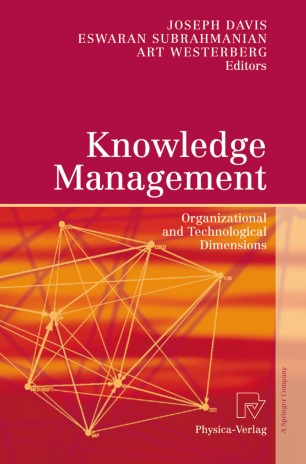
Knowledge Management : Organizational and Technological Dimensions
Presents a unique blend of articles which combines both conceptual and practical concerns related to devising and implementing sustainable Knowledge Management systems and solutions in contemporary global organizations. The book's contributors are among the leading thinkers and practitioners in this growing field. The seamless synthesis of the human, organizational, and technological dimensions of Knowledge Management makes this book a definitive guide for academics and practising managers alike.

Knowledge Integration : The Practice of Knowledge Management in Small and Medium Enterprises
The ability to manage knowledge is relevant for millions of small and medium sized enterprises (SMEs) that operate in high-tech environments. They strongly depend on external knowledge about customers, technologies, and competitors because, as opposed to large companies, they have limited internal knowledge resources and little power to control their business environments.
Knowledge graphs and big data processing
This book is part of the LAMBDA Project (Learning, Applying, Multiplying Big Data Analytics), funded by the European Union, GA No. 809965. Data Analytics involves applying algorithmic processes to derive insights.
Knowledge and Skill Chains in Engineering and Manufacturing : Information Infrastructure in the Era of Global Communications
Explores knowledge and skill chains in engineering and manufacturing in the age of global communications. Information infrastructure involves a range of activities from product planning, engineering, and manufacturing trough transportation, marketing, and repair/upgrade to returns and recycling/disposal. Distinct from the traditional engineering database, life-cycle support information has its own characteristic requirements, -- flexible extensibility, distributed architecture, multiple viewpoints, long-time archiving, and product usage information. Several authors address the architecture of the information infrastructure, its services and its requirements. Other papers focus on the knowledge and skill chains that develop in a variety of situations: the supply chain, the factory floor, the man-system interaction, etc. For each of these, state-of-the-art and state-of-research scenarios for various industrial sectors address both engineering and operations requirements in the current socio-economic environment.

Key Aspects of German Business Law : A Practical Manual
This book presents a clear and precise overview of the key aspects of German business law. It was written by attorneys involved in the daily practice of business law in Germany and is aimed at people who wish to orient themselves quickly with the German legal system and the manner in which it impacts business purchases, establishment, operations and liquidations. The first section of the book is devoted to an explanation of the major issues to be considered in acquiring or establishing a business in Germany. The second section focuses on areas of commercial law that are important for an operating business. The following sections deal with labor law as an independent part of German business law and with computer law. Furthermore, procedural law and European law are addressed. Finally, the last two sections of the book are devoted to an overview over the German tax law, which has an enormous impact on business decisions, and IP law.
