



الصفحة 48
الصفحة 48

Computer vision / computer graphics collaboration Techniques ; 3rd International Conference on Computer Vision/Computer Graphics, MIRAGE 2007, Rocquencourt, France, March 28-30, 2007, Proceedings
This volume contains foundational, methodological, and application issues.

Computer Vision -- ECCV 2006 ; Vol. 3954 ; 9th European Conference on Computer Vision, Graz, Austria, May 7-13, 2006, Proceedings, Part IV
Constitutes the refereed proceedings of the 9th European Conference on Computer Vision, 2006. This book covers a range of issues in computer vision, on recognition, statistical models and visual learning, 3D reconstruction and multi-view geometry, energy minimization, tracking and motion, segmentation, shape from X, visual tracking, and more.

Computer Vision -- ECCV 2006 ; Vol. 3953 ; 9th European Conference on Computer Vision, Graz, Austria, May 7-13, 2006, Proceedings, Part III
Constitutes the refereed proceedings of the 9th European Conference on Computer Vision, 2006. This book covers a range of issues in computer vision, on recognition, statistical models and visual learning, 3D reconstruction and multi-view geometry, energy minimization, tracking and motion, segmentation, shape from X, visual tracking, and more.

Computer Vision -- ECCV 2006 ; Vol. 3952 ; 9th European Conference on Computer Vision, Graz, Austria, May 7-13, 2006, Proceedings, Part II
Constitutes the refereed proceedings of the 9th European Conference on Computer Vision, 2006. This book covers a range of issues in computer vision, on recognition, statistical models and visual learning, 3D reconstruction and multi-view geometry, energy minimization, tracking and motion, segmentation, shape from X, visual tracking, and more.

Computer Vision – ACCV 2007 ; 8th Asian Conference on Computer Vision, Tokyo, Japan, November 18-22, 2007, Proceedings, Part I
Contains sections on shape and texture, fitting, calbration, detection, image and video processing, applications, face and gesture, tracking, camera networks, and face/gesture/action detection and recognition. This book also covers learning, motion and tracking, retrival and search, and human pose estimation.

Computer Vision - ACCV 2006 ; Vol. 3852 ; 7th Asian Conference on Computer Vision, Hyderabad, India, January 13-16, 2006, Proceedings, Part II
ACCV has been making its rounds through the Asian landscape and came to India this year. Interest in computer vision is increasing and ACCV 2006 attracted about 500 submission. The evaluation team consisted of 27 experts serving as Area Chairs and about 270 reviewers in all. The whole process was conducted electronically in a double-blind manner,a ?rstfor ACCV.

Computer Vision - ACCV 2006 ; Vol. 3851 ; 7th Asian Conference on Computer Vision, Hyderabad, India, January 13-16, 2006, Proceedings, Part I
proceedings. ACCV has been making its rounds through the Asian landscape and came to India this year. Interest in computer vision is increasing and ACCV 2006 attracted about 500 submission. The evaluation team consisted of 27 experts serving as Area Chairs and about 270 reviewers in all. The whole process was conducted electronically in a double-blind manner,a ?rstfor ACCV.

Computer Supported Cooperative Work in Design IV ; 11th International Conference, CSCWD 2007, Melbourne, Australia, April 26-28, 2007. Revised Selected Papers
This book constitutes the thoroughly refereed post-conference proceedings of the 11th International Conference on Computer Supported Cooperative Work in Design, CSCWD 2007, held in Melbourne, Australia, in April 2007.
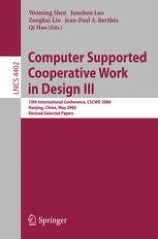
Computer Supported Cooperative Work in Design III ; 10th International Conference, CSCWD 2006, Nanjing, China, May 3-5, 2006, Revised Selected Papers
The design of complex artifacts and systems requires the cooperation of multidiscip- nary design teams using multiple commercial and proprietary engineering software tools (e.g., CAD, modeling, simulation, visualization, and optimization), engineering databases, and knowledge-based systems. Individuals or individual groups of mult- isciplinary design teams usually work in parallel and separately with various en- neering software tools which are located at different sites. In addition, individual members may be working on different versions of a design or viewing the design from different perspectives, at different levels of detail. In order to accomplish the work, it is necessary to have effective and efficient c- laborative design environments. Such environments should not only automate in- vidual tasks, in the manner of traditional computer-aided engineering tools, but also enable individual members to share information, collaborate, and coordinate their activities within the context of a design project. CSCW (computer-supported coope- tive work) in design is concerned with the development of such environments.
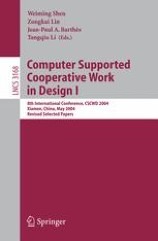
Computer Supported Cooperative Work in Design I
The design of complex artifacts and systems requires the cooperation of multidisciplinary design teams using multiple commercial and non-commercial engineering tools such as CAD tools, modeling, simulation and optimization software, engineering databases, and knowledge-based systems. Individuals or individual groups of multidisciplinary design teams usually work in parallel and separately with various engineering tools, which are located on different sites, often for quite a long time. At any moment, individual members may be working on different versions of a design or viewing the design from various perspectives, at different levels of detail. In order to meet these requirements, it is necessary to have effective and efficient collaborative design environments. These environments should not only automate individual tasks, in the manner of traditional computer-aided engineering tools, but also enable individual members to share information, collaborate and coordinate their activities within the context of a design project. CSCW (computer-supported cooperative work) in design is concerned with the development of such environments.

Computer simulations in condensed matter : From materials to chemical biology ; Vol.1
This extensive and comprehensive collection of lectures by world-leading experts in the field introduces and reviews all relevant computer simulation methods and their applications in condensed matter systems. Volume 1 is an in-depth introduction to a vast spectrum of computational techniques for statistical mechanical systems of condensed matter. It will enable the graduate student and both the specialist and nonspecialist researcher to get acquainted with the tools necessary to carry out numerical simulations at an advanced level. Volume 2 published as LNP 704 (ISBN 3-540-35283-X) is a collection of state-of-the-art surveys on numerical experiments carried out for a great number of systems, ranging from materials sciences to chemical biology.
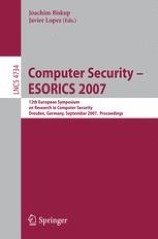
Computer Security – ESORICS 2007 ; 12th European Symposium On Research In Computer Security, Dresden, Germany, September 24 - 26, 2007, Proceedings
This book address issues such as data protection; security protocols; systems; web and network security; privacy; threat modeling and detection; information flow; and security in emerging applications such as cryptocurrencies, the Internet of Things and automotive.

Computer Security – ESORICS 2006 ; 11th European Symposium on Research in Computer Security, Hamburg, Germany, September 18-20, 2006, Proceedings
This book constitutes the refereed proceedings of the 11th European Symposium on Research in Computer Security, ESORICS 2006. it presents original research contributions, case studies and implementation experiences addressing any aspect of computer security - in theory, mechanisms, applications, or practical experience.

Computer safety, reliability, and security ; Vol. 4166 ; 25th International Conference, SAFECOMP 2006, Gdansk, Poland, September 27-29, 2006, Proceedings
The conference focuses on the state of the art, expe- ence and new trends in the areas of safety, security and reliability of critical IT systems and applications and serves as a platform for knowledge and technology transfer for researchers, industry (suppliers, operators, users), regulators and certi?ers of such systems. SAFECOMP provides ample opportunity to exchange insights and experiences on emerging methods, approaches and practical so- tions to safety, security and reliability problems across the borders of di?erent application domains and technologies.

Computer safety, reliability, and security ; Vol. 3688
This book constitutes the refereed proceedings of the 24th International Conference on Computer Safety, Reliability, and Security, SAFECOMP 2005, held in Fredrikstad, Norway, in September 2005. The 30 revised full papers were carefully reviewed and selected for inclusion in the book. The papers address all aspects of dependability and survivability of critical computerized systems in various branches and infrastructures.

Computer safety, reliability, and security ; 26th International Conference, SAFECOMP 2007, Nurmberg, Germany, September 18-21, 2007, Proceedings
It' s important to improving the state of the art of highly depe- able computer-based systems, since then increasingly applied to safety-relevant industrial domains.This book included a considerable number of contributions addressing technical problems and engineering solutions across the border between safety-related and securi- related concerns.

Computer Music Modeling and Retrieval. Sense of Sounds ; 4th International Symposium, CMMR 2007, Copenhagen, Denmark, August 27-31, 2007. Revised Papers
This book constitutes the thoroughly refereed post-conference proceedings of the 4th International Computer Music Modeling and Retrieval Symposium, CMMR 2007, held in Copenhagen, Denmark, in August 2007 jointly with the International Computer Music Conference 2007, ICMC 2007.

Computer Music Modeling and Retrieval Vol. 3902 ; 3rd International Symposium, CMMR 2005, Pisa, Italy, September 26-28, 2005, Revised Papers
This book constitutes the thoroughly refereed post-proceedings of the Third International Computer Music Modeling and Retrieval Symposium, CMMR 2005. the papers address a broad variety of topics. The papers are organized in topical sections on sound synthesis; music perception and cognition; interactive music: interface, interaction, gestures and sensors, music composition; music retrieval: music performance, music analysis, music representation; as well as interdisciplinarity and computer music.

Computer Music Modeling and Retrieval ; Vol. 3310
This volume contains the final proceedings for the 2004 Computer Music Model-ing and Retrieval Symposium (CMMR 2004). CMMR is an annualevent focusing on important aspects of computer music. CMMR 2004 is the sec-ond event in this series. The use of computers in music is well established. CMMR 2004 provided aunique opportunity to meet and interact with peers concerned with the cross-influence of the technological and creative in computer music. The field of com-puter music is interdisciplinary by nature and closely related to a number of com-puter science and engineering areas such as information retrieval, programming,human computer interaction, digital libraries, hypermedia, artificial intelligence,acoustics, signal processing, etc. The event gathered many interesting people(researchers, educators, composers, performers, and others). There were manyhigh-quality keynote and paper presentations, that fostered inspiring discussions.

Computer graphics and geometric modelling : Implementation & algorithms
Possibly the most comprehensive overview of computer graphics as seen in the context of geometric modelling, this two volume work covers implementation and theory in a thorough and systematic fashion. Computer Graphics and Geometric Modelling: Implementation and Algorithms, covers the computer graphics part of the field of geometric modelling and includes all the standard computer graphics topics. The first part deals with basic concepts and algorithms and the main steps involved in displaying photorealistic images on a computer. The second part covers curves and surfaces and a number of more advanced geometric modelling topics including intersection algorithms, distance algorithms, polygonizing curves and surfaces, trimmed surfaces, implicit curves and surfaces, offset curves and surfaces, curvature, geodesics, blending etc. The third part touches on some aspects of computational geometry and a few special topics such as interval analysis and finite element methods. The volume includes two companion programs.
