



الصفحة 47
الصفحة 47

Leveraging applications of formal methods, verification and validation : Verification Principles ; 9th International Symposium on Leveraging Applications of Formal Methods, ISoLA 2020, Rhodes, Greece, October 20–30, 2020, Proceedings, Part I
Constitutes the refereed proceedings of the 9th International Symposium on Leveraging Applications of Formal Methods, ISoLA 2020, which was planned to take place during October 20–30, 2020, on Rhodes, Greece. The papers presented were carefully reviewed and selected for inclusion in the proceedings. Each volume focusses on an individual topic with topical section headings within the volume : Part I, Verification Principles : Modularity and (De-)Composition in Verification ; X-by-Construction: Correctness meets Probability ; 30 Years of Statistical Model Checking ; Verification and Validation of Concurrent and Distributed Systems.

Leveraging applications of formal methods, verification and validation : Engineering Principles ; 9th International Symposium on Leveraging Applications of Formal Methods, ISoLA 2020, Rhodes, Greece, October 20–30, 2020, Proceedings, Part II
Constitutes the refereed proceedings of the 9th International Symposium on Leveraging Applications of Formal Methods, ISoLA 2020, which was planned to take place during October 20–30, 2020, on Rhodes, Greece. The event itself was postponed to 2021 due to the COVID-19 pandemic. The papers presented were carefully reviewed and selected for inclusion in the proceedings. Each volume focusses on an individual topic with topical section headings within the volume: Part II, Engineering Principles : Automating Software Re-Engineering ; Rigorous Engineering of Collective Adaptive Systems.

Leveraging applications of formal methods, verification and validation : Applications ; 9th International Symposium on Leveraging Applications of Formal Methods, ISoLA 2020, Rhodes, Greece, October 20–30, 2020, Proceedings, Part III
The three-volume set LNCS 12476 - 12478 constitutes the refereed proceedings of the 9th International Symposium on Leveraging Applications of Formal Methods, ISoLA 2020, which was planned to take place during October 20–30, 2020, on Rhodes, Greece. The event itself was postponed to 2021 due to the COVID-19 pandemic. The papers presented were carefully reviewed and selected for inclusion in the proceedings. Each volume focusses on an individual topic with topical section headings within the volume: Part III, Applications: Reliable Smart Contracts: State-of-the-art, Applications, Challenges and Future Directions; Automated Verification of Embedded Control Software; Formal methods for DIStributed COmputing in future RAILway systems.
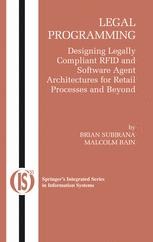
Legal Programming : Designing Legally Compliant RFID and Software Agent Architectures for Retail Processes and Beyond
LEGAL PROGRAMMING: Designing Legally Compliant RFID and Software Agent Architectures for Retail Processes and Beyond provides a process-oriented discussion of the legal concerns presented by agent-based technologies, processes and programming. It offers a general outline of the potential legal difficulties that could arise in relation to them, focusing on the programming of negotiation and contracting processes in a privacy, consumer and commercial context. The authors will elucidate how it is possible to create form of legal framework and design methodology for transaction agents, applicable in any environment and not just in a specific proprietary framework, that provides the right level of compliance and trust. Key elements considered include the design and programming of legally compliant methods, the determination of rights in respect of objects and variables, and ontologies and programming frameworks for agent interactions. Examples are used to illustrate the points made and provide a practical perspective.

Learning to Live in the Knowledge Society ; IFIP 20th World Computer Congress, IFIP TC 3 ED-L2L Conference September 7–10, 2008, Milano, Italy
The IFIP series publishes state-of-the-art results in the sciences and technologies of information and communication. The scope of the series includes: foundations of computer science; software theory and practice; education; computer applications in technology; communication systems; systems modeling and optimization; information systems; computers and society; computer systems technology; security and protection in information processing systems; artificial intelligence; and human-computer interaction. Proceedings and post-proceedings of refereed international conferences in computer science and interdisciplinary fields are featured. These results often precede journal publication and represent the most current research.

Learning Classifier Systems ; 10th International Workshop, IWLCS 2006, Seattle, MA, USA, July 8, 2006 and 11th International Workshop, IWLCS 2007, London, UK, July 8, 2007, Revised Selected Papers
Constitutes the thoroughly refereed joint post-conference proceedings of two consecutive International Workshops on Learning Classifier Systems that took place in Seattle, WA, USA in July 2006, and in London, UK, in July 2007 - all hosted by the Genetic and Evolutionary Computation Conference, GECCO.The 14 revised full papers presented were carefully reviewed and selected from the workshop contributions. The papers are organized in topical sections on knowledge representation, analysis of the system, mechanisms, new directions, as well as applications.

Learning and Intelligent Optimization ; 2nd International Conference, LION 2007 II, Trento, Italy, December 8-12, 2007. Selected Papers
The papers cover current issues of machine learning, artificial intelligence, mathematical programming and algorithms for hard optimization problems and are organized in topical sections on improving optimization through learning, variable neighborhood search, insect colony optimization, applications, new paradigms, cliques, stochastic optimization, combinatorial optimization, fitness and landscapes, and particle swarm optimization.

Learning and Adaption in Multi-Agent Systems ; 1st International Workshop, LAMAS 2005, Utrecht, The Netherlands, July 25, 2005, Revised Selected Papers
Contains selected and revised papers of the International Workshop on Lea- ing and Adaptation in Multi-Agent Systems (LAMAS 2005), held at the AAMAS 2005 Conference in Utrecht, The Netherlands, July 26. An important aspect in multi-agent systems (MASs) is that the environment evolves over time, not only due to external environmental changes but also due to agent int- actions. For this reason it is important that an agent can learn, based on experience, and adapt its knowledge to make rational decisions and act in this changing environment autonomously. Machine learning techniques for single-agent frameworks are well established. Agents operate in uncertain environments and must be able to learn and act - tonomously. This task is, however, more complex when the agent interacts with other agents that have potentially different capabilities and goals. The single-agent case is structurally different from the multi-agent case due to the added dimension of dynamic interactions between the adaptive agents. Multi-agent learning, i.e., the ability of the agents to learn how to cooperate and compete, becomes crucial in many domains. Autonomous agents and multi-agent systems (AAMAS) is an emerging multi-disciplinary area encompassing computer science, software engineering, biology, as well as cognitive and social sciences. A t- oretical framework, in which rationality of learning and interacting agents can be - derstood, is still under development in MASs, although there have been promising ?

Lean Business Systems and Beyond ; 1st IFIP TC 5 Advanced Production Management Systems Conference (APMS’2006), Wroclaw, Poland, September 18-20, 2006
Includes : foundations of computer science; software theory and practice; education; computer applications in technology; communication systems; systems modeling and optimization; information systems; computers and society; computer systems technology; security and protection in information processing systems; artificial intelligence; and human-computer interaction. Proceedings and post-proceedings of referred international conferences in computer science and interdisciplinary fields are featured.
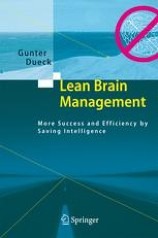
Lean Brain Management : More Success and Efficiency by Saving Intelligence
Intelligence is wasted on problems that themselves have been caused by an excess of intelligence. Lean Brain Management strives toward uncompromising Lean Brain Quality. Lean Brain stands for consistent economization of intelligence in all realms of life: Intelligent systems will only be operated by unskilled workers. Education, universities, and schools would become obsolete. A week of training would be enough for virtually any job. ("You are now the physician for the measles in the State of Ohio. In response to phone calls, send this prescription.") Lean Brain is not aimed at dumbing down! Lean Brain can survive on just a very small amount of central intelligence. Potential savings amount to trillions! This is demonstrated using Germany as an example. With this book, Dueck presents a radical suggestion for world improvement. The desire to laugh infinitely about it will eventually segue into a collective rude awakening. The book contains concrete advice for managers to economize on intelligence, and is thus--in keeping with the theme--written in an easy-to-read fashion.

Leading edge technologies in fashion innovation : Product design and development process from materials to the end products to consumers
Offers cutting-edge knowledge on various design and product development related technologies, and applications of these technologies in fashion. Further, it envisions the future of these technologies when designing and engineering apparel-related products.

Leadership today : Practices for personal and professional performance
Provides a clear understanding of leadership needs in today’s business world, explained within the scope of hard and soft leadership skills. It captures qualities and skills such as spirituality, empathy, moral behavior, mindfulness, empathy, problem solving, self-confidence, ambition, knowledge, global understanding, and information technology. This text explains and provides guidelines for the implementation of each skill and includes examples from contemporary and historical leaders inviting the reader to consider each quality and engage in self-reflection. This book deviates from excessive theoretical descriptions presenting a timely, hands-on approach to leadership.

Layce (Image data poisoning) = لايس (تسميم بيانات الصور )
The ongoing growth of image generative artificial intelligence models was paved with existing drawings and art pieces by great artists both past and present, and while generative models are very useful and helpful, there is the issue of the origin of the datasets trained on, and the morality of usage regarding copyrights and artistic identity. A novel line of defense that helps artists and visual content creators actively protect their pieces emerged, dubbed Data Poisoning and it works by misleading Artificial Intelligence models that attempt to use a Poisoned Image for training, or as a reference, as the Poisoned Image will appear to the human eye identical to the original art piece, while the Artificial Intelligence model will be seeing a remarkably different image, causing generative models to generate false positive results when given a prompt poisoned by the author or when trained on data poisoned by the original owner. This study aims to study image data poisoning methods and technologies, and build an application containing multiple image models, and poisoning models as well, accompanied by a Community for artists to share art and interact with each other.

Languages, Methodologies and Development Tools for Multi-Agent Systems ; 1st International Workshop, LADS 2007, Durham, UK, September 4-6, 2007. Revised Selected Papers
Constitutes the thoroughly refereed post-workshop proceedings of the First International Workshop on Languages, Methodologies and Development Tools for Multi-Agent Systems, LADS 2007, held in Durham, UK, in September 2007. The workshop was part of MALLOW 2007, a federation of workshops on Multi-Agent Logics, Languages, and Organizations.

Languages and Compilers for Parallel Computing ; 21th International Workshop, LCPC 2008, Edmonton, Canada, July 31 - August 2, 2008, Revised Selected Papers
This book constitutes the thoroughly refereed post-conference proceedings of the 21th International Workshop on Languages and Compilers for Parallel Computing, LCPC 2008, held in Edmonton, Canada, in July/August 2008.The 18 revised full papers and 6 revised short papers presented were carefully reviewed and selected from 35 submissions. The papers address all aspects of languages, compiler techniques, run-time environments, and compiler-related performance evaluation for parallel and high-performance computing and comprise

Languages and Compilers for Parallel Computing ; 20th International Workshop, LCPC 2007, Urbana, IL, USA, October 11-13, 2007, Revised Selected Papers
This book constitutes the thoroughly refereed post-conference proceedings of the 20th International Workshop on Languages and Compilers for Parallel Computing, LCPC 2007, held in Urbana, IL, USA, in October 2007.The 23 revised full papers presented were carefully reviewed and selected from 49 submissions. The papers are organized in topical sections on reliability, languages, parallel compiler technology, libraries, run-time systems and performance analysis, and general compiler techniques.

Language Technologies for the Challenges of the Digital Age ; 27th International Conference, GSCL 2017, Berlin, Germany, September 13-14, 2017, Proceedings
Constitutes the refereed proceedings of the 27th biennial conference of the German Society for Computational Linguistics and Language Technology, GSCL 2017, held in Berlin, Germany, in September 2017, which focused on language technologies for the digital age. The 16 full papers and 10 short papers included in the proceedings were carefully selected from 36 submissions. Topics covered include text processing of the German language, online media and online content, semantics and reasoning, sentiment analysis, and semantic web description languages.
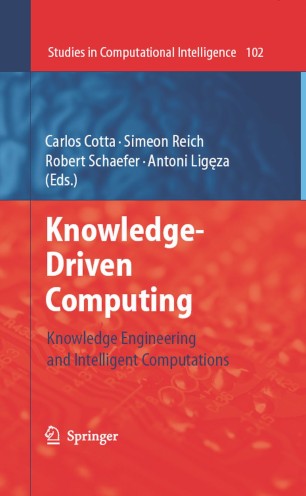
Knowledge-Driven Computing : Knowledge Engineering and Intelligent Computations
Knowledge-Driven Computing constitutes an emerging area of intensive research located at the intersection of Computational Intelligence and Knowledge Engineering with strong mathematical foundations. It embraces methods and approaches coming from diverse computational paradigms, such as evolutionary computation and nature-inspired algorithms, logic programming and constraint programming, rule-based systems, fuzzy sets and many others. The use of various knowledge representation formalisms and knowledge processing and computing paradigms is oriented towards the efficient resolution of computationally complex and difficult problems.
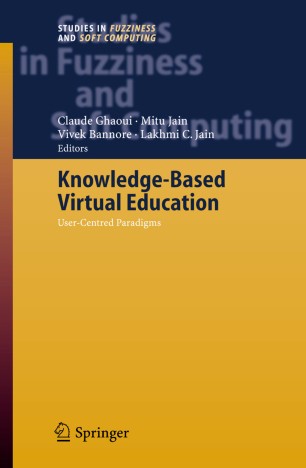
Knowledge-Based Virtual Education : User-Centred Paradigms
The book covers a multitude of important issues on the subject of "Innovations in Knowledge-Based Virtual Education ", aiming at researchers and practitioners from academia, industry, and government. The carefully selected contributions report on research, development and real-world experiences of virtual education.

Knowledge-Based Intelligent Information and Engineering Systems ; Vol.3684 : 9th International Conference, KES 2005, Melbourne, Australia, September 14-16, 2005, Proceedings, Part IV
The KES conference series has been established for almost a decade, and it cont- ues each year to attract participants from all geographical areas of the world, including Europe, the Americas, Australasia and the Paci?c Rim. The KES conferences cover a wide range of intelligent systems topics. The broad focus of the conference series is the theory and applications of intelligent systems. From a pure research ?eld, intel- gent systems have advanced to the point where their abilities have been incorporated into many business and engineering application areas. KES 2005 provided a valuable mechanism for delegates to obtain an extensive view of the latest research into a range of intelligent-systems algorithms, tools and techniques. The conference also gave de- gates the chance to come into contact with those applying intelligent systems in diverse commercial areas. The combination of theory and practice represented a unique opp- tunity to gain an appreciation of the full spectrum of leading-edge intelligent-systems activity. The papers for KES 2005 were either submitted to invited sessions, chaired and organized by respected experts in their ?elds, or to a general session, managed by an extensive International Program Committee, or to the Intelligent Information Hiding and Multimedia Signal Processing (IIHMSP) Workshop, managed by an International Workshop Technical Committee.
