



الصفحة 44
الصفحة 44
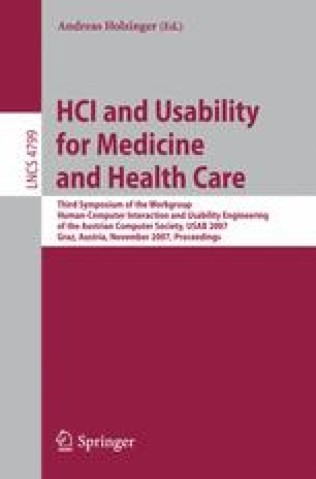
HCI and usability for medicine and health care ; 3rd Symposium of the Workgroup Human-computer interaction and usability engineering of the Austrian Computer Society, USAB 2007 Graz, Austria, November, 22, 2007, Proceedings
The work group Human–Computer Interaction & Usability Engineering (HCI&UE) of the Austrian Computer Society (OCG) serves as a platform for interdisciplinary exchange, research and development. Our 2007 topic was “Human–Computer Interaction for Medicine and Health Care” (HCI4MED), Medical information systems are already extremely sophisticated and technological performance increases exponentially.
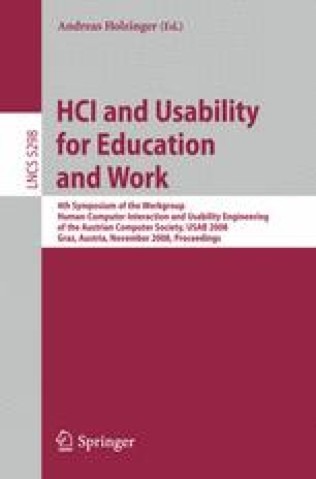
HCI and usability for education and work ; 4th Symposium of the Workgroup Human-Computer Interaction and Usability Engineering of the Austrian Computer Society, USAB 2008, Graz, Austria, November 20-21, 2008. Proceedings
This book constitutes the refereed proceedings of the 4th Usability Symposium of the Human-Computer Interaction and Usability Engineering Workgroup of the Austrian Computer Society, USAB 2008, held in Graz, Austria, in November 2008.The 7 revised full papers and 26 revised short papers presented were carefully reviewed and selected from 85 submissions. The papers are organized in topical sections on cognitive processes and end user experience, social software and collaborative knowledge development, knowledge processing, assessment and human performance.

Hardware and software : Verification and testing ; 3rd International Haifa Verification Conference, HVC 2007, Haifa, Israel, October 23-25, 2007. Proceedings
These are the conference proceedings of the 4th Haifa Verifcation Conference, held October 27–30, 2008 in Haifa, Israel. This international conference is a unique venue that brings together leading researchers and practitioners of both formal and dynamic verifcation, for both hardware and software systems. This year’s conference extended the successes of the previous years, with a largejumpinthenumberofsubmitted papers. with many more high-quality papers than we had room to accept. Submissions came from 19 di?erent countries, re?ecting the growing international visibility of the conference. Of the 49 submissions, 43 were regular papers, 2 of which were later withdrawn, and 6 were tool papers. After a rigorous review process.

Hardware and software : Verification and testing ; 1st International Haifa Verification Conference, Haifa, Israel, November 13-16, 2005, Revised Selected Papers
The First Haifa Verification Conference was held at the IBM Haifa Research Lab and at the Haifa University in Israel from November 13 to16, 2005. The conference incorporated three different workshops that took place separately in previous years. The IBM Verification Workshop is now its sixth year, the IBM Software Testing Workshop is now in its fourth year, and the PADTAD Workshop on testing and debugging multi-threaded and parallel software was held for the third time. The Verification Conference was a three-day, single-track conference followed by a one-day tutorial on the testing and review of multi-threaded code. The conference presented a unique combination of fields that brought together the hardware and software testing communities. Merging the different communities under a single roof gave the conference a distinctive flavor and provided the participants with added benefits. While the applications in these separate fields are different, the techniques used are often very similar. By offering lectures in these disparate but related disciplines, the conference engendered an environment of collaboration and discovery.

Haptics : Perception, Devices and Scenarios ; 6th International Conference, EuroHaptics 2008 Madrid, Spain, June 10-13, 2008 Proceedings
This book constitutes the refereed proceedings of the 6th International Conference on Human Haptic Sensing and Touch Enabled Computer Applications, EuroHaptics 2008, held in Madrid, Spain, in June 2008.The 119 revised full papers presented were carefully reviewed and selected from 150 submissions. The papers are organized in topical sections on control and technology, haptic perception and psychophysics, haptic devices, haptics rendering and display, multimodal interaction and telepresence, as well as haptic applications.

Haptic and Audio Interaction Design ; 3rd International Workshop, HAID 2008 Jyväskylä, Finland, September 15-16, 2008 Proceedings
This book constitutes the refereed proceedings of the Third International Workshop on Haptic and Audio Interaction Design, HAID 2008 held in Jyväskylä, Finland, in September 2008.The 13 revised full papers presented were carefully reviewed and selected for inclusion in the book. The papers are organized in topical sections on visual impairment, applications of multimodality, evaluation, conceptual integration of audio and haptics, interaction techniques, and perception.

Haptic and Audio Interaction Design ; 2nd International Workshop, HAID 2007 Seoul, Korea, November 29-30, 2007 Proceedings
This book constitutes the refereed proceedings of the Second International Workshop on Haptic and Audio Interaction Design, HAID 2007 held in Seoul, South Korea, in November 2007. The papers are organized in topical sections on tactile displays, communication and games, accessibility and navigation, as well as design.

Haptic and Audio Interaction Design ; 1st International Workshop, HAID 2006, Glasgow, UK, August 31 - September 1, 2006, Proceedings
Overview The International Workshop on Haptic and Audio Interaction Design was - ganized as part of the EPSRC-funded MultiVis project. The main focus of the workshop was to investigate how the modalities of sound and haptics (touch) could be used together in interaction, and what novel interfaces could be p- vided when they are used in conjunction. What are the relative advantages of each of the modalities when used alone and together? Are there reasons why haptic-based information is moreuseful in certain situations than equivalent - dio information? How can di?erent modalities be used together to create c- pelling and useful interaction with computer-based systems?

Handbook to the Construction and Use of Insect Collection and Rearing Devices : A guide for teachers with suggested classroom applications
The purpose of this book is to explain how to build and use insect collecting and rearing devices and through explanations of the various techniques stimulate educators to explore the study of insects in their classrooms. Insects are often given little consideration with regard to humane handling practices. Please remember that insects are living creatures and, as such, are entitled to the same treatment as other living creatures.

Handbook on Information Technology in Finance
This Handbook contains surveys of state-of-the-art concepts, systems, applications, best practices as well as contemporary research in the intersection between IT and finance. Included are recent trends and challenges, IT systems and architectures in finance, essential developments and case studies on management information systems, service oriented architecture modelling, IT architectures for securities trading, IT-systems in banking, process-oriented systems in corporate treasuries, grid computing and networking. The IT applications in banking, trading and insurance cover risk management and controlling, financial portals, electronic payment and others. In addition, also finance-related IT applications in non-financial companies are considered. The concept-oriented part of the book focuses on IT methods in finance like financial models and modelling financial data, planning and processes, security, algorithms and complexity.

Handbook on Decision Support Systems 2 : Variations
As the most comprehensive reference work dealing with decision support systems (DSS), this book is essential for the library of every DSS practitioner, researcher, and educator. Written by an international array of DSS luminaries, its more than 70 chapters approach decision support systems from a wide variety of perspectives ranging from classic foundations to cutting-edge thought, informative to provocative, theoretical to practical, historical to futuristic, human to technological, and operational to strategic. The chapters are conveniently organized into 10 major sections: foundations of decision support systems, DSS fundamentals, multiparticipant DSSs, intelligent DSSs, effects of decision support, time & space issues, scopes of decision support, developing & managing decision support systems, cases &applications, and decision support horizons. Novices and experts alike will refer to the authoritative and stimulating content again and again for years to come.

Handbook on Decision Support Systems 1 : Basic Themes
Decision support systems have experienced a marked increase in attention and importance over the past 25 years. The aim of this book is to survey the decision support system (DSS) field – covering both developed territory and emergent frontiers. It will give the reader a clear understanding of fundamental DSS concepts, methods, technologies, trends, and issues. It will serve as a basic reference work for DSS research, practice, and instruction. To achieve these goals, the book has been designed according to a ten-part structure, divided in two volumes with chapters authored by well-known, well-versed scholars and practitioners from the DSS community.

Handbook on Architectures of Information Systems
This book is the first volume of a running series under the title Inter- tional Handbooks on Information Systems. The series is edited by Peter Bernus, Jacek Blazewicz, Günter Schmidt and Mike Shaw. One objective is to give state of the art surveys on selected topics of information systems theory and applications. To this end, a distinguished international group of academics and practitioners are invited to provide a reference source not only for problem solvers in business, industry, and government but also for professional researchers and graduate students.

Handbook of topological fixed point theory
This book is the first in the world literature presenting all new trends in topological fixed point theory. Until now all books connected to the topological fixed point theory were devoted only to some parts of this theory. The content is also likely to stimulate the interest of mathematical economists, population dynamics experts as well as theoretical physicists exploring the topological dynamics.

Handbook of Response to Intervention : The Science and Practice of Assessment and Intervention
Education professionals have traditionally relied on a wait-to-fail formula to identify and assist students experiencing academic difficulties. With the reauthorization of the Individuals with Disabilities Education Improvement Act, however, a unique early-identification tool – known as response to intervention (RTI) – now offers professionals the option of implementing a collaborative, problem-solving tool designed to ensure that all students achieve academic success.

Handbook of research on nano-drug delivery and tissue engineering : Guide to strengthening healthcare systems
Provides an important and valuable collection of research accomplishments in nanomedicine, drug delivery, tissue engineering, processing, formulations, and their applications. Addresses topical issues in nano-drug delivery and nanotechnological approaches to tissue engineering. The first section offers research on a variety of diverse nano-based drug delivery systems, along with discussions of their efficacy, safety, toxicology, and applications for different purposes. Focusing on nanotechnology approaches to tissue engineering, part two of the volume considers the use of hydrogel systems, nanoceria and micro- and nano-structured biomaterials for bone tissue engineering, mesenchymal stem cells, and more. This volume is a systematic scientific reference of the novel research developments specifically in this area. The editors give special emphasis on the new trends and developments in the field of nanomedicine that will be very helpful for pharmaceutical and medical researchers, scientists, faculty, and students.

Handbook of Radiopharmaceuticals : Methodology and Applications ; 2nd ed.
A comprehensive review of the field, presenting up-to-date coverage of central topics such as radionuclide production, synthetic methodology, radiopharmaceutical development and regulations, and a wide range of practical applications. A valuable reference work for those new to the Radiopharmaceutical Sciences and experienced professionals alike, this volume explores the latest concepts and issues involving both targeted diagnostic and therapeutic radiopharmaceuticals. Contributions from a team of experts from across sub-disciplines provide readers with an immersive examination of radiochemistry, nuclear medicine, molecular imaging, and more. Features extensive new and revised content throughout Covers key areas of application for diagnosis and therapy in oncology, neurology, and cardiology Emphasizes the multidisciplinary nature of Radiopharmaceutical Sciences Discusses how drug companies are using modern radiopharmaceutical imaging techniques to support drug discovery Examines current and emerging applications of Positron Emission Tomography (PET) and Single Photon Emission Computed Tomography (SPECT)

Handbook of public finance
The Handbook of Public Finance provides a definitive source, reference, and text for the field of public finance. In 18 chapters it surveys the state of the art - the tradition and breadth of the field but also its current status and recent developments. The Handbook's intellectual foundation and orientation is truly multidisciplinary. Throughout its examination of the standard material of public finance, it explores the connections between that material and such neighboring fields as political science, sociology, law, and public administration.

Handbook of production scheduling
The HANDBOOK OF PRODUCTION SCHEDULING concentrates on real-world production scheduling in factories and industrial settings. It includes industry case studies that use innovative techniques as well as academic research results that can be used to improve real-world production scheduling. Its purpose is to present scheduling principles, advanced tools, and examples of innovative scheduling systems to persons who could use this information to improve production scheduling in their own organization.

Handbook of Practical X-Ray Fluorescence Analysis
X-Ray Fluorescence analysis (XRF) is a reliable multi-elemental and nondestructive analytical method widely used in research and industrial applications. This practical handbook provides self-contained modules featuring XRF instrumentation, quantification methods, and most of the current applications. The book gives a survey of the theoretical fundamentals, analytical instrumentation, software for data processing, various excitation regimes including gracing incidents and microfocus measurements, quantitative analysis, applications in routine and micro analysis, mineralogy, biology, medicine, criminal investigations, archeology, metallurgy, abrasion, microelectronics, environmental air and water analysis. It gives the basic knowledge on this technique, information on analytical equipment and guides the reader to the various applications.
