



الصفحة 41
الصفحة 41

Conjoint measurement : Methods and applications
Covering developments in Conjoint Analysis, this book presents the theory and applications of this technique. It discusses: normative models that maximize return, extension of choice-based conjoint simulations, latent class, hierarchical Bayes modelling, choice simulators, and normative models for representing competitive actions and reactions.

Congruency, Expectations and Consumer Behavior in Digital Environments
A progress in technologies, the increasing expansion and use of digital environments lead to remarkable shifts of business activities. These transformations not only impact business but also affect consumers’ attitudes, beliefs, and practices. Thus, Frederic Nimmermann sheds light on consumer behavior in central subareas in digital environments such as advertising.

Conducting Quantitative Research In Education
provides a clear and straightforward guide for all those seeking to conduct quantitative research in the field of education, using primary research data samples. While positioned as less powerful and somehow inferior, non-parametric tests can be very useful where the research can only be designed to accommodate data structure which is ordinal, or scale but violates a normality assumption, which is required for parametric tests. Non-parametric data are a staple of educational research, and as such, it is essential that educational researchers learn how to work with these data with confidence and rigour.

Condorcets Paradox
It begins with a historical overview of the discovery of Condorcet's Paradox in the 18th Century, reviews numerous studies conducted to find actual occurrences of the paradox, and compiles research that has been done to develop mathematical representations for the probability that the paradox will be observed.

Conceptual Structures: Knowledge Architectures for Smart Applications ; 15th International Conference on Conceptual Structures, ICCS 2007, Sheffield, UK, July 22-27, 2007, Proceedings
Conceptual structures focus on the representation and analysis of concepts, events, actions and objects with applications in - search,softwareengineering,manufacturing and business.The book covers computer science, information technology,artificial int- ligence, philosophy and a variety of applied disciplines to explore novel ways that information technologies can be leveraged to assist human reasoning and interaction for tangible business or social benefits. Conceptual structures can be used to augment human intelligence by facilitating knowledge integration, desion making, the creation of intelligent software systems and the exploration of implicit structures.

Conceptual Modeling for New Information Systems Technologies ; ER 2001 Workshops, HUMACS, DASWIS, ECOMO, and DAMA, Yokohama Japan, November 27-30, 2001. Revised Papers
The objective of the workshops associated with ER 2001, the 20th International Con- rence on Conceptual Modeling, was to give participants the opportunity to present and discuss emerging hot topics, thus adding new perspectives to conceptual modeling.

Conceptual Modeling - ER 2007 ; 26th International Conference on Conceptual Modeling, Auckland, New Zealand, November 5-9, 2007, Proceedings
Conceptual modeling is fundamental to the development of complex systems, because it provides the key communication means between systems developers, end-users and customers.Conceptua lmodeling provides languages,methods and tools to understand and represent the application domain;to elicitate,concepalize and formalize system requirements and user needs;to communicate systems designs to all stakeholders; to formally verify and validate system designs on high levels of abstractions; and to minimize ambiguities in system development. Initially, conceptual modeling mainly addressed data-intensive information s- tems and contributed to data modeling and database application engineering. The area of conceptual modeling has now matured to encompass all kinds of application areas such as e-applications (including e-business and e-learning), web-based systems (including the semantic web and ubiquitous systems), life science and geographic applications.

Computers and Productivity : How Firms Make a General Purpose Technology Work
Highlighting the importance of innovations, firm-sponsored training, and recruitment of high-skilled workers, this monograph analyses why and to what extent firms differ in their capabilities to make ICT work productively. The work also comprises a detailed discussion of economic theory concerning ICT use and complementary firm strategies. In addition it provides a comprehensive treatment of various methodological issues concerning the measurement of firm-level productivity in econometric analyses.

Computer-aided Systems in Public Transport
This proceedings volume consists of selected papers presented at the Ninth Int- national Conference on Computer-Aided Scheduling of Public Transport (CASPT 2004), which was held at the Hilton San Diego Resort and Conference Center in San Diego, California, USA, from August 9-11, 2004. The CASPT 2004 conference is the continuation of a series of international workshops and conferences prese- ing recent research and progress in computer-aided scheduling in public transport.

Computer Vision and Internet of Things : Technologies and Applications
Explores the utilization of Internet of Things (IoT) with computer vision and its underlying technologies in different applications areas. Using a series of present and future applications – including business insights, indoor-outdoor securities, smart grids, human detection and tracking, intelligent traffic monitoring, e-health departments, and medical imaging – this book focuses on providing a detailed description of the utilization of IoT with computer vision and its underlying technologies in critical application areas, such as smart grids, emergency departments, intelligent traffic cams, insurance, and the automotive industry.

Computer Supported Cooperative Work in Design IV ; 11th International Conference, CSCWD 2007, Melbourne, Australia, April 26-28, 2007. Revised Selected Papers
This book constitutes the thoroughly refereed post-conference proceedings of the 11th International Conference on Computer Supported Cooperative Work in Design, CSCWD 2007, held in Melbourne, Australia, in April 2007.
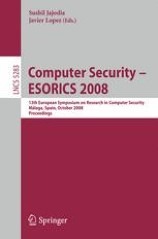
Computer Security - ESORICS 2008 ; 13th European Symposium on Research in Computer Security, Málaga, Spain, October 6-8, 2008. Proceedings
This book constitutes the refereed proceedings of the 13th European Symposium on Research in Computer Security, ESORICS 2008, held in Torremolinos, Spain, in October 2008.

Computational Science – ICCS 2007; 7th International Conference, Beijing China, May 27-30, 2007, Proceedings, Part I
This book contiants sections on efficient data management, parallel monte carlo algorithms, simulation of multiphysics multiscale systems, dynamic data driven application systems, computer graphics and geometric modeling, computer algebra systems, computational chemistry, computational approaches and techniques in bioinformatics, computational finance and business intelligence, geocomputation, high-level parallel programming, networks theory and applications, collective intelligence for semantic and knowledge grid, collaborative and cooperative environments, tools for program development and analysis in CS, intelligent agents in computing systems, CS in software engineering, computational linguistics in HCI, internet computing in science and engineering, workflow systems in e-science, graph theoretic algorithms and applications in cs, teaching CS, high performance data mining, mining text, semi-structured, Web, or multimedia data,

Computational Probability : Algorithms and Applications in the Mathematical Sciences
Computational probability encompasses data structures and algorithms that have emerged over the past decade that allow researchers and students to focus on a new class of stochastic problems. COMPUTATIONAL PROBABILITY is the first book that examines and presents these computational methods in a systematic manner. The techniques described here address problems that require exact probability calculations, many of which have been considered intractable in the past. The first chapter introduces computational probability analysis, followed by a chapter on the Maple computer algebra system. The third chapter begins the description of APPL, the probability modeling language created by the authors. The book ends with three applications-based chapters that emphasize applications in survival analysis and stochastic simulation.

Computational Methods in Financial Engineering : Essays in Honour of Manfred Gilli
The focus of this book is the development of computational methods and analytical models in financial engineering that rely on computation. The book contains eighteen chapters written by leading researchers in the area on portfolio optimization and option pricing; estimation and classification; banking; risk and macroeconomic modelling. It explores and brings together current research tools and will be of interest to researchers, analysts and practitioners in policy and investment decisions in economics and finance. "This book collects frontier work by researchers in computational economics in a tribute to Manfred Gilli, a leading member of this community. Contributions cover many of the topics researched by Gilli during his career: portfolio optimization and option pricing, estimation and classification, as well as banking, risk and macroeconomic modeling. The editors have put together a remarkable panorama of the rapidly growing and diversifying field of computational economics and finance

Computational intelligence in economics and finance ; Vol. II
Computational intelligence (CI), as an alternative to statistical and econometric approaches, has been applied to a wide range of economics and finance problems in recent years, for example to price forecasting and market efficiency. This book contains research ranging from applications in financial markets and business administration to various economics problems. Not only are empirical studies utilizing various CI algorithms presented, but so also are theoretical models based on computational methods. In addition to direct applications of computational intelligence, readers can also observe how these methods are combined with conventional analytical methods such as statistical and econometric models to yield preferred results.

Computational intelligence : A compendium
Computational Intelligence paradigms have proven effective on real-world problems in virtually all disciplines including Science, Engineering, Business, healthcare, Management and Avionics. This handbook includes contributions from the leading international experts in their respective fields. There are twenty five chapters grouped in the following ten parts covering theoretical aspects and practical applications.

Commercial lending : principles and practice
Supports the Chartered Banker Institute's Commercial Lending module requirements and helps to prepare for assessment Is written by a banking sector expert with cutting-edge industry perspective, ideal to support students of banking at undergraduate and postgraduate level Aids work-based learning and professional development with a highly practical and applied approach, bringing learning to life with activities to carry out in the workplace as well as case studies, further reading recommendations and definitions of key terms throughout Offers additional numeracy support to help readers with practical lending work, such as assessing balance sheets and understanding financial reports and documents Offers thought leadership on commercial lending from an expert author with over 30 years of experience in the sector, endorsed by the Chartered Banker Institute

Column Generation
Column Generation is an insightful overview of the state of the art in integer programming column generation and its many applications. The volume begins with "A Primer in Column Generation" which outlines the theory and ideas necessary to solve large-scale practical problems, illustrated with a variety of examples. Other chapters follow this introduction on "Shortest Path Problems with Resource Constraints," "Vehicle Routing Problem with Time Window," "Branch-and-Price Heuristics," "Cutting Stock Problems," each dealing with methodological aspects of the field. Three chapters deal with transportation applications: "Large-scale Models in the Airline Industry," "Robust Inventory Ship Routing by Column Generation," and "Ship Scheduling with Recurring Visits and Visit Separation Requirements." Production is the focus of another three chapters: "Combining Column Generation and Lagrangian Relaxation," "Dantzig-Wolfe Decomposition for Job Shop Scheduling," and "Applying Column Generation to Machine Scheduling." The final chapter by François Vanderbeck, "Implementing Mixed Integer Column Generation," reviews how to set-up the Dantzig-Wolfe reformulation, adapt standard MIP techniques to the column generation context (branching, preprocessing, primal heuristics), and deal with specific column generation issues (initialization, stabilization, column management strategies).

Collective Beings
With collective behaviors playing a fundamental role in many scientific and technical disciplines, COLLECTIVE BEINGS focuses its attention on socio-economic applications to be used, the book provides the reader with deep insights into modern conceptual tools of economy based on systemics.
