



الصفحة 4
الصفحة 4

Microsoft Dynamics NAV : Jump Start to Optimization
Mastering Microsoft Dynamics NAV for beginners and IT professionals: from jump start to optimization. This book covers general use and shows you how to tailor Microsoft Dynamics NAV to mirror your firm's unique needs. Learn skills that enable you to navigate and interpret the world of possibilities locked within the ERP system. Through easy, concrete examples, you will master the layered environment and be able to use and create reports, forms, import/export functions and more. This book gives you the basis you need to demand the best information infrastructure for your enterprise.

Micro-ISV : From Vision to Reality
Micro-ISV: From Vision to Reality explains what works and why in today's emerging micro-ISV sector. Currently, thousands of programmers build and deliver great solutions ISV-style, earning success and revenues much larger than you might guess. Written by and for micro-ISVs, with help from some of the leaders of the field, this book takes you beyond just daydreaming to running your own business. It thoroughly explores how it is indeed possible to launch and maintain a small and successful ISV business, and is an ideal read if you're interested in getting started.

The 8051 microcontroller and embedded systems
The Classical Period: Nineteenth Century Sociology Auguste Comte (1798-1857) on Women in Positivist Society Harriett Martineau (1802-1876) on American Women Bebel, August (1840-1913) on Women and Socialism Emile Durkheim (1858-1917) on the Division of Labor and Interests in Marriage Herbert Spencer (1820-1903) on the Rights and Status of Women Lester Frank Ward (1841-1913) on the Condition of Women Anna Julia Cooper (1858-1964) on the Voices of Women Thorstein Veblen (1857-1929) on Dress as Pecuniary Culture The Progressive Era: Early Twentieth Cent.

MICAI 2008 : Advances in Artificial Intelligence ;7th Mexican International Conference on Artificial Intelligence, Atizapán de Zaragoza, Mexico, October 27-31, 2008 Proceedings
The 96 revised full papers presented together with 2 invited lectures were carefully reviewed and selected from 363 submissions. The papers are organized in topical sections on logic and reasoning, knowledge-based systems, knowledge representation and acquisition, ontologies, natural language processing, machine learning, pattern recognition, data mining, neural networks, genetic algorithms, hybrid intelligent systems, computer vision and image processing, robotics, planning and scheduling, uncertainty and probabilistic reasoning, fuzzy logic, intelligent tutoring systems, multi-agent systems and distributed ai, intelligent organizations, bioinformatics and medical applications, as well as applications.

MICAI 2007 : Advances in artificial intelligence ; 6th Mexican International Conference on Artificial Intelligence, Aguascalientes, Mexico, November 4-10, 2007, Proceedings
The Mexican International Conference on Artificial Intelligence (MICAI), a yearly international conference series organized by the Mexican Society for Artificial Intelligence (SMIA), is a major international AI forum and the main event in the academic life of the country’s growing AI community.
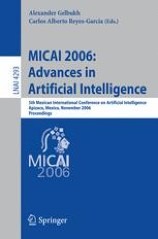
MICAI 2006 : Advances in Artificial Intelligence ; 5th Mexican International Conference on Artificial Intelligence, Apizaco, Mexico, November 13-17, 2006, Proceedings
This volume contains the papers presented during the oral session of the 5 Mexican International Conference on Artificial Intelligence, held on November 13–17, 2006, at the Technologic Institute of Apizaco, Mexico. The conference received for evaluation 448 submissions by 1207 authors from 42 different countries

MICAI 2005 : Advances in Artificial Intelligence ; 4th Mexican International Conference on Artificial Intelligence, Monterrey, Mexico, November 14-18, 2005, Proceedings
Constitutes the refereed proceedings of the 4th Mexican International Conference on Artificial Intelligence, MICAI 2005, held Mexico, in November 2005. This book is organized in topical sections on knowledge representation and management, logic and constraint programming, uncertainty reasoning, multiagent systems and distributed AI, and others.

Melting Hadrons, Boiling Quarks - From Hagedorn Temperature to Ultra-Relativistic Heavy-Ion Collisions at CERN : With a Tribute to Rolf Hagedorn
Shows how the study of multi-hadron production phenomena in the years after the founding of CERN culminated in Hagedorn's pioneering idea of limiting temperature, leading on to the discovery of the quark-gluon plasma -- announced, in February 2000 at CERN.

Medical Imaging and Informatics ; 2nd International Conference, MIMI 2007, Beijing, China, August 14-16, 2007 Revised Selected Papers
This book constitutes the thoroughly refeered post-conference proceedings of the Second Interational Conference on Medical Imaging and Informatics, MIMI 2007, held in Beijing, China, in August 2007.The 40 revised full papers presented together with 4 keynote talks were carefully reviewed and selected from 110 submissions. The papers are organized in topical sections on medical image segmentation and registration, medical informatics, PET, fMRI, ultrasound and thermal imaging, 3D reconstruction and visualization. The volume is rounded off by 4 papers from 2 workshops on legal, ethical and social issues in medical imaging and informatics, as well as on computer-aided diagnosis (CAD).

Medical Imaging and Augmented Reality ; 4th International Workshop Tokyo, Japan, August 1-2, 2008 Proceedings
Constitutes the refereed proceedings of the 4th International Workshop on Medical Imaging and Augmented Reality, MIAR 2008, held in Tokyo, Japan, in August 2008.The 44 revised full papers presented together with 3 invited papers were carefully reviewed and selected from 90 submissions. The papers are organized in topical sections on surgical planning and simulation, medical image computing, image analysis, shape modeling and morphometry, image-guided robotics, image-guided intervention, interventional imaging, image registration, augmented reality, and image segmentation.

Medical Image Computing and Computer-Assisted Intervention - MICCAI 2008 ; 11th International Conference, New York, NY, USA, September 6-10, 2008, Proceedings, Part II
The program committee carefully selected 258 revised papers from numerous submissions for presentation in two volumes, based on rigorous peer reviews. The first volume includes 127 papers related to medical image computing, segmentation, shape and statistics analysis, modeling, motion tracking and compensation, as well as registration. The second volume contains 131 contributions related to robotics and interventions, statistical analysis, segmentation, intervention, modeling, and registration.

Medical data processing and analysis
Medical data can be defined as obtaining information from patients (such as signals, images, sounds, chemical components and their concentration, body temperature, respiratory rate, blood pressure, and different treatment measurements) to quantify the patient’s status and disease stage. Computer-aided diagnostic (CAD) systems use classical image processing, computer vision, machine learning, and deep learning methods for image analysis. Using image classification or segmentation algorithms, they find a region of interest (ROI) pointing to a specific location within the given image or an outcome of interest in the form of a label pointing to a diagnosis or prognosis. Computer science, with the evolution of artificial intelligence and machine learning techniques, facilitates the modeling and interpretation of results—from carrying out measurements to experiments and observations.

Medical Biometrics ; 1st International Conference, ICMB 2008, Hong Kong, China, January 4-5, 2008, Proceedings
Medical biometrics primarily refers to the usage of beh- ioral and physiological characteristics of humans for medical diagnosis and body care. Thus the goal of medical biometrics is to explore solutions to the open problems in medicine using biometric measurements, technologies and systems.

Medial Representations : Mathematics, Algorithms and Applications
The last half century has seen the development of many biological or physical theories that have explicitly or implicitly involved medial descriptions of objects and other spatial entities in our world. Simultaneously mathematicians have studied the properties of these skeletal descriptions of shape, and, stimulated by the many areas where medial models are useful, computer scientists and engineers have developed numerous algorithms for computing and using these models. We bring this knowledge and experience together into this book in order to make medial technology more widely understood and used.

Mechatronics and Machine Vision in Practice
From grading and preparing harvested vegetables to the tactile probing of a patient’s innermost recesses, mechatronics has become part of our way of life. The addition of senses and computing intelligence to blend with mechanical actuation gives rise to a breed of new machines with all the best attributes of a robot.

Measuring emission of agricultural greenhouse gases and developing mitigation options using nuclear and related Techniques : Applications of nuclear techniques for GHGs
This book is an outcome of the collaboration between the Soil and Water Management & Crop Nutrition Section, Joint FAO/IAEA Division of Nuclear Techniques in Food and Agriculture, Department of Nuclear Sciences and Applications, International Atomic Energy Agency (IAEA), Vienna, Austria, and the German Science Foundation research unit DASIM (Denitrification in Agricultural Soils: Integrated control and Modelling at various scales) and other institutes.

Mathematics of Surfaces XII ; 12th IMA International Conference, Sheffield, UK, September 4-6, 2007, Proceedings
This book constitutes the refereed proceedings of the 12th IMA International Conference on the Mathematics of Surfaces, held in Sheffield, UK in September 2007. The papers cover a range of ideas from underlying theoretical tools to industrial uses of surfaces.

Mathematical Problems in Image Processing : Partial Differential Equations and the Calculus of Variations
The goals of this book are to present a variety of image analysis applications, the precise mathematics involved and how to discretize them. Thus, this book is intended for two audiences. The first is the mathematical community by showing the contribution of mathematics to this domain. It is also the occasion to highlight some unsolved theoretical questions. The second is the computer vision community by presenting a clear, self-contained and global overview of the mathematics involved in image processing problems. This work will serve as a useful source of reference and inspiration for fellow researchers in Applied Mathematics and Computer Vision, as well as being a basis for advanced courses within these fields.

Isolated Neutron Stars : from the Surface to the Interior
This book collects the contributions presented at the conference Isolated Neutron Stars, held in London in April 2006. It presents an up-to-date description of the new vision of isolated neutron stars that has emerged in recent years with the advance of multi-wavelength observations.

IP Networking over Next-Generation Satellite Systems ; International Workshop, Budapest, July 2007
Highlights the very latest research output of several EU satellite-related projects and addresses many unresolved issues in next-generation satellite systems, such as efficient deployment of IPv6 over satellites, working with WLAN and WiMax, QoS provisioning over multi-segment networks (including satellite networks), multicast networks and security.
