



الصفحة 4
الصفحة 4

Molecular Biology of Metal Homeostasis and Detoxification : From Microbes to Man
One of the challenges faced by every cell as well as by whole organisms is to maintain appropriate concentrations of essential nutrient metals while excluding nonessential toxic metals. Toward that end, all organisms have developed mechanisms for metal homeostasis and detoxification to maintain metal levels within physiological limits. This book brings together current knowledge of the molecular basis of metal homeostasis and detoxification in various eukaryotic model systems, including yeasts, plants, and mammals. It focuses on the cellular systems controlling metal transport, intracellular distribution, and immobilization as well as on systems regulating metal-dependent transcription. In addition to environmental aspects (including phytoremediation), the book treats the pathophysiology of metal deficiency and overload in relation to disease.

Molecular Biology of Human Cancers: An Advanced Student's Textbook
Presents many of the molecules and mechanisms generally important in human cancers. Following an overview on the cancer problem, individual chapters deal with cancer genetics and epigenetics, DNA damage and repair, oncogenes, tumor suppressors, regulatory pathways in cancer, apoptosis, cellular senescence, tumor invasion, and metastasis. A consensus is emerging that while these common mechanisms and molecules are all relevant to human cancers, in each cancer type (or even subtype) a selection of them are extremely important. For selected cancers, the route from genetic and epigenetic changes to their biological and clinical behavior can already be traced. Part II of the book presents a broad, but exemplary selection of cancers that serve as paradigms to illustrate this point. In fact, cancer research has now reached a critical stage, in which the accumulated knowledge on molecular mechanisms is gradually translated into improved prevention, diagnosis, and treatment. The state, pitfalls, and potential of these efforts are summarized in Part III. More than ever, cancer research is now an interdisciplinary effort which requires a basic knowledge of commonly used terms, facts, issues, and concepts. The aim of this book is to provide advanced students and practitioners of different disciplines with this basis, bridging the gap between standard textbooks of molecular biology, pathology, and oncology on the one hand and the specialized cancer literature on the other.

Modular Programming Languages ; 7th Joint Modular Languages Conference, JMLC 2006, Oxford, UK, September 13-15, 2006, Proceedings
On behalf of the Steering Committee we are pleased to present the proceedings of the 2006 Joint Modular Languages Conference (JMLC), organized by Oxford Brookes University, Oxford, UK and held at Jesus College, Oxford. The mission of JMLC is to explore the concepts of well-structured programming languages and software and those of teaching good design and programming style. JMLC 2006 was the seventh in a series of successful conferences with themes including the construction of large and distributed software systems, and software en- neering aspects in new and dynamic application areas.

Modern trends in research on steel, aluminium and composite structures includes papers presented at the 14th International Conference on metal structures 2021 ; ICMS 2021, Poznań, Poland, 16-18 June 2021
Modern Trends in Research on Steel, Aluminium and Composite Structures includes papers presented at the 14th International Conference on Metal Structures 2021 (ICMS 2021, Pozna, Poland, 16-18 June 2021). The 14th ICMS summarised a few years' theoretical, numerical and experimental research on steel, aluminium and composite structures, and presented new concepts.

Modern treatments for chronic blood diseases
Blood is a body fluid in humans and other animals that delivers necessary substances such as nutrients and oxygen to the cells and transports metabolic waste products away from those same cells. In vertebrates, it is composed of blood cells suspended in blood plasma. Plasma, which constitutes 55% of blood fluid, is mostly water (92% by volume), and contains proteins, glucose, mineral ions, hormones, carbon dioxide (plasma being the main medium for excretory product transportation), and blood cells themselves. Albumin is the main protein in plasma, and it functions to regulate the colloida osmotic pressure of blood. The blood cells are mainly red blood cells (also called RBCs or erythrocytes), white blood cells (also called WBCs or leukocytes) and platelets (also called thrombocytes). Thalassemias are inherited blood disorders characterized by decreased hemoglobin production Symptoms depend on the type and can vary from none to severe. Often there is mild to severe anemia (low red blood cells or hemoglobin). Anemia can result in feeling tired and pale skin. There may also be bone problems, an enlarged spleen, yellowish skin, and dark urine. Slow growth may occur in children.

Modern Meteor Science : An Interdisciplinary View
"During the past half century meteor research has evolved into a comprehensive multidisciplinary science … . New findings are flowing from the ever-broadening range of investigative techniques that are being employed to great effect by the contributors to this book. This comprehensive overview of leading edge research by well over one hundred authors is an essential resource volume for scientists and engineers conducting studies and exploration of the solar system. It demands a place in the libraries supporting their activities.

Modern Magnetic Resonance ; Part 1 : Applications in Chemistry, Biological and Marine Sciences ; Part 2 : Applications in Medical and Pharmaceutical Sciences ; Part 3 : Applications in Materials Science and Food Science
Modern Magnetic Resonance provides a unique and comprehensive resource on up-to-date uses and applications of magnetic resonance techniques in the sciences, including chemistry, biology, materials, food, medicine, pharmaceuticals and marine sciences.The widespread appeal of MMR methods for revealing information at the molecular and microscopic levels is noted and examples are provided from the chemical and other sciences.Until now, there has been no single publication that covers all the areas encompassed by "Modern Magnetic Resonance", by bringing together the various techniques and their applications in many scientific areas, the internationally renowned Editors have created a resource of broad appeal to the scientific community.

Modern deep learning for tabular data : Novel approaches to common modeling problems
Synthesizes and presents novel deep learning approaches to a seemingly unlikely domain - tabular data. Whether for finance, business, security, medicine, or countless other domain, deep learning can help mine and model complex patterns in tabular data - an incredibly ubiquitous form of structured data. Part I of the book offers a rigorous overview of machine learning principles, algorithms, and implementation skills relevant to holistically modeling and manipulating tabular data. Part II studies five dominant deep learning model designs - Artificial Neural Networks, Convolutional Neural Networks, Recurrent Neural Networks, Attention and Transformers, and Tree-Rooted Networks - through both their 'default' usage and their application to tabular data. Part III compounds the power of the previously covered methods by surveying strategies and techniques to supercharge deep learning systems: autoencoders, deep data generation, meta-optimization, multi-model arrangement, and neural network interpretability.

Modern avenues in metal-nucleic acid chemistry
Provides a timely overview of selected relevant developments in a field which previously had a pronounced focus on fundamental chemistry aspects such as coordination principles, structural chemistry, and consequences for biological processes and disease-related medicinal issues. More recently, also as a consequence of the advent of supramolecular chemistry, advancements in nanochemistry, and new bio-analytical methods, novel aspects of this field have emerged. MILS-25 gives a state-of-the-art account on the present state of research in this field, addressing, among others, porous materials, non-covalent interactions, stimuli-responsive bioconjugates, DNA-templated metal arrays and nanoclusters, genotyping, guanine quadruplexes, and riboswitches.
Modern Aspects of Electrochemistry ; Vol. 42
MODERN ASPECTS OF ELECTROCHEMISTRY No. 42 Edited by Constantinos Vayenas University of Patras, Greece Topics in Number 42 include: The electrochemistry and electrocatalysis of Ruthenium in regards to the development of electrodes for Polymer Electrolyte Membrane (PEM) fuel cells Breakthroughs in Solid Oxide Fuel Cell (SOFC) anodes and cathodes leading to improved electrocatalysis Electrocatalysis of the electrochemical reduction of CO2 on numerous metals The interfacial phenomena of electrodeposition and codeposition, and the need for new theoretical analyses of the electrode-electrolyte interface Advantages of scanning tunneling microscopy (STM) in understanding the basics of catalysis, electrocatalysis and electrodeposition The role of electrochemistry in emerging technologies including electrodeposition and electroforming at the micro and nano levels, semiconductor and information storage, including magnetic storage devices.

Modern Aspects of Electrochemistry ; Vol. 38
Solid State Electrochemistry encompassing modern equilibria concepts, thermodymanics and kinetics of charge carriers in solids.,Electron transfer processes, with special sections devoted to hydration of the proton and its heterogeneous transfer.Electrosorption at electrodes and its relevance to electrocatalysis and electrodeposition of metals,The behavior of Pt and other alloy electrocatalyst crystallites used as the electrode materials for phosphoric acid electrolyte fuel-cells.Applications of reflexology and electron microscopy to the materials science aspect of metal electrodes.Electroplating of metal matrix composites by codeposition of suspended particles, a process that has improved physical and electrochemical properties.

Models in Software Engineering ; Workshops and Symposia at MoDELS 2006, Genoa, Italy, October 1-6, 2006, Reports and Revised Selected Papers
This book constitutes the thoroughly refereed post-proceedings of 11 international workshops held as satellite events of the 9th International Conference on Model Driven Engineering Languages and Systems, MoDELS 2006, in Genoa, Italy, in October 2006 (see LNCS 4199). The 32 revised full papers were carefully selected for inclusion in the book.

Modelling of Powder Die Compaction
In particular, the book presents a number of case studies that have been developed to test compaction models. Full details of the data required for input to compaction models of these case studies is given, together with a survey of the techniques used to generate the data. Details are also given of methods to produce and assess components for validation of die compaction models. The inclusion of information on case studies then provides a reference for the testing and validation of compaction models.

Modeling of metal forming and machining processes : By finite element and soft computing methods
The physics of metal forming and metal removing is normally expressed using non-linear partial differential equations which can be solved using the finite element method (FEM). However, when the process parameters are uncertain and/or the physics of the process is not well understood, soft computing techniques can be used with FEM or alone to model the process.
Modeling and Management of Fuzzy Semantic RDF Data
Presents the latest research findings in fuzzy RDF data modeling and management. Fuzziness widely exist in many data and knowledge intensive applications. With the increasing amount of metadata available, efficient and scalable management of massive semantic data with uncertainty is of crucial importance. This book goes to great depth concerning the fast-growing topic of technologies and approaches of modeling and managing fuzzy metadata with Resource Description Framework (RDF) format. Its major topics include representation of fuzzy RDF data, fuzzy RDF graph matching, query of fuzzy RDF data, and persistence of fuzzy RDF data in diverse databases. The objective of the book is to provide the state-of-the-art information to researchers, practitioners, and postgraduates students who work on the area of big data intelligence and at the same time serve as the uncertain data and knowledge engineering professional as a valuable real-world reference.
Model-Driven Design Using Business Patterns
This book takes exactly this step: it shows you how to apply the pattern ideas in business applications and presents more than 20 structural and behavioral business patterns that use the REA (resources, events, agents) pattern as a common backbone. If you are a developer working on business frameworks, you can use the patterns presented to derive the right abstractions (e.g., business objects) and to design and ensure that the meta-rules (e.g., process patterns) are followed by the developers of the actual applications. And if you are an application developer, you can use these patterns to design your business application, to ensure that it does not violate the domain rules, and to adapt the application to changing requirements without the need to change the overall architecture. As with patterns in general, this approach allows for both more flexible and more solid software architectures and hence better software quality.

Model-Driven Architecture - Foundations and Applications ; 2nd European Conference, ECMDA-FA 2006, Bilbao, Spain, July 10-13, 2006, Proceedings
The goal of the European Conference on Model-Driven Architecture — Foundations and Applications (ECMDA-FA) is to bring together industry and academia to tackle the problems in model-driven development. This volume includes 18 foundation papers and 12 application papers, which is a fine balance between both worlds. ECMDA-FA 2006 also hosted six workshops on both theoretical and practical aspects of MDA. Furthermore, the keynote speakers, David Frankel and Bran Selic, from some of the world’s largest IT companies proved that industry is very much involved in MDA. This second ECMDA-FA conference is the result of the work of the authors who submitted a total of 78 papers, the Program Committee members who took the effort to review the papers, the people organizing the workshops, and of course the Steering Committee. All in all, several hundreds of people have worked hard to make this conference a success.
Model Driven Engineering Languages and Systems ; 11th International Conference, MoDELS 2008, Toulouse, France, September 28 - October 3, 2008. Proceedings
The book also contains three keynote speeches and contributions to workshops, symposia, tutorials and panels at the conference. The papers are organized in topical sections on Model Transformation: Foundations; Requirements Modeling; Domain-Specific Modeling; Model Transformation: Techniques, Composition and Analysis of Behavioral Models; Model Comprehension; Model Management; Behavioral Conformance and Refinement; Metamodeling and Modularity; Constraints; Model Analysis; Service-Oriented Architectures; Adaptive and Autonomic Systems; Empirical Studies; Evolution and Reverse Engineering; Modeling Language Semantics; Dependability Analysis and Testing; Aspect-Oriented Modeling; Structural Modeling;and Embedded Systems.
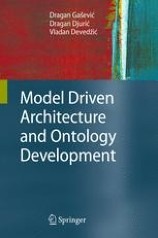
Model Driven Architecture and Ontology Development
Gaševic and his co-authors try to fill this gap by covering the subject of MDA application for ontology development on the Semantic Web. Part I of their book describes existing technologies, tools, and standards like XML, RDF, OWL, MDA, and UML. Part II presents the first detailed description of OMG’s new ODM (Ontology Definition Metamodel) initiative, a specification which is expected to be in the form of an OMG language like UML. Finally, Part III is dedicated to applications and practical aspects of developing ontologies using MDA-based languages.
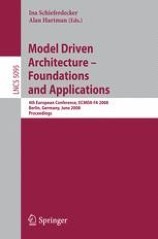
Model Driven Architecture - Foundations and Applications ; 4th European Conference, ECMDA-FA 2008, Berlin, Germany, June 9-13, 2008. Proceedings
The 31 revised full papers presented - 21 research papers and 10 industry papers - were carefully reviewed and selected from 87 submissions. The papers address all current issues of model-driven architecture, i.e. model management, executable models, concrete syntaxes, aspects, and concerns, validation and testing, model-based systems engineering, model-driven development and service-oriented architectures, and the application of model-driven development. The papers are organized in topical sections on model management, executable models, concrete syntaxes, aspects and concerns, validation and testing, model-based systems engineering, model-driven development and service-oriented architectures, as well as surveys on applying model-driven development.
