



الصفحة 4
الصفحة 4

Flash 8 Essentials
As a creative professional or interactive developer, you’ll be amazed at the exciting possibilities presented to you by the features available in Flash 8; but as a busy designer, we know you won't have as much time as you’d like to explore these new additions. Never fear; this book wastes no time looking at timeline basics, tweens, or movie-publishing options—it focuses exclusively on the new Flash 8 features, getting you quickly up to speed with a combination of illustrative tutorials, handy references, and inspirational examples. By the end of the book, you’ll know that there’s no shortage of new tools to enhance and inspire your Flash development; and since this book is written by some of the community's leading Flash experts, you’ll know you’re in good hands.

Experimental Business Research ; Vol. III: Marketing, Accounting and Cognitive Perspectives
the book presented at the conference and a few others that were solicited especially for this volume contain original research on individual and interactive decision behavior in various branches of business research including, but not limited to, economics, marketing, management, finance, and accounting. Experimental Business Research is suitable as a secondary text for a graduate level course, and as a reference for researchers and practitioners in industry.

Evolution from Cellular to Social Scales
Evolution is a critical challenge for many areas of science, technology and development of society. The book reviews general evolutionary facts such as origin of life and evolution of the genome and clues to evolution through simple systems. Emerging areas of science such as "systems biology" and "bio-complexity" are founded on the idea that phenomena need to be understood in the context of highly interactive processes operating at different levels and on different scales. This is where physics meets complexity in nature, and where we must begin to learn about complexity if we are to understand it. Similarly, there is an increasingly urgent need to understand and predict the evolutionary behavior of highly interacting man-made systems, in areas such as communications and transport, which permeate the modern world. The same applies to the evolution of human networks such as social, political and financial systems, where technology has tended to vastly increase both the complexity and speed of interaction, which is sometimes effectively instantaneous.

Evaluation of Multilingual and Multi-modal Information Retrieval ; 7th Workshop of the Cross-Language Evaluation Forum, CLEF 2006, Alicante, Spain, September 20-22, 2006, Revised Selected Papers
This book covers Multilingual Textual Document Retrieval, Domain-Specifig Information Retrieval, i-CLEF, QA@CLEF, ImageCLEF, CLSR, WebCLEF and GeoCLEF.

Equidosimetry : Ecological Standardization and Equidosimetry for Radioecology and Environmental Ecology
Considerable experience with radioecological and related ecological research on terrestrial and aquatic ecosystems has been achieved, especially after the Chernobyl accident. The combined effects of the radiation, chemical and biological factors, after a contamination of the environment and during its remediation have shown an interactive complexity that highlights the need for equidosimetrical evaluations of the influence of the various stressors and the need for their ecological normalization. In radioecology and radiation protection, methods of radiation dosimetry are key for dose assessment. It is therefore highly desirable to develop a clear theoretical approach as well as a practical method of equidosimetry that would allow for an ecological normalization of the different stressors in unified uniform units, especially for comparison purposes.
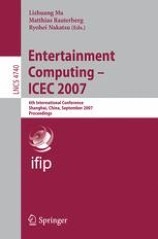
Entertainment computing – ICEC 2007 ; 6th International Conference, Shanghai, China, September 15-17, 2007, Proceedings
This book are organized in topical sections on augmented, virtual and mixed reality, computer games, image processing, mesh and modeling, digital storytelling and interactive systems, sound, music and creative environments, video processing, rendering, computer animation and networks, game based interfaces, as well as robots and cyber pets.

Entertainment computing - ICEC 2006 ; 5th International Conference, Cambridge, UK, September 20-22, 2006, Proceeding
ICEC 2006 attracted 47 full paper submissions, 48 short paper submissions in total 95 technical papers. Based on a thorough review and selection process by 85 international experts from academia and industry as members of the Program Committee, a high-quality program was compiled. The International Program Committee consisted of experts from all over the world As a result, 17 full papers and 17 short papers were accepted as submitted or with minor revisions. For the remaining submissions, 28 were recommended to change according to the reviews and were submitted as posters. This proceedings volume presents 62 technical contributions which are from many different countries.
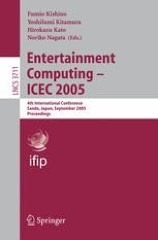
Entertainment Computing - ICEC 2005 ; 4th International Conference, Sanda, Japan, September 19-21, 2005, Proceedings
First of all, we appreciate the hard work of all the authors who contributed to ICEC 2005 by submitting their papers. ICEC 2005 attracted 95 technical paper submissions, 8 poster submissions and 7 demo submissions, in total 110. This number is nearly equal to ICEC 2004. Based on a thorough review and selection process carried out by 76 international experts from academia and industry as members of the senior and international program committees, a high-quality program was compiled. The program committee consisted of experts from all over the world: 1 from Austria, 3 from Bulgaria, 2 from Canada, 4 from China, 1 from Finland, 4 from France, 10 from Germany, 1 from Greece, 1 from Ireland, 1 from Israel, 1 from Italy, 26 from Japan, 1 from Korea, 4 from The Netherlands, 1 from New Zealand, 1 from Norway, 1 from Singapore, 1 from Thailand, 4 from the UK, and 8 from the USA. In this number, reviewers are included. The final decision was made at the senior program committee meeting based on three reviewers' feedback, available online via the conference management tool. Through earnest and fair discussion at the meeting, 25 technical papers were accepted as long papers and 32 technical papers were accepted as short papers from 95 submitted technical papers. Moreover, 3 poster papers and 5 demo papers were accepted.

Engineering Knowledge in the Age of the Semantic Web ; 15th International Conference, EKAW 2006, Podebrady, Czech Republic, October 6-10, 2006, Proceedings
The 15th International Conference on Knowledge Engineering and Knowledge Management (2006), held on October 6-10, 2006 in Pod? ebrady,Czech Republic, followed a long tradition of European Knowledge Acquisition Workshops (from 1987),whicheventuallyacquiredtheformatofconference(in2000)whilekeeping their open-minded and interactive spirit. During the nearly 20 year lifespan of the series, the discipline of knowledge engineering (KE) evolved greatly. While knowledge acquisition (KA) techniques dominated in the very ?rst years, formal approaches to knowledge-based inf- ence and variousnew streamssuch as knowledgediscoveryfrom data/textslater cameinto play. During thelate1990sandafterwards,EKAWbecamea founding community for ontology and Semantic Web Research, which was also re?ected in the sub-titles of the 2002 and 2004 editions: “Ontologies and the Semantic Web” and “Engineering Knowledge in the Age of the Semantic Web,” resp- tively.

Engineering Interactive Systems ; EIS 2007 Joint Working Conferences, EHCI 2007, DSV-IS 2007, HCSE 2007, Salamanca, Spain, March 22-24, 2007. Selected Papers
This book constitutes the post-conference proceedings of the WG2.7/13.4 10th Conference on Engineering Human Computer Interaction (EHCI 2007), the WG 13.2 First Conference on Human Centred Software Engineering (HCSE 2007), and the 14th Conference on Design Specification and Verification of Interactive Systems (DSV-IS 2007); jointly held as EIS 2007, the international event on Engineering Interactive Systems, in Salamanca, Spain, in March 2007 - under the auspices of IFIP.

Engineering Interactive Systems ; 2nd Conference on Human-Centered Software Engineering, HCSE 2008, and 7th International Workshop on Task Models and Diagrams, TAMODIA 2008, Pisa, Italy, September 25-26, 2008. Proceedings
This book constitutes the combined proceedings of the second working conference on Human-Centred Software Engineering (HCSE 2008) and the 6th International Workshop on TAsk MOdels and DIAgrams (TAMODIA 2008); jointly held as EIS 2008, the international event on Engineering Interactive Systems, in Pisa, Italy, in September 2008.

Engineering human computer interaction and interactive systems ; Joint Working Conferences EHCI-DSVIS 2004, Hamburg, Germany, July 11-13, 2004, Revised Selected Papers
As its name suggests, the EHCI-DSVIS conference has been a special event, merging two different, although overlapping, research communities: EHCI (Engineering for Human-Computer Interaction) is a conference organized by the IFIP 2.7/13.4 working group, started in 1974 and held every three years since 1989. The group’s activity is the scientific investigation of the relationships among the human factors in computing and software engineering. DSVIS (Design, Specification and Verification of Interactive Systems) is an annual conference started in 1994, and dedicated to the use of formal methods for the design of interactive systems. Of course these two research domains have a lot in common, and are informed by each other’s results.

Enabling a Simulation Capability in the Organisation
Enabling a Simulation Capability in the Organisation addresses the application of simulation modelling techniques in order to enable better informed decisions in business and industrial organisations.

Drugs and nutrients : The interactive effects
Devoted to the effects of food and of nutrient intake on the disposition of foreign compounds, and discusses effects of drugs on nutrition. It is intended for nutritionists and clinical investigators concerned with interpretation of aberrant effects of therapeutic drugs.

Distributed Cooperative Laboratories : Networking, Instrumentation, and Measurements
This is a highly interdisciplinary topic, where various aspects converge: multimedia communications and networking, sensor networks, Grid technology, Quality of Service (QoS) provisioning and control, network management, measurement instrumentation and methodology, architecture of measurement systems. The material is organized into six parts: Technologies for Real-Time Interactive Multimedia Communications; Monitoring, Management and Configuration of Networks and Networking Devices; Data Acquisition and Aggregation in Sensor Networks; Grid Structures for Distributed Cooperative Laboratories; Architectures and Techniques for Tele-Measurements; Virtual Immersive Communications and Distance Learning. Each contribution presents a self-contained treatment, within a framework that provides the reader with an up-to-date picture of the most recent state-of-the-art developments.

Digital Image Processing
The book offers an integral view of image processing from image acquisition to the extraction of the data of interest. The discussion of the general concepts is supplemented with examples from applications on PC-based image processing systems and ready-to-use implementations of important algorithms. Each chapter now includes exercises that help you to test your understanding, train your skills, and introduce you to real-world image processing tasks. An important part of the exercises is a wealth of interactive computer exercises, which cover all topics of this textbook.

Digital Holography and Three-Dimensional Display : Principles and Applications
Digital (or electronic) holography and its application to 3-D display is one of the formidable problems of evolving areas of high technology that has been receiving great attention in recent years. The realization of life-size interactive 3-D displays has been a seemingly unobtainable goal. Technology is not quite at that level yet, but advances in 3-D display now allow us to take important steps toward the achievement of this objective. The reader is presented with the state-of-the-art developments in both digital holography and 3-D display techniques. The book contains a large amount of research material as well as reviews, new ideas and insights that will be useful for graduate students, scientists, and engineers working in the field.

Designing and evaluating e-management decision tools : The integration of decision and negotiation models into internet-multimedia technologies
Presents the most relevant concepts for designing intelligent decision tools in an Internet-based multimedia environment and assessing the tools using concepts of statistical design of experiments. The book covers : Decision modeling paradigms , Visual interactive decision modeling , Online preference elicitation , collaborative decision making , negotiation and conflict resolution , marketing decision optimization , and guidelines for designing and evaluating decision support tools. This book is designed for the following uses: 1) for researchers and engineers, who are seeking recent advances and who are developing e-management systems; 2) for practitioners and managers, who seek insights about ICT potential and using ICT for business intelligence management; and 3) for students, who seek theoretical and practical concepts of building and evaluating prototype decision tools.

Designing Accessible Technology
This book was stimulated by the third CWUAAT workshop, held in Cambridge, England in April 2006; the contributors representing leading researchers in the fields of Inclusive Design, Rehabilitation Robotics, Universal Access and Assistive Technology. Contributions focus on the following topics: design issues for a more inclusive world / enabling computer access and the development of new technologies / assistive technology and rehabilitation robotics and understanding users and involving them in design.

Designing a programming education system for children to program and simulate robots
JuniorCoders is an innovative educational platform designed to introduce programming and robotics concepts to kids and beginners. It provides an easy-to-use visual programming interface that allows users to create Arduino programs by dragging and dropping blocks of code. The system aims to make programming accessible and shareable, allowing them to create complex programs without having to learn a traditional programming language. Enables users to program and simulate robots using Arduino boards.
