



الصفحة 4
الصفحة 4

Fuzzy Logic Applications in Engineering Science
Fuzzy logic is a relatively new concept in science applications. Hitherto, fuzzy logic has been a conceptual process applied in the field of risk management. Its potential applicability is much wider than that, however, and its particular suitability for expanding our understanding of processes and information in science and engineering in our post-modern world is only just beginning to be appreciated.

Fungi as an Alternative Source of Anticancer and Antioxidant
Fungi are an " excellent but underexplored source " for new therapeutic compounds. The limited availability of bioactive principles in plant sources could be surpassed by exploiting the chemical entities in the endophytes fungi . fungi represent a rich source of bioactive metabolite that can manipulated to produce desirable novel analogs. In addition to the active substances that can be extracted from the fungi, so that they are useful in several mechanisms. Exploring and exploiting of metabolites from endophytic in terrestrial, mangrove and marine habitats may provide an avenue for discovery of drug candidates against deadly human disease. This review focuses on the production of antioxidant and anticancer from severa fungi habitats.

Fragile Families and the Marriage Agenda
Some social sciences contend that marriage is the solution to many of the problems associated with single-parent families. Other experts believe that government programs designed to raise marriage rates may cause more problems than they solve,The proposed volume will explore issues related to fragile families from many different perspectives on the causes and consequences of this issue. This book is divided up into sections covering legal and theoretical perspectives, causes and consequences of offspring wellbeing, and the aspect of father’s importance to the "fragile families".

Fracture of Nano and Engineering Materials and Structures; Proceedings of the 16th European Conference of Fracture, Alexandroupolis, Greece, July 3-7, 2006
The 16th European Conference of Fracture (ECF16) was held in Greece, July, 2006. Emphasis was given to the failure of nanostructured materials and nanostructures including micro- and nano-electromechanical systems (MEMS and NEMS).

Fracture Mechanics of Ceramics ; Active Materials, Nanoscale Materials, Composites, Glass, and Fundamentals
The 8th International Symposium on fracture mechanics of ceramics was held in on the campus of the University of Houston, Houston, TX, USA, on February 25-28, 2003. With the natural maturing of the fields of structural ceramics, this symposium focused on nano-scale materials, composites, thin films and coatings as well as glass. The symposium also addressed new issues on fundamentals of fracture mechanics and contact mechanics, and a session on reliability and standardization.

Fracture Mechanics ; Vol.123 : An Introduction
The second edition of the book contains four new chapters in addition to the ten chapters of the first edition. The fourteen chapters of the book cover the basic principles and traditional applications, as well as the latest developments of fracture mechanics as applied to problems of composite materials, thin films, nanoindentation and cementitious materials. Thus the book provides an introductory coverage of the traditional and contemporary applications of fracture mechanics in problems of utmost technological importance.
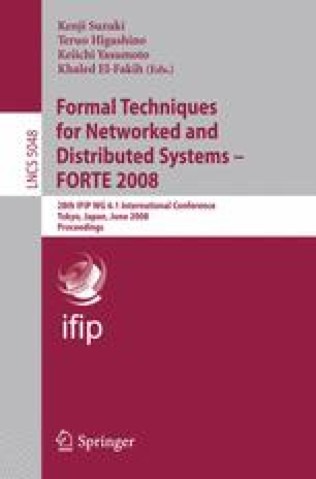
Formal Techniques for Networked and Distributed Systems - FORTE 2008 ; 28th IFIP WG 6.1 International Conference Tokyo, Japan, June 10-13, 2008 Proceedings
This book constitutes the refereed proceedings of the 28th IFIP WG 6.1 International Conference on Formal Techniques for Networked and Distributed Systems, FORTE 2008, held in Tokyo, Japan, in June 2008 co-located with TestCom/FATES 2008.The 19 revised full papers and 1 revised short paper presented together with 1 invited talk were carefully reviewed and selected from 44 submissions. The papers cover new approaches, concepts and experience in the application of formal methods for the specification and verification of distributed systems and applications.

Formal approaches to software testing and runtime verification ; 1st Combined International Workshops FATES 2006 and RV 2006, Seattle, WA, USA, August 15-16, 2006, Revised Selected Papers
Software validation is one of the most cost-intensive tasks in modern software production processes. The objective of FATES/RV 2006 was to bring sci- tists from both academia and industry together to discuss formal approaches to test and analyze programs and monitor and guide their executions. Formal approaches to test may cover techniques from areas like theorem proving, model checking, constraint resolution, static program analysis, abstract interpretation, Markov chains, and various others. Formal approaches to runtime veri?cation use formal techniques to improve traditional ad-hoc monitoring techniques used in testing, debugging, performance monitoring, fault protection, etc.

Formal approaches to software testing ; Vol. 3997 ; 5th International Workshop, FATES 2005, Edinburgh, UK, July 11, 2005, Revised Selected Papers
This book constitutes the thoroughly refereed post-proceedings of the 5th International Workshop on Formal Approaches to Software Testing, FATES 2005, held in Edinburgh, UK, in July 2005 in conjunction with CAV 2005.

Formal approaches to software testing ; Vol. 3395 ; 4th International workshop, FATES 2004, Linz, Austria, September 21, 2004, Revised Selected Papers
Testing often accounts for more than 50% of the required e?ort during system development.Thechallengeforresearchistoreducethesecostsbyprovidingnew methods for the speci?cation and generation of high-quality tests. Experience has shown that the use of formal methods in testing represents a very important means for improving the testing process. Formal methods allow for the analysis andinterpretationofmodelsinarigorousandprecisemathematicalmanner.The use of formal methods is not restricted to system models only. Test models may alsobeexamined.Analyzingsystemmodelsprovidesthepossibilityofgenerating complete test suites in a systematic and possibly automated manner whereas examining test models allows for the detection of design errors in test suites and their optimization with respect to readability or compilation and execution time. Due to the numerous possibilities for their application, formal methods have become more and more popular in recent years. The Formal Approaches in Software Testing (FATES) workshop series also bene?ts from the growing popularity of formal methods. After the workshops in Aalborg (Denmark, 2001), Brno (Czech Republic, 2002) and Montr´ eal (Canada, 2003), FATES 2004 in Linz (Austria) was the fourth workshop of this series. Similar to the workshop in 2003, FATES 2004 was organized in a?liation with the IEEE/ACM Conference on Automated Software Engineering (ASE 2004). FATES 2004 received 41 submissions. Each submission was reviewed by at least three independent reviewers from the Program Committee with the help of some additional reviewers. Based on their evaluations, 14 full papers and one wo- in-progress paper from 11 di?erent countries were selected for presentation.

Forensic pathology reviews ; Vol. 3
Maintaining the high quality achieved in earlier volumes, leading national and international forensic pathologists provide in Forensic Pathology Reviews, Volume 3 evidence-based accounts of special topics of current interest from various fields of forensic pathology and death-scene investigation. The authors offer cutting-edge insights into the medicolegal investigation of bodies found in water, the forensic aspects of the human immunodeficiency virus (HIV)-1 infection of the central nervous system, deaths in a head-down position, and forensic bitemark analysis. Additional chapters address taphonomic changes in human bodies during the early postmortem interval, arrhythmogenic ventricular dysplasia that produces sudden death in young people, the postmortem diagnosis of death in anaphylaxis, and iatrogenic deaths. The forensic aspects of suicide, murder-suicide, and suicide trends in the United States are also discussed, along with the evaluation of fatal pulmonary thromboembolism and the use of radiology in medicolegal investigations. A comprehensive, up-to-date review of the international literature is given for each chapter. Evidence-based and state-of-the-art, Forensic Pathology Reviews, Volume 3 synthesizes the practical advances made in a variety of important subspecialties of forensic pathology, demonstrating how the latest medical and scientific advances are being applied to solve current problems of high interest to forensic pathologists today.

Food Safety and Ways to Prevent Life-Threatening Pollutants
The fears regarding food safety started long time ago, and till this very moment of ours, the international organizations and INGOs pay lots of hard work to minimize and achieve reduction in the effects and the suffering caused to people around the world by contaminated foods each year. This research talks about the main patterns of food contaminants, and they are chemical, physical, biological, and last but not least the contamination caused by radioactive substances. It is also important to talk about the methods of precaution and protection against the diseases and illnesses produced by contaminated foods, as well about the role of INGOs which are dedicated and specialized in law and regulations enactment for bounding the incidence of food contamination in the world, for raising the public awareness towards food safety, and to keep up with the latest updates of events. This research also contains vast Information about Covid-19 and its spreading process via contaminated food.

Food lens = فود لينس
Food lens is an innovative application designed to revolutionize dietary management by leveraging advanced image recognition and nutritional analysis. The primary objective of this senior project is to develop a user-friendly tool that identifies various foods through a camera interface and provides detailed nutritional information. This application not only enhances the user's understanding of their dietary intake but also assists in achieving personalized health and fitness goals. The core functionality of Food Lens involves the integration of a robust image recognition system capable of accurately identifying a wide range of foods. Upon identification, the application retrieves comprehensive nutritional data, including calorie content, macronutrient distribution (proteins, fats, carbohydrates), and essential micronutrients (vitamins and minerals). This data is then seamlessly integrated into the user's dietary profile. Food Lens is designed to track the user's daily caloric intake and compare it against personalized recommendations based on age, gender, weight, height, and activity level. By maintaining a dynamic record of consumed foods, the application provides real-time feedback on the user’s nutritional progress. This feature is particularly beneficial for individuals aiming to manage weight, address dietary restrictions, or improve overall health.

Fatty acids
Fatty acid metabolism, including the de novo synthesis, uptake, oxidation, and derivation of fatty acids, plays several important roles at cellular and organ levels. Recent studies have identified characteristic changes in fatty acid metabolism in idiopathic pulmonary fibrosis (IPF) lungs, which implicates its dysregulation in the pathogenesis of this disorder. Here, we review the evidence for how fatty acid metabolism contributes to the development of pulmonary fibrosis, focusing on the profibrotic processes associated with specific types of lung cells, including epithelial cells, macrophages, and fibroblasts. We also summarize the potential therapeutics that target this metabolic pathway in treating IPF.

Fatigue Science for Human Health
Fatigue is quite a familiar sensation, one that everyone is likely to have experienced. Its molecular and neural mechanisms have not yet been elucidated, however, probably because of the complicated nature of its causes. To provide a broad forum for discussion, the International Conference on Fatigue Science was organized, the first being held in 2002 in Sandhamn, Sweden, and the second in 2005 in Karuizawa, Japan. Subsequently it was decided that the papers presented at the two conferences should be collected and incorporated in this pioneering work, Fatigue Science for Human Health. The book summarizes fatigue researchers' achievements, explains the status of the research on fatigue, and presents perspectives on remedies for chronic fatigue and chronic fatigue syndrome. The result is an authoritative guide to recent progress in the molecular and neural mechanisms of fatigue and in the development of the ways to prevent and overcome fatigue and chronic fatigue.

Farmacognosia applicata : Controllo di qualità delle droghe vegetali
Il processo di identificazione è per una droga vegetale di enorme importanza ai fini dell'efficacia e sicurezza della stessa. Infatti la risposta terapeutica e gli effetti indesiderati sono fortemente condizionati dall'identificazione della droga e dalla presenza di contaminanti botanici. Il testo si compone di due parti; la prima sintetizza gli aspetti diagnostici che indirizzano verso il riconoscimento della droga vegetale, mentre la seconda descrive gli aspetti macro- e microscopici della droga ed i saggi chimici e farmacologici che consentono con certezza l’identificazione della stessa. Infine, l’ultima parte riporta alcuni esempi di cromatogrammi e di tracciati di organi isolati.

Experimental analysis of nano and engineering materials and structures ; Proceedings of the 13th international conference on experimental mechanics, Alexandroupolis, Greece, July 1-6, 2007
ICEM13 focused on all aspects of experimental mechanics of solids with emphasis on mechanical characterization and testing at the micro and nano scale levels. The technical program of ICEM13 was the product of hard work and devotion of more than 100 world leading experts. This volume contains two-page abstracts of the 482 papers presented at ICEM13. The accompanying CD contains the full length papers. The abstracts of the fifteen plenary lectures are included in the beginning of the book. The remaining 467 abstracts are arranged in 23 tracks and 28 special symposia/sessions with 225 and 242 abstracts, respectively. The papers of the tracks have been contributed from open call, while the papers of the symposia/sessions have been solicited by the respective organizers.

Expanding Horizons in Bioethics
What are the resources and needs, the strengths and the vulnerabilities of patients, of society, or of nature? How do we evaluate the societal potential of scientific discovery? It is fairly well assured that we are influencing the terms of existence of many inhabitants of this planet, from flora to fauna to humans. Moreover, history has shown that while technologies can be used neutrally, they can be (and have been) used to the great benefit – or the great detriment – of human life and the fate of the world as a whole. How various types of knowledge and technological ability will be deployed is up to us, individually and collectively. How such information and ability should be deployed, and for what reasons, are questions at the core of bioethical inquiry. These are the "expanding horizons in bioethics" to which this volume refers. This volume is comprised of fourteen essays. It is a rare gathering of scholarly opinion, featuring well-known experts from a diversity of disciplines. The topics addressed are of immediate concern to the public. The essays ask questions about human nature, genetic technologies, reproductive rights, human subjects research, and environmental issues – all in provocative and challenging new ways. Yet the themes that emerge throughout the volume are of enduring interest to anyone concerned about the interactions of scientific development, ethics, and society. This volume is of interest to students and teachers of bioethics and related topics, as well as to professionals working in these disciplines.

Executing magic in the modern era : Criminal bodies and the Gallows in popular medicine
This book explores the magical and medical history of executions from the eighteenth to the early twentieth century by looking at the afterlife potency of criminal corpses, the healing activities of the executioner, and the magic of the gallows site. The use of corpses in medicine and magic has been recorded back into antiquity. The lacerated bodies of Roman gladiators were used as a source of curative blood, for instance. In early modern Europe, a great trade opened up in ancient Egyptian mummies and the fat of executed criminals, plundered as medicinal cure-alls. However, this is the first book to consider the demand for the blood of the executed, the desire for human fat, the resort to the hanged man’s hand, and the trade in hanging rope in the modern era. It ends by look at the spiritual afterlife of dead criminals.

Essentials of Sports Nutrition and Supplements
Millions of consumers want to lose body fat, gain muscle mass, and/or improve exercise performance. In addition to an exercise program, they often look to sports supplements as ‘tools’ to help them reach their goals. This book, the culmination of years of work by the thought leaders in the sports nutrition field will help the consumer, student, scientist, and sports nutrition professional sift through the huge volume of information and come up with reasonable and scientifically-based ideas and conclusions about sports nutrition.
