



الصفحة 4
الصفحة 4
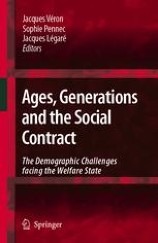
Ages, generations and the social contract : The demographic challenges facing the welfare state
Our societies are ageing. The Family is changing. Labour force behaviour is evolving. How is the organisation of family and collective solidarity adapting in this context of longer life spans, low fertility, and work that is simultaneously scarce and abundant? The welfare states are currently facing three main challenges: ensure satisfactory living conditions for the elderly without increasing the cost burden on the active population, reduce social inequality, and maintain equity between successive generations. In this book, researchers from different countries compare their experiences and offer contrasting views on the future of social protection. They consider the theoretical aspects of the intergenerational debate, relations between generations within the family, the living standards of elderly people, and the question of social time.

Advancing the Science of Cancer in Latinos
This book gives an overview of the sessions, panel discussions, and outcomes of the Advancing the Science of Cancer in Latinos conference, held in February 2018 in San Antonio, Texas, USA, and hosted by the Mays Cancer Center and the Institute for Health Promotion Research at UT Health San Antonio.

Accounting, Cash Flow and Value Relevance
Investigates the value relevance of the operating cash flow as reported under the International Financial Reporting Standards (IAS/IFRS) for the largest European listed companies and US listed companies in the past recent years. Using the model based on the valuation theory developed by Ohlson, which measures the market value of equity as a function of accounting variables, the author concludes that operating cash flow represents a significant variable in determining the value relevance of the largest European and US listed companies. These findings provide siginificant implications for standard setters and support the continued requirements for disclosure of cash flow information under IAS 7.

A Trading Desk View of Market Quality
"Market quality" is a complex, ambiguous term that means different things to different people. How should it be defined, measured, monitored, and improved? What is the evidence about the current state of our markets? How effective have recent innovations been? How can we better meet investor needs? These are some of the questions that we address in this book, along with a broad range of issues concerning equity market structure, regulation, and the quest for best execution. Throughout, particular attention is given to the perspective of front line participants on the buy-side and sell-side trading desks.

A proposed model for predicting financial Loss of private conventional and Islamic banks in Syria
This study aimed to find a model consisting of a set of financial ratios in which each ratio has its own weight that indicate its importance to predict probability of financial loss of conventional and Islamic banks in Syria. The early prediction warns the concerned parties that they can intervene and take corrective actions before the collapses of bank. To achieve this ratios of conventional and Islamic Syrian banks were analyzed using Binary logistic regression from the period of 2011-2020 The statistical results show that the logistic regression model is accurate to predict the probability of a financial loss in conventional banks about 82.2%, 81.3%, 80.1%, 78% before 90 days ,180 days, 270 days, one year respectively. We can generally use five variables (Non-performing debt, return on equity, size, growth rate and financing portfolio ratio) in bank's financial loss prediction, but for Islamic banks, no significant values were shown so we can’t find logistic regression model is accurate for Islamic banks.
