



الصفحة 4
الصفحة 4

Advanced Topics in Control Systems Theory ; Vol. 311 : Lecture Notes from FAP 2004
Advanced Topics in Control Systems Theory contains selected contributions written by lecturers at the second (annual) Formation dAutomatique de Paris (FAP) (Graduate Control School in Paris). It is addressed to graduate students and researchers in control theory with topics touching on a variety of areas of interest to the control community such as cascaded systems, flatness, optimal control, and Hamiltonian and infinite-dimensional systems. The reader is provided with a well-integrated synthesis of the latest thinking in these subjects without the need for an exhaustive literature review.
Advanced Motion Control and Sensing for Intelligent Vehicles
Provides the latest information in intelligent vehicle control, sensing, and intelligent transportation. It addresses the growing need for safe, comfortable, time and energy-efficient modes of transportation with emphasis on the latest key findings, current trends, and likely future developments in this rapidly expanding field. Highlights : Discusses individual vehicle dynamics, sensory and multiple ground-vehicle interactions / Includes systematic review of past and current research achievements / Presents case studies in cutting-edge directions such as vehicle steering motion, vehicle vision systems, cooperative driving, intersection safety, and tire pressure monitoring / Assesses the likely future developments of this field. This book is useful for both practicing engineers and researchers in the automotive industry.
Advanced Microsystems for Automotive Applications 2008 ; 4th ed.
With the total number of vehicles steadily increasing and soon approaching one billion, the world is facing serious challenges in terms of both safety of road transport and sustainability. Consequently the two major persistent issues for the automotive industry are improved safety and reduced emissions. The book in hand is a showroom of activities, the International Forum on Advanced Microsystems for Automotive Applications (AMAA) has been known for during the last 12 years.
Advanced Microsystems for Automotive Applications 2007 ; 3rd ed.
There is a coincidence of the AMAA objectives and those of EPoSS, the European Technology Platform on Smart Systems Integration, contributing intensively to the development of automotive-specific smart systems. You will find a series of the EPoSS items in the programme of the 11th AMAA, which continues to be a unique exchange forum for companies in the automotive value chain. The publication in hand also reflects these issues. It is a cut-out of new technological priorities in the area of microsystems-based smart devices and opens up a mid-term perspective of future smart systems applications in automobiles
Advanced Microsystems for Automotive Applications 2006 ; 2nd ed.
Microsystems in many cases provided the key functions for this progress. Although the issues the event concentrated on didn’t change significantly (safety, powertrain, comfort, etc.), considerable shifts of technological paradigms and approaches can be stated. The future of microsystems will consist of integrated smart systems which are able to diagnose a situation, to describe and to qualify it. They will be able to identify and mutually address each other. They will be predictive and therefore they will be able to decide and help to decide. Smart systems will enable the automobile to interact with the environment, they will perform multiple tasks and assist a variety of activities. Smart systems will be highly reliable, often networked and energy autonomous.
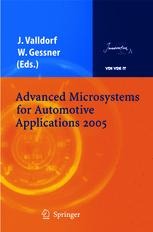
Advanced Microsystems for Automotive Applications 2005 ; 1st ed.
The book accompanying the event has demonstrated to be an efficient instrument for the diffusion of new concepts and technology results. The present volume including the papers of the AMAA 2005 gives an overview on the state-of-the-art and outlines imminent and mid-term R&D perspectives. The 2005 publication reflects – as in the past – the current state of discussions within industry. More than the previous publications, the AMAA 2005 "goes back" to the technological requirements and indispensable developments for fulfilling the market needs. The large part of contributions dealing with sensors as well as "sensor technologies and data fusion" is exemplary for this tendency.
Advanced mathematical science for mobility society
The automotive industry has made steady progress in technological innovations under the names of Connected Autonomous-Shared-Electric (CASE) and Mobility as a Service (MaaS). Needless to say, mathematics and informatics are important to support such innovations. As the concept of cars and movement itself is diversifying, they are indispensable for grasping the essence of the future mobility society and building the foundation for the next generation. This book contains three main contents. 1. Mathematical models of flow 2. Mathematical methodsfor huge data and network analysis 3. Algorithm for mobility society The first one discusses mathematical models of pedestrian and traffic flow, as they are important for preventing accidents and achieving efficient transportation.
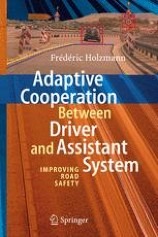
Adaptive Cooperation between Driver and Assistant System : Improving Road Safety
One of the next challenges in vehicular technology field is to improve drastically the road safety. Current developments are focusing on both vehicle platform and diverse assistance systems. This book presents a new engineering approach based on lean vehicle architecture ready for the drive-by-wire technology.
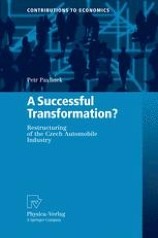
A Successful Transformation? : Restructuring of the Czech Automobile Industry
This book investigates the complex processes of the post-1990 transformation in the Czech automotive industry and its selective integration in the West European automobile manufacturing system. The post-1990 restructuring of the Czech automotive industry is analyzed in the context of its pre-1990 development and in the context of the Central and East European automobile industry as a whole. Specifically, the book examines the development and post-1990 restructuring of the Czech passenger car industry, the components industry and truck manufacturing. Major topics covered include the development of the Czech automotive industry before 1990, the detailed case study of Škoda Auto, the effects of the post-1990 privatization in the Czech automotive industry, the role and effects of foreign direct investment during the post-1990 restructuring, the restructuring of the Czech truck industry, and the rapid development of the automotive components manufacturing.
