



الصفحة 4
الصفحة 4

Cryptographic hardware and embedded systems - CHES 2005 ; 7th International Workshop, Edinburgh, UK, August 29 - September 1, 2005, Proceedings
Constitutes the refereed proceedings of the 7th International Workshop on Cryptographic Hardware and Embedded Systems, CHES 2005, held in Edinburgh, UK in August/September 2005. The papers in this book are organized in topical sections on side channels, arithmetic for cryptanalysis, special purpose hardware, hardware attacks and more.

Cryptanalytic Attacks on RSA
RSA is a public-key cryptographic system, and is the most famous and widely-used cryptographic system in today's digital world. Cryptanalytic Attacks on RSA, a professional book, covers almost all major known cryptanalytic attacks and defenses of the RSA cryptographic system and its variants.

Crop Biosecurity : Assuring our Global Food Supply
Prevention and preparedness are the two basic approaches to maximize food security against any sort of tampering, whether natural, inadvertent or intentional. The NATO funded project “Tools for crop biosecurity” was designed to strengthen the cooperation among U.S., Europe and Israel in the field of crop biosecurity and to generate awareness on how the psychological, economic and cultural consequences of crop bioterrorism, especially attacks on soft targets such as crop seeds, could have a disproportionate adverse effect on Mediterranean agriculture and, more generally, on society.This book illustrates the achievements of the project originated from the workshops organized during the project itself taking in consideration main microbiological threads posed to crops, the tools to recognize and to control them, the needs for international cooperation and research funds to create networks which can face emerging risks for agriculture.

Crisis Reporters, Emotions, and Technology : An Ethnography
This book explores the emotional labour of crisis reporters in an original style that combines fictional and factual narrative. Exploring how journalists make sense of their emotional experience and development in relation to their professional ideology, it illustrates how media professionals learn to think and act within crisis situations. Drawing on in-depth interviews with journalists reporting on wars, terror attacks and natural disasters, the book rethinks traditional concepts in journalistic thought. Finally, it reflects on the specific, contemporary vulnerabilities of industry professionals, including the impact of new technologies, specific forms of precarity, and a particular strain of cynicism central to the industry. Combining comprehensive, empirical research with the fictional narrative of a journalist protagonist, Crisis Reporters, Emotions and Technology establishes an innovative approach to academic storytelling.

Contributions to Ubiquitous Computing
This book puts the larger vision of ubiquitous computing in the context of today’s mobile and distributed computing systems and presents innovative solutions at all system layers ranging from hardware over vertical and horizontal infrastructure services and novel middleware techniques to various types of application software. Some chapters address core properties of ubiquitous applications including mobility, self-healing and self-organisation of both technical and social-technical systems. Other contributions deal with common facilities like secure e-payment or semantic web techniques and business solutions like wireless asset management or e- maintenance. Distributed systems management with self-monitoring capabilities, Internet congestion control, and novel security solutions coping with denial of service attacks against mobile agent systems and software- and hardware-based data encryption methods are further topics addressed.
Computer Security – ESORICS 2007 ; 12th European Symposium On Research In Computer Security, Dresden, Germany, September 24 - 26, 2007, Proceedings
This book address issues such as data protection; security protocols; systems; web and network security; privacy; threat modeling and detection; information flow; and security in emerging applications such as cryptocurrencies, the Internet of Things and automotive.

Computer Security – ESORICS 2006 ; 11th European Symposium on Research in Computer Security, Hamburg, Germany, September 18-20, 2006, Proceedings
This book constitutes the refereed proceedings of the 11th European Symposium on Research in Computer Security, ESORICS 2006. it presents original research contributions, case studies and implementation experiences addressing any aspect of computer security - in theory, mechanisms, applications, or practical experience.

Computer Network Security ; Vol. 3685
This volume contains papers presented at the 3rd International Workshop on Mathematical Methods, Models and Architectures for Computer Network - curity (MMM-ACNS 2005) held in St. Petersburg, Russia, 2005. The 1st and the 2nd International Workshops on Mathematical Methods, Models and Architectures for Computer Network Security (MMM-ACNS 2001 and MMM-ACNS 2003), hosted by the St. Petersburg Institute for Informatics and Automation, demonstrated the keen interest of the international research community in the subject area. It was recognized that conducting a biannual series of such workshops in St. Petersburg stimulates fruitful exchanges between the di?erent schools of thought, facilitates the dissemination of new ideas and promotesthespirit of cooperationbetweenresearchersontheinternationalscale. MMM-ACNS 2005 provided an international forum for sharing original - search results and application experiences among specialists in fundamental and applied problems of computer network security. An important distinction of the workshop was its focus on mathematical aspects of information and computer network security addressing the ever-increasing demands for secure computing and highly dependable computer networks.

Collaborative Medicine Case Studies : Evidence in Practice
Collaborative Medicine Case Studies Collaborative Medicine Case Studies shows physicians and mental health practitioners working together across a variety of settings to assess and treat entrenched illnesses, combined physical and psychological conditions (back pain/panic attacks, diabetes/bipolar disorder), and cases that defy straightforward diagnosis. At the same time, the cases reflect the economic and financial realities of contemporary health care.
Machine Learning Approaches in Cyber Security Analytics
Introduces various machine learning methods for cyber security analytics. With an overwhelming amount of data being generated and transferred over various networks, monitoring everything that is exchanged and identifying potential cyber threats and attacks poses a serious challenge for cyber experts. Further, as cyber attacks become more frequent and sophisticated, there is a requirement for machines to predict, detect, and identify them more rapidly. Machine learning offers various tools and techniques to automate and quickly predict, detect, and identify cyber attacks.
Machine Intelligence and Big Data Analytics for Cybersecurity Applications
Presents the latest advances in machine intelligence and big data analytics to improve early warning of cyber-attacks, for cybersecurity intrusion detection and monitoring, and malware analysis. Cyber-attacks have posed real and wide-ranging threats for the information society. Detecting cyber-attacks becomes a challenge, not only because of the sophistication of attacks but also because of the large scale and complex nature of today’s IT infrastructures. It discusses novel trends and achievements in machine intelligence and their role in the development of secure systems and identifies open and future research issues related to the application of machine intelligence in the cybersecurity field.
Asias New Institutional Architecture : Evolving Structures for Managing Trade, Financial, and Security Relations
This book investigates the origins and evolution of Asia’s new institutional architecture in trade, finance, and security from both a theoretical and empirical perspective. The traditional institutional equilibrium in Asia has come under heavy strain in the "post triple shocks period" - the post-Cold War, the post-financial crisis of 1997-98, and the post-9-11 attacks. The new dynamics of rivalry and cooperation among states at both the intraregional and transregional levels is now shaping a new institutional architecture. Political and business leaders from Northeast and Southeast Asia interact with each other more frequently. South Asia’s participation in the rest of Asia in recent years is truly impressive. As we show, the future institutional trajectory of Asia is still open, but we believe that the book provides a timely examination of key shifts in the region. In doing so, our hope is to provide policymakers and analysts with an institutional road map for the future.
Artificial intelligence and national security
Analyses the implications of the technical, legal, ethical and privacy challenges as well as challenges for human rights and civil liberties regarding Artificial Intelligence (AI) and National Security. It also offers solutions that can be adopted to mitigate or eradicate these challenges wherever possible. As a general-purpose, dual-use technology, AI can be deployed for both good and evil. The use of AI is increasingly becoming of paramount importance to the governments mission to keep their nations safe. However, the design, development and use of AI for national security poses a wide range of legal, ethical, moral and privacy challenges. This book explores national security uses for Artificial Intelligence (AI) in Western Democracies and its malicious use. This book also investigates the legal, political, ethical, moral, privacy and human rights implications of the national security uses of AI in the aforementioned democracies. It illustrates how AI for national security purposes could threaten most individual fundamental rights, and how the use of AI in digital policing could undermine user human rights and privacy.
Applied cryptography and network security ; Vol. 3989 : 4th International Conference, ACNS 2006, Singapore, June 6-9, 2006, Proceedings
The 4th International Conference on Applied Cryptography and Network Security(ACNS 2006)washeldin Singapore,during June6-9,2006.ACNS 2006 brought together individuals from academia and industry involved in multiple research disciplines of cryptography and security to foster exchange of ideas. This volume (LNCS 3989) contains papers presented in the academic track. ACNS was set a high standard when it was initiated in 2003. There has been a steady improvement in the quality of its program in the past 4 years: ACNS 2003 (Kunming, China), ACNS 2004 (Yellow Mountain, China), ACNS 2005 (New York, USA), ACNS 2006 (Singapore). The average acc- tance rate is kept at around 16%. We wish to receive the continued support from the community of cryptographyand security worldwide to further improve its quality and make ACNS one of the leading conferences.
Applied cryptography and network security ; 6th International Conference, ACNS 2008, New York, NY, USA, June 3-6, 2008. Proceedings
This book constitutes the refereed proceedings of the 6th International Conference on Applied Cryptography and Network Security, ACNS 2008, held in New York, NY, USA, in June 2008.
Applied cryptography and network security ; 5th International Conference, ACNS 2007, Zhuhai, China, June 5-8, 2007, Proceedings
The book is organized in topical sections on signature schemes, computer and network security, cryptanalysis, group-oriented security, cryptographic protocols, anonymous authentication, identity-based cryptography, security in wireless, ad-hoc, and peer-to-peer networks, as well as efficient implementation.

Applied cryptography and network security ; 19th International Conference, ACNS 2021, Kamakura, Japan, June 21–24, 2021, Proceedings, Part I
The two-volume set LNCS 12726 + 12727 constitutes the proceedings of the 19th International Conference on Applied Cryptography and Network Security, ACNS 2021, which took place virtually during June 21-24, 2021. The 37 full papers presented in the proceedings were carefully reviewed and selected from a total of 186 submissions. They were organized in topical sections as follows: Part I: Cryptographic protocols; secure and fair protocols; cryptocurrency and smart contracts; digital signatures; embedded system security; lattice cryptography; Part II: Analysis of applied systems; secure computations; cryptanalysis; system security; and cryptography and its applications.
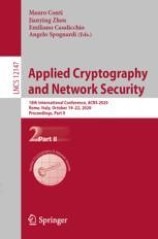
Applied cryptography and network security ; 18th International Conference, ACNS 2020, Rome, Italy, October 19–22, 2020, Proceedings, Part II
This two-volume set of LNCS 12146 and 12147 constitutes the refereed proceedings of the 18th International Conference on Applied Cryptography and Network Security, ACNS 2020, held in Rome, Italy, in October 2020.The conference was held virtually due to the COVID-19 pandemic. The 46 revised full papers presented were carefully reviewed and selected from 214 submissions. The papers were organized in topical sections named: cryptographic protocols cryptographic primitives, attacks on cryptographic primitives, encryption and signature, blockchain and cryptocurrency, secure multi-party computation, post-quantum cryptography.
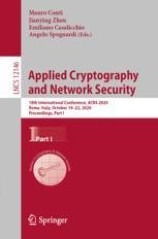
Applied Cryptography and Network Security ; 18th International Conference, ACNS 2020, Rome, Italy, October 19–22, 2020, Proceedings, Part I
This two-volume set of LNCS 12146 and 12147 constitutes the refereed proceedings of the 18th International Conference on Applied Cryptography and Network Security, ACNS 2020, held in Rome, Italy, in October 2020. The conference was held virtually due to the COVID-19 pandemic. The 46 revised full papers presented were carefully reviewed and selected from 214 submissions. The papers were organized in topical sections named: cryptographic protocols cryptographic primitives, attacks on cryptographic primitives, encryption and signature, blockchain and cryptocurrency, secure multi-party computation, post-quantum cryptography.
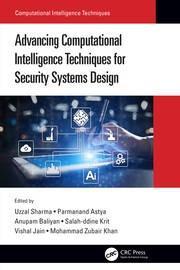
Advancing Computational Intelligence Techniques for Security Systems Design
Security systems have become an integral part of the building and large complex setups, and intervention of the computational intelligence (CI) paradigm plays an important role in security system architecture. This book covers both theoretical contributions and practical applications in security system design by applying the Internet of Things (IoT) and CI. It further explains the application of IoT in the design of modern security systems and how IoT blended with computational intel- ligence can make any security system improved and realizable. Focuses on the computational intelligence techniques of security system design / Covers applications and algorithms of discussed computational intelligence techniques / Includes convergence-based and enterprise integrated security systems with their applications / Explains emerging laws, policies, and tools affecting the landscape of cyber security / Discusses application of sensors toward the design of security systems
