



الصفحة 35
الصفحة 35

Geometric mechanics on riemannian manifolds : Applications to partial differential equations
This work presents a purely geometric treatment of problems in physics involving quantum harmonic oscillators, quartic oscillators, minimal surfaces, and Schrödinger's, Einstein's and Newton's equations. Historically, problems in these areas were approached using the Fourier transform or path integrals, although in some cases (e.g., the case of quartic oscillators) these methods do not work. New geometric methods are introduced in the work that have the advantage of providing quantitative or at least qualitative descriptions of operators, many of which cannot be treated by other methods. And, conservation laws of the Euler–Lagrange equations are employed to solve the equations of motion qualitatively when quantitative analysis is not possible. It includes : Lagrangian formalism on Riemannian manifolds; energy momentum tensor and conservation laws; Hamiltonian formalism; Hamilton–Jacobi theory; harmonic functions, maps, and geodesics; fundamental solutions for heat operators with potential; and a variational approach to mechanical curves.

Geometric Integration Theory
This textbook introduces geometric measure theory through the notion of currents. Currents—continuous linear functionals on spaces of differential forms—are a natural language in which to formulate various types of extremal problems arising in geometry, and can be used to study generalized versions of the Plateau problem and related questions in geometric analysis. Key features of Geometric Integration Theory: * Includes topics on the deformation theorem, the area and coarea formulas, the compactness theorem, the slicing theorem and applications to minimal surfaces * Applies techniques to complex geometry, partial differential equations, harmonic analysis, differential geometry, and many other parts of mathematics

Geometric Group Theory ; Geneva and Barcelona Conferences
This volume assembles research papers in geometric and combinatorial group theory. This wide area may be defined as the study of those groups that are defined by their action on a combinatorial or geometric object, in the spirit of Klein’s programme.The contributions range over a wide spectrum: limit groups, groups associated with equations, with cellular automata, their structure as metric objects, their decomposition, etc. Their common denominator is the language of group theory, used to express and solve problems ranging from geometry to logic.

Geometric Fundamentals of Robotics
Geometric Fundamentals of Robotics provides an elegant introduction to the geometric concepts that are important to applications in robotics. This second edition is still unique in providing a deep understanding of the subject: rather than focusing on computational results in kinematics and robotics, it includes significant state-of-the art material that reflects important advances in the field, connecting robotics back to mathematical fundamentals in group theory and geometry.

Geometric Function Theory : Explorations in Complex Analysis
Complex variables is a precise, elegant, and captivating subject. Presented from the point of view of modern work in the field, this new book addresses advanced topics in complex analysis that verge on current areas of research, including invariant geometry, the Bergman metric, the automorphism groups of domains, harmonic measure, boundary regularity of conformal maps, the Poisson kernel, the Hilbert transform, the boundary behavior of harmonic and holomorphic functions, the inhomogeneous Cauchy–Riemann equations, and the corona problem.
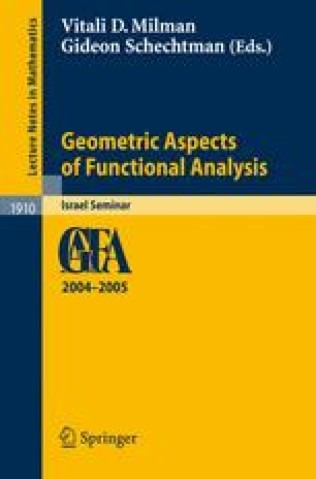
Geometric Aspects of Functional Analysis : Israel Seminar 2004-2005
Most of the papers deal with different aspects of the Asymptotic Geometric Analysis, ranging from classical topics in the geometry of convex bodies, to inequalities involving volumes of such bodies or, more generally, log-concave measures, to the study of sections or projections of convex bodies. In many of the papers Probability Theory plays an important role; in some limit laws for measures associated with convex bodies, resembling Central Limit Theorems, are derive and in others probabilistic tools are used extensively. There are also papers on related subjects, including a survey on the behavior of the largest eigenvalue of random matrices and some topics in Number Theory.

Geometric and Topological Methods for Quantum Field Theory
This volume offers an introduction, in the form of four extensive lectures, to some recent developments in several active topics at the interface between geometry, topology and quantum field theory. The first lecture is by Christine Lescop on knot invariants and configuration spaces, in which a universal finite-type invariant for knots is constructed as a series of integrals over configuration spaces. This is followed by the contribution of Raimar Wulkenhaar on Euclidean quantum field theory from a statistical point of view. The author also discusses possible renormalization techniques on noncommutative spaces. The third lecture is by Anamaria Font and Stefan Theisen on string compactification with unbroken supersymmetry. The authors show that this requirement leads to internal spaces of special holonomy and describe Calabi-Yau manifolds in detail. The last lecture, by Thierry Fack, is devoted to a K-theory proof of the Atiyah-Singer index theorem and discusses some applications of K-theory to noncommutative geometry. These lectures notes, which are aimed in particular at graduate students in physics and mathematics, start with introductory material before presenting more advanced results. Each chapter is self-contained and can be read independently.

Geomagnetics for aeronautical safety : A case study in and around the Balkans
Flying safely in aircraft implies the use of navigation instruments. Among them, the magnetic compass is still a first choice for orientation and it is compulsory in all aircraft. In our increasingly sophisticated but fragile world of global navigation systems and gyroscopic sensors, the compass is especially useful as a back-up: it is highly reliable and likely to survive in harsh electromagnetic aggressions or when all power supplies fail. This book examines in detail how the science of geomagnetism is able to promote correct use of the magnetic compass for navigation. A selected group of specialists met in Ohrid, Macedonia to expose their approaches to the question. Using techniques from Geology, Instrument science, Magnetism, Chaos theory and Potential Fields applied to the Balkan region and surroundings, they put together a roadmap to fully tackle the issue of measurement, analysis, mapping and forecasting the magnetic declination in support of aeronautical safety.

Génetique statistique = Statistical genetics
Presents the main statistical tools useful in genetics: significance tests, analysis methods based on the likelihood function, EM algorithm, modeling, analysis of variance, hierarchical classifications, multiple comparisons, etc. All of them shed light on a number of biological phenomena such as carcinogenesis, population genetics, Hardy-Weinberg equilibrium, natural selection, mutations, heredity, coalescence processes, and even evolution. This book is intended for mathematicians and biologists alike. Written with a great concern for clarity, it is also accessible to non-specialists who will be able, thanks to it, to strengthen their theoretical base and above all to develop their know-how through very concrete applications.

Genetic Systems Programming : Theory and Experiences
This book is devoted to reporting innovative and significant progress about the contribution of genetic programming in systems programming. The contributions of this book clearly demonstrate that genetic programming is very effective in solving hard and yet-open problems in systems programming. Followed by an introductory chapter, in the remaining contributed chapters, the reader can easily learn about systems where genetic programming can be applied successfully. These include but are not limited to, information security systems, compilers, data mining systems, stock market prediction systems, robots and automatic programming.

Genetic Programming Theory and Practice V
Genetic Programming Theory and Practice V was developed from the fifth workshop at the University of Michigan’s Center for the Study of Complex Systems to facilitate the exchange of ideas and information related to the rapidly advancing field of Genetic Programming (GP). Contributions from the foremost international researchers and practitioners in the GP arena examine the similarities and differences between theoretical and empirical results on real-world problems. The text explores the synergy between theory and practice, producing a comprehensive view of the state of the art in GP application.

Genetic Programming Theory and Practice IV
Genetic Programming Theory and Practice IV was developed from the fourth workshop at the University of Michigan’s Center for the Study of Complex Systems to facilitate the exchange of ideas and information related to the rapidly advancing field of Genetic Programming (GP). Contributions from the foremost international researchers and practitioners in the GP arena examine the similarities and differences between theoretical and empirical results on real-world problems.

Genetic Programming Theory and Practice III
Genetic Programming Theory and Practice III explores the emerging interaction between theory and practice in the cutting-edge, machine learning method of Genetic Programming (GP). This contributed volume was developed from the third workshop at the University of Michigan’s Center for the Study of Complex Systems to facilitate the exchange of ideas and information related to this rapidly advancing field. The text provides a cohesive view of the issues facing both practitioners and theoreticians and examines the synergy between GP theory and application.

Genetic Programming ; 11th European Conference, EuroGP 2008, Naples, Italy, March 26-28, 2008. Proceedings
The 11th European Conference on Genetic Programming, EuroGP 2008, took place in Naples, Italy from 26 to 28 March in the University of Naples Congress Centre with spectacular views over the Gulf of Naples. This volume contains the papers for the 21 oral presentations and 10 posters that were presented during this time. A diverse array of topics were covered refecting the current state of research in the ?eld of Genetic Programming, including the latest work on representations, theory, operators and analysis, evolvable hardware, agents and numerous applications. A rigorous, double-blind peer review process was employed, with each s- mission reviewed by at least three members of the international Program C- mittee.

Genetic programming : Theory and practice II
This volume explores the emerging interaction between theory and practice in the cutting-edge, machine learning method of Genetic Programming (GP). The contributions developed from a second workshop at the University of Michigan's Center for the Study of Complex Systems where leading international genetic programming theorists from major universities and active practitioners from leading industries and businesses met to examine how GP theory informs practice and how GP practice impacts GP theory. Chapters include such topics as financial trading rules, industrial statistical model building, population sizing, the roles of structure in problem solving by computer, stock picking, automated design of industrial-strength analog circuits, topological synthesis of robust systems, algorithmic chemistry, supply chain reordering policies, post docking filtering, an evolved antenna for a NASA mission and incident detection on highways.

Genetic Democracy : Philosophical Perspectives
GENETIC DEMOCRACY involves an in-depth analysis of the ethical, social and philosophical issues related to modern genetic research and gene technology. The aim of the book is to introduce systematic research on the social and ethical impacts of the use and development of genetically modified organisms (GMOs) as well as the acquisition, use and storage of human genetic information (HGI). The book contributes into enhancing public discussion and reaching fair and democratic decision-making practices in GMO and HGI use and development both on local and global level.

Genetic algorithms: theory, design and programming
We present a series of scientific contributions that delve into the intricate theoretical foundations and practical nuances of genetic algorithms (GAs). Beyond the academic realm, GAs have demonstrated profound applications in societal decision-making and engineering optimization, showcased through real-world examples and case studies. A dedicated section on programming principles offers a thorough guide for implementing GAs across diverse languages. This edition, tailored for researchers and academics, serves as a testament to the scientific advancements within the field, inviting readers to explore the nuanced journey from theoretical constructs to pragmatic applications in the dynamic landscape of GAs.

Generating hardware assertion checkers : For hardware verification, emulation, post-fabrication debugging and on-line monitoring
This is the first book that presents an “under-the-hood” view of generating assertion checkers, and as such provides a unique and consistent perspective on employing assertions in major areas, such as: specification, verification, debugging, on-line monitoring and design quality improvement.

Generalized Plasticity
The book is divided into five major parts: 1. Yield function and choice; 2. Constitutive relation; 3. Slip-line Field Theory for plane strain problems, Characteristics Field Theory for plane stress problems and Characteristics Field Theory for spatial axisymmetrical problems; 4. Plastic zone analysis at crack tip and fracture criterion for mixed mode crack; 5. Limit loads and shakedown loads for pressure vessel. Examples of applications and problems are given for most chapters.

Generalized Convexity, Generalized Monotonicity and Applications ; Proceedings of the 7th International Symposium on Generalized Convexity and Generalized Monotonicity
This volume contains a collection of refereed articles on generalized convexity and generalized monotonicity. The first part of the book contains invited papers with applications of (generalized) convexity to such diverse fields as algebraic dynamics of the Gamma function values, discrete optimization, Lipschitzian stability of parametric constraint systems, and monotonicity of functions. The second part contains contributions presenting the latest developments in generalized convexity and generalized monotonicity: its connections with discrete and with continuous optimization, multiobjective optimization, fractional programming, nonsmooth Aanalysis, variational inequalities, and its applications to concrete problems such as finding equilibrium prices in mathematical economics, or hydrothermal scheduling.
