



الصفحة 35
الصفحة 35

Condition Monitoring and Control for Intelligent Manufacturing
Manufacturing systems and processes are becoming increasingly complex, making more rational decision-making in process control a necessity. The book presents a wide and comprehensive review of the key areas of research in machine condition monitoring and control, before focusing on an in-depth treatment of each important technique, from multi-domain signal processing for defect diagnosis to web-based information delivery for real-time control.

Concurrency Theory : Calculi an Automata for Modelling Untimed and Timed Concurrent Systems
Concurrency Theory is a synthesis of one of the major threads of theoretical computer science research focusing on languages and graphical notations for describing collections of simultaneously evolving components that interact through synchronous communication. The main specification notation focused on in this book is LOTOS. An extensive introduction to this particular process calculus is given, highlighting how the approach differs from competitor techniques, such as CCS and CSP.

CONCUR 2007 – Concurrency Theory ; 18th International Conference, CONCUR 2007, Lisbon, Portugal, September 3-8, 2007, Proceedings
This book includes model checking, process calculi, minimization and equivalence checking, types, semantics, probability, bisimulation and simulation, real time, and formal languages.
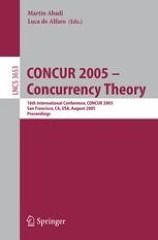
CONCUR 2005 - Concurrency Theory
This volume contains the papers presented at CONCUR 2005, the 16th - ternational Conference on Concurrency Theory. The purpose of the CONCUR series of conferences is to bring together researchers,developers, and students in order to advance the theory of concurrency and to promote its applications. The Program Committee selected 38 papers for presentation. Because of the format of the conference and the high number of submissions, many good papers could not be included. Although submissions werereadand evaluated, the papers that appear in this volume may di?er in form and contents from the corresponding submissions.

Concrete permeability and durability performance: from theory to field applications
Durability and service life design of concrete constructions have considerable socio-economic and environmental consequences, in which the permeability of concrete to aggressive intruders plays a vital role.Concrete Permeability and Durability Performance provides deep insight into the permeability of concrete, moving from theory to practice, and presents over 20 real cases.

Concrete bridge strengthening and repair
Covering a wide range of structural elements and related defects, this collection of twenty concrete bridge strengthening and repair case studies showcases solutions to real problems encountered in the field and the processes by which those solutions were developed. Drawing on a lifetime of experience Atkins consultant Iain Kennedy Reid provides insight into methods of investigation and diagnosis of problems relating to beams, slabs, columns and panel walls, as well as how to apply demand-led research to these problems in a practical way.

CONCREEP 10 : Mechanics and physics of creep, shrinkage, and durability of concrete and concrete structures
Contains 187 papers invited on the basis of carefully peer-reviewed abstracts. It elucidates the intricacies of concrete, linking atomistic physics to real life civil engineering design. Topics include: microstructures and micromechanics; multiscale creep, shrinkage, fracture, and durability properties; constitutive and numerical modeling; simulation and design of concrete structures; molecular- to lab-scale simulations and characterization of concrete; macroscopic material testing; creep and shrinkage of concrete under extreme conditions; monitoring of concrete structures and exploitation of measurement data; and creep and shrinkage properties of new cementitious materials.

Conceptual Modeling of Information Systems
When designing an information system, conceptual modeling is the activity that elicits and describes the general knowledge the system needs to know. This description, called the conceptual schema, is necessary in order to develop an information system.textbook explains in detail the principles of conceptual modeling independently from particular methods and languages and shows how to apply them in real-world projects. It covers all aspects of the engineering process from structural modeling over behavioral modeling to meta-modeling, and completes the presentation with an extensive case study based on the osCommerce system, an online store-management software program freely available under the GNU General Public License. His presentation is based on well-known industry standards like UML and OCL as a particular conceptual modeling language, yet also delivers the basics of the formal logical language background.

Conceptual Modeling - ER 2005
Conceptual modeling is fundamental to any domain where one must cope with complex real-world situations and systems because it fosters communication - tween technology experts and those who would bene?t from the application of those technologies. Conceptual modeling is the key mechanism for und- standing and representing the domains of information system and database - gineering but also increasingly for other domains including the new “virtual” e-environmentsandtheinformationsystemsthatsupportthem.Theimportance of conceptual modeling in software engineering is evidenced by recent interest in “model-drivenarchitecture”and“extremenon-programming”.Conceptualm- eling also plays a prominent rolein various technical disciplines and in the social sciences. The Annual International Conference on Conceptual Modeling (referred to as the ER Conference) provides a central forum for presenting and discussing current research and applications in which conceptual modeling is the major emphasis.

Concepts and Results in Chaotic Dynamics : A Short Course
The book is a good introduction to the field of dynamical systems with a particular emphasis on statistical properties and applications. In particular, the relations both with real experiments with numerical simulations are discussed. The book contains many figures that really help the understanding of the text. The book can be used as a text for an introductory course in dynamical systems

Conceptions of the Desirable : What Cities Ought to Know about the Future
Right in the heart of Graz, the second largest city in Austria, an entire city district had simply fallen into oblivion. The owners have taken up the search for answers: How, in future, do we wish to work and live? This title presents the results of a research by structuring its content into: Life, Work, Urbanity and Education.

Computers and Education : E-Learning, From Theory to Practice
This book contains a selection of contributions presenting the latest research in the field of Computers in Education and, more specifically, in E-Learning. The topics covered range from proposals regarding the newest "de facto" standards in E-Learning - such as IMS Learning Design - to the more practical aspects of the design, i.e. implementations and the actual application of educational tools in real settings. The volume reflects the diverse scenario of the application of computers in the educational field by describing previous experiences and addressing some of the present key issues such as Learning Management Systems as well as more innovative aspects such as personalized or ubiquitous learning.

Computer-Aided Highway Engineering
Aimed at developing professional knowledge in the field of highway engineering with adequate skills in planning, designing and implementation of the highway project with an exposure of hands on training of computer software in designing the worldwide road infrastructures. It discusses Digital Terrain Model (DTM) using satellite data including highway geometric, pavement and tunnel design, supported by relevant tutorials. Quantity estimation, cost estimation and production of various types of construction drawings are described in detail with theory and tutorials backed by real project data. Recognizes the role of information and computer technology in various aspects of highway design. Reviews different tasks for feasibility studies and DPR with software applications. Explores topographic survey, Digital Terrain Model (DTM) and highway geometrics and, pavement and drainage design. Discusses project estimations for various revisions of the engineering work. Includes HEADS Pro along with chapter wise tutorials containing design and field data, tutorial guides and various tutorial videos.

Computer-Aided Architectural Design Futures (CAADFutures) 2007 ; Proceedings of the 12th International CAADFutures Conference
This volume is the proceedings of the 12th International Conference of CAAD Futures, which took place in Sydney, Australia. The internationally refereed papers in this book present the state of the art in computer-aided architectural design research. The papers in this year's conference theme, Integrating Technologies for Computer-Aided Design, provide the technological foundation for new ways of thinking about using computers in designing and the use of computers in design itself as well as in the education of designers.

Computer vision in human-computer interaction ; Vol. 3766
Human-Computer Interaction (HCI) lies at the crossroads of many scienti?c areas including arti?cial intelligence, computer vision, face recognition, motion tracking, etc. In order for HCI systems to interact seamlessly with people, they need to understand their environment through vision and auditory input. Mo- over, HCI systems should learn how to adaptively respond depending on the situation. The goal of this workshop was to bring together researchers from the ?eld of computer vision whose work is related to human-computer interaction. The selected articles for this workshop address a wide range of theoretical and - plication issues in human-computer interaction ranging from human-robot - teraction, gesture recognition, and body tracking, to facial features analysis and human-computer interaction systems.

Computer Vision Beyond the Visible Spectrum
Recently, there has been a dramatic increase in the use of sensors in the non-visible bands. As a result, there is a need for existing computer vision methods and algorithms to be adapted for use with non-visible sensors, or for the development of completely new methods and systems. Computer Vision Beyond the Visible Spectrum is the first book to bring together state-of-the-art work in this area. It presents new & pioneering research across the electromagnetic spectrum in the military, commercial, and medical domains. By providing a detailed examination of each of these areas, it focuses on the development of state-of-the-art algorithms and looks at how they can be used to solve existing & new challenges within computer vision. Essential reading for academics & industrial researchers working in the area of computer vision, image processing, and medical imaging, it will also be useful background reading for advanced undergraduate & postgraduate students.

Computer vision and machine learning for intelligent sensing systems
Offers a selection of high-quality research articles that tackle the major difficulties in computer vision and machine learning for intelligent sensing systems from both theoretical and practical standpoints. This publication includes intelligent sensing techniques, twelve foundational investigations into sense-making methods, and discusses particular uses of intelligent sensing systems in autonomous driving and virtual reality.
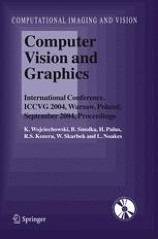
Computer vision and graphics ; International Conference, ICCVG 2004, Warsaw, Poland, September 2004, Proceedings
The objectives of the ICCVG are: presentation of current research topics and d- cussions leading to the integration of the community engaged in machine vision and computer graphics, carrying out and supporting research in the ?eld and ?nally pro- tion of new applications. The ICCVG is a continuation of the former International Conference on Computer Graphics and Image Processing called GKPO, held in Poland every second year in May since 1990, organized by the Institute of Computer Science of the Polish Academy of Sciences, Warsaw.

Computer vision : Algorithms and applications
Explores the variety of techniques commonly used to analyze and interpret images. It also describes challenging real-world applications where vision is being successfully used, both for specialized applications such as medical imaging, and for fun, consumer-level tasks such as image editing and stitching, which students can apply to their own personal photos and videos.

Computer vision : Algorithms and applications
Explores the variety of techniques used to analyze and interpret images. It also describes challenging real-world applications where vision is being successfully used, both in specialized applications such as image search and autonomous navigation, as well as for fun, consumer-level tasks that students can apply to their own personal photos and videos. Suitable for an upper-level undergraduate or graduate-level course in computer science or engineering, this textbook focuses on basic techniques that work under real-world conditions and encourages students to push their creative boundaries. Its design and exposition also make it eminently suitable as a unique reference to the fundamental techniques and current research literature in computer vision.
