



الصفحة 35
الصفحة 35

Metaheuristic Optimization via Memory and Evolution : Tabu Search and Scatter Search
Tabu Search (TS) and, more recently, Scatter Search (SS) have proved highly effective in solving a wide range of optimization problems, and have had a variety of applications in industry, science, and government. The goal of METAHEURISTIC OPTIMIZATION VIA MEMORY AND EVOLUTION: Tabu Search and Scatter Search is to report original research on algorithms and applications of tabu search, scatter search or both, as well as variations and extensions having "adaptive memory programming" as a primary focus. Individual chapters identify useful new implementations or new ways to integrate and apply the principles of TS and SS, or that prove new theoretical results, or describe the successful application of these methods to real world problems.The chapters of this book provide a series of landmarks along the way as we investigate and seek to better understand the elements of tabu search and scatter search that account for their successes in an astonishingly varied range of applications.

Metaheuristic Optimization Algorithms in Civil Engineering : New Applications
Discusses the application of metaheuristic algorithms in a number of important optimization problems in civil engineering. Advances in civil engineering technologies require greater accuracy, efficiency and speed in terms of the analysis and design of the corresponding systems. As such, it is not surprising that novel methods have been developed for the optimal design of real-world systems and models with complex configurations and large numbers of elements.

Metagraphs and Their Applications
The graph is a critical and useful concept in designing many information processing systems. Systems such as transaction processing systems, decision support systems, and workflow systems are all helped immensely by a graphical structure. Simple graphs and digraphs allow for the construction of a variety of system design tools that provide a convenient and appealing format for illustrating information infrastructures, while allowing any subsequent analyses to be performed by the user. However, the metagraph, a new graphical structure that is developed in this book, goes beyond the representational and provides Information Systems with a robust, analytical modeling graphic tool.

Metabolomics : A powerful tool in systems biology
This book brings together the latest results in the field of metabolomics. It comprehensively presents the current state of the metabolomics field by underscoring experimental methods, analysis techniques, standardization practices, and advances in specific model systems. As a result, it significantly broadens our perspective on the principles and strategies underpinning this emerging field.
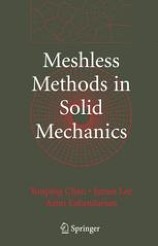
Meshless Methods in Solid Mechanics
The main objective of this book is to provide a textbook for graduate courses on the computational analysis of continuum and solid mechanics based on meshless (also known as mesh free) methods. It can also be used as a reference book for engineers and scientists who are exploring the physical world through computer simulations. Emphasis of this book is given to the understanding of the physical and mathematical characteristics of the procedures of computational solid mechanics. It naturally brings the essence, advantages and challenging problems of meshless methods into the picture. The subjects in this book cover the fundamentals of continuum mechanics, the integral formulation methods of continuum problems, the basic concepts of finite element methods, and the methodologies, formulations, procedures, and applications of various meshless methods. It also provides general and detailed procedures of meshless analysis on elastostatics, elastodynamics, non-local continuum mechanics and plasticity with a large number of numerical examples. Some basic and important mathematical methods are included in the Appendixes. For the readers who want to gain knowledge through hands-on experience, the meshless programs for elastostatics and elastodynamics are also introduced in the book and included in the disc.
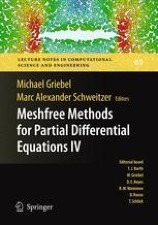
Meshfree Methods for Partial Differential Equations IV
The numerical treatment of partial differential equations with particle methods and meshfree discretization techniques is a very active research field both in the mathematics and engineering community. Due to their independence of a mesh, particle schemes and meshfree methods can deal with large geometric changes of the domain more easily than classical discretization techniques. Furthermore, meshfree methods offer a promising approach for the coupling of particle models to continuous models. This volume of LNCSE is a collection of the proceedings papers of the Fourth International Workshop on Meshfree Methods held in September 2007 in Bonn. The articles address the different meshfree methods (SPH, PUM, GFEM, EFGM, RKPM, etc.) and their application in applied mathematics, physics and engineering. The volume is intended to foster this very active and exciting area of interdisciplinary research and to present recent advances and results in this field.

Meshfree Methods for Partial Differential Equations III
Meshfree methods for the numerical solution of partial differential equations are becoming more and more mainstream in many areas of applications. Their flexiblity and wide applicability are attracting engineers, scientists, and mathematicians to this very dynamic research area. This volume represents the state of the art in meshfree methods. It consists of articles which address the different meshfree techniques, their mathematical properties and their application in applied mathematics, physics and engineering.

Meshfree Methods for Partial Differential Equations II
A Particle Strategy for Solving the Fokker-Planck Equation Modelling the Fiber Orientation Distribution in Steady Recirculating Flows Involving Short Fiber Suspensions.- Extended Meshfree Method for Elastic and Inelastic Media.- Meshfree Petrov-Galerkin Methods for the Incompressible Navier-Stokes Equations.- The ?-shape Based Natural Element Method in Solid and Fluid Mechanics.- A Particle-Partition of Unity Method Part VI: A p-robust Multilevel Solver.- Enriched Reproducing Kernel Approximation: Reproducing Functions with Discontinuous Derivatives.- Reproducing Kernel Element Interpolation: Globally Conforming I m/C n/P k Hierarchies.- Multi-scale Analysis Using Two Influence Radii in EFGM.- Solution of a Dynamic Main Crack Interaction with a System of Micro-Cracks by the Element Free Galerkin Method.- Finite Cover Method for Physically and Geometrically Nonlinear Problems.- A Numerical Scheme for Solving Incompressible and Low Mach Number Flows by the Finite Pointset Method.- SPH Renormalized Hybrid Methods for Conservation Laws: Applications to Free Surface Flows.- Discontinuous Radial Basis Function Approximations for Meshfree Methods.- Treating Moving Interfaces in Thermal Models with the C-NEM.- Bridging Scale Particle and Finite Element Methods.

Mercury
Mercury, the planet closest to the Sun, is different in several respects from the other three terrestrial planets. In appearance, it resembles the heavily cratered surface of the Moon, but its density is high, it has a magnetic field and magnetosphere, but no atmosphere or ionosphere. This book reviews the progress made in Mercury studies since the flybys by Mariner 10 in 1974-75, based on the continued research using the Mariner 10 archive, on observations from Earth, and on increasingly realistic models of its interior evolution.

Men’s care center
"سين" مركزٌ للعافية والاسترخاء، مصمم بمزيج فريد من العناصر الطبيعية والهندسة المعمارية الحديثة ليمنح الزوار تجربة حسية متكاملة. يدمج المشروع المساحات الخضراء الداخلية والإضاءة الهادئة وخطوط التصميم المعاصرة لخلق بيئة فاخرة وهادئة. تشمل المساحات الرئيسية الحديقة الداخلية، والحمام التركي التقليدي، وغرف كبار الشخصيات، ومنطقة الاستقبال - جميعها مُرتبة بعناية لتعزيز الهدوء والتوازن. يركز التصميم على التفاصيل المعمارية والوظيفية، موفرًا للضيوف ملاذًا من ضغوط الحياة اليومية. خضعت التصاميم الداخلية والخارجية لدراسة دقيقة لضمان تجربة راقية وشاملة. “Sén” is a wellness and re laxation center designed with a unique blend of natural elements and modern architecture to provide visitors with a complete sensor experience. The project integrates indoor greenery, calming lighting, and con temporary design lines to create a luxurious and peaceful environment. Key spaces include the indoor garden, traditional hammam, VI P rooms, and reception area — all carefully arranged to promote tranquility and balance. The design focuses on architectural and functional details, offering guests a retreat from the stresses of everyday life. Both interior and exterior designs were carefully studied to ensure a refined and holistic experience.

MEMS/NEMS : (1) Handbook Techniques and Applications Design Methods, (2) Fabrication Techniques, (3) Manufacturing Methods, (4) Sensors and Actuators, (5) Medical Applications and MOEMS
Micro-Electro Mechanical Systems (MEMS) is the integration of mechanical elements, sensors, actuators, and electronics on a common silicon substrate. While the electronics are fabricated using integrated circuit (IC) process sequences (e.g., CMOS, Bipolar, or BICMOS processes),the micromechanical components are fabricated using compatible micromachining processes that selectively etch away parts of the silicon wafer or add new structural layers to form the mechanical and electromechanical devices. MEMS promises to revolutionize nearly every product category by bringing together silicon-based microelectronics with micromachining technology, thereby, making possible the realization of complete systems-on-a-chip.

Memory B-cells : Methods and protocols
Details in methods to assess memory B cell formation and function in mice and humans. Chapters guide readers through tetramer-based methods to assess antigen-specific memory B cell dynamics in humans and mice in different vaccine, next-generation deep-sequencing, single-cell techniques to assess epigenomic, VDJ landscapes, lymph node aspirates from humans, advanced imaging, murine models to determine memory B cells formation, and bioinformatic techniques and in silico modelling of memory b cell formation. Written in the highly successful Methods in Molecular Biology series format, chapters include introductions to their respective topics, lists of the necessary materials and reagents, step-by-step, readily reproducible laboratory protocols, and key tips on troubleshooting and avoiding known pitfalls.

Membrane Computing; 8th International Workshop, WMC 2007 Thessaloniki, Greece, June 25-28, 2007 Revised Selected and Invited Papers
This volume contains a selection of papers presented at the Eighth Workshop on Membrane Computing, WMC8, which took place in Thessaloniki, Greece, during June 25–28, 2008. Special attention was paid to the interaction of membrane computing with biology and computer science, focusing on the - ological roots of membrane computing, on applications of membrane computing in biology and medicine, and on possible electronically based implementations.

Membrane Computing ; Vol. 4361 ; 7th International Workshop, WMC 2006, Leiden, Netherlands, July 17-21, 2006, Revised, Selected, and Invited Papers
The present volume contains a selection of papers presented at the Seventh Workshop on Membrane Computing, WMC7, which took place in Leiden, The Netherlands, during July 17–21, 2006. The ?rst three workshops on membrane computing were organized in Curtea de Arge¸ s, Romania – they took place in August 2000 (with the proceedings published in Lecture Notes in Computer Science, volume2235),in August 2001(with a selection of papers published asa special issue of Fundamenta Informaticae, volume 49, numbers 1–3, 2002), and in August 2002 (with the proceedings published in Lecture Notes in Computer Science, volume 2597). The next three workshops were organized in Tarragona, Spain, in July 2003, in Milan, Italy, in June 2004, and in Vienna, Austria, in July 2005, with the proceedings published as volumes 2933, 3365, and 3850, respectively, of Lecture Notes in Computer Science. The 2006edition of WMC wasorganized(and supported) byLorentzCenter, Leiden, under the auspices of the European Molecular Computing Consortium (EMCC). Special attention was paid to the interaction of membrane computing with biology, focusing both on the biological roots of membrane computing and on applications of membrane computing in biology and medicine.

Membrane Computing ; Vol. 3850 ; 6th International Workshop, WMC 2005, Vienna, Austria, July 18-21, 2005, Revised Selected and Invited Papers
The papers in this volume cover all the main directions of research in membrane computing, ranging from theoretical topics in mathematics and computer science, to application issues, especially in biology. More specifically, these papers present research on topics such as: computational power and complexity classes, new types of P systems, relationships to Petri nets, quantum computing, and brane calculi, determinism vs. nondeterminism, hierarchies, the size of small families, algebraic approaches, and designing polynomial solutions to NP-complete problems through the use of membrane systems. Like the previous workshops,

Melting Hadrons, Boiling Quarks - From Hagedorn Temperature to Ultra-Relativistic Heavy-Ion Collisions at CERN : With a Tribute to Rolf Hagedorn
Shows how the study of multi-hadron production phenomena in the years after the founding of CERN culminated in Hagedorn's pioneering idea of limiting temperature, leading on to the discovery of the quark-gluon plasma -- announced, in February 2000 at CERN.

MEGAFLOW - Numerical Flow Simulation for Aircraft Design ; Results of the second phase of the German CFD initiative MEGAFLOW, presented during its closing symposium at DLR, Braunschweig, Germany, December 10 and 11, 2002
This volume contains results of the German CFD initiative MEGAFLOW which combines many of the CFD development activities from DLR, universities and aircraft industry. It highlights recent improvements and enhancements of the MEGAFLOW software system.

Medicinal spice and condiment crops
Spices are used in small quantities to add flavor, aroma, color, and texture in food preparation. However, spices and condiments have also been recognized as having medicinal value. They have been used traditionally as curative and preventive agents, the bioactive compounds obtained from these plants are used in herbal drug formulations in modern times.

Medicinal roots and tubers for pharmaceutical and commercial applications
The root and tuber are vital parts of medicinal plants providing mechanical support, producing critical growth regulators, and storing food. Bioactive compounds obtained from plant roots and tubers demonstrate health benefits presenting antioxidative, antimicrobial, hypoglycaemic, hypocholesterolaemic, and immunomodulatory properties. Roots of many medicinal plants have been used for the treatment of disease and formulation of drugs, and they are also known for their commercial value, being used as an ingredient in the pharmaceutical and cosmetic industries.

Medicinal plants of the world ; Vol.3 : Chemical constituents, traditional and modern medicinal uses
The author's exhaustive summary of available scientific data for each plant provides detailed information on how the plant is used in different countries, describing its traditional therapeutic applications and what is known from its use in clinical trials. Additional material presented includes a botanical description with a color photo of each plant for identification, the common names used for the plant throughout the world, and a listing of the plant's known chemical constituents. A comprehensive bibliography cites the literature available from a wide range of disciplines. Medicinal Plants of the World: Chemical Constituents, Traditional and Modern Medicinal Uses, Volume 3, offers a unique collection of vital scientific information for pharmacologists, herbal medicine practitioners, drug developers, phytochemists, medicinal chemists, phytologists, toxicologists, and researchers who want to explore the many uses of plant materials for medicinal and related purposes. Its wealth of significant information will reveal little-known facts about these plants and open new horizons of application for the many novel drugs and drug candidates found in them.
