



الصفحة 35
الصفحة 35
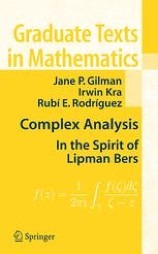
Complex Analysis : In the Spirit of Lipman Bers
In this book, the main focus is the theory of complex-valued functions of a single complex variable. This theory is a prerequisite for the study of many current and rapidly developing areas of mathematics including the theory of several and infinitely many complex variables, the theory of groups, hyperbolic geometry and three-manifolds, and number theory.
Complex analysis
The guiding principle of this presentation of ``Classical Complex Analysis'' is to proceed as quickly as possible to the central results while using a small number of notions and concepts from other fields. Thus the prerequisites for understanding this book are minimal; only elementary facts of calculus and algebra are required.
Completeness theory for propositional logics
Completeness is one of the most important notions in logic and the foundations of mathematics. Many variants of the notion have been de?ned in literature. We shallconcentrateonthesevariants,andaspects,of completenesswhicharede?ned in propositional logic. Completeness means the possibility of getting all correct and reliable sc- mata of inference by use of logical methods. The word ‘all’, seemingly neutral, is here a crucial point of distinction. Assuming the de?nition as given by E. Post we get, say, a global notion of completeness in which the reliability refers only to syntactic means of logic and outside the correct schemata of inference there are only inconsistent ones. It is impossible, however, to leave aside local aspects of the notion when we want to make it relative to some given or invented notion of truth. Completeness understood in this sense is the adequacy of logic in relation to some semantics, and the change of the logic is accompanied by the change of its semantics.
Compatible Spatial Discretizations
Compatible spatial discretizations are those that inherit or mimic fundamental properties of the PDE such as topology, conservation, symmetries, and positivity structures and maximum principles. It offer a snapshot of the current trends and developments in compatible spatial discretizations. The reader will find valuable insights on spatial compatibility from several different perspectives and important examples of applications compatible discretizations in computational electromagnetics, geosciences, linear elasticity, eigenvalue approximations and MHD. The contributions collected in this volume will help to elucidate relations between different methods and concepts and to generally advance our understanding of compatible spatial discretizations for PDEs.
Compactifying Moduli Spaces for Abelian Varieties
This volume presents the construction of canonical modular compactifications of moduli spaces for polarized Abelian varieties (possibly with level structure), building on the earlier work of Alexeev, Nakamura, and Namikawa. This provides a different approach to compactifying these spaces than the more classical approach using toroical embeddings, which are not canonical. There are two main new contributions in this monograph: (1) The introduction of logarithmic geometry as understood by Fontaine, Illusie, and Kato to the study of degenerating Abelian varieties; and (2) the construction of canonical compactifications for moduli spaces with higher degree polarizations based on stack-theoretic techniques and a study of the theta group.
Compactifications of Symmetric and Locally Symmetric Spaces
Noncompact symmetric and locally symmetric spaces naturally appear in many mathematical theories, including analysis (representation theory, nonabelian harmonic analysis), number theory (automorphic forms), algebraic geometry (modulae) and algebraic topology (cohomology of discrete groups). In most applications it is necessary to form an appropriate compactification of the space. The literature dealing with such compactifications is vast. The main purpose of this book is to introduce uniform constructions of most of the known compactifications with emphasis on their geometric and topological structures. The book is divided into three parts. Part I studies compactifications of Riemannian symmetric spaces and their arithmetic quotients. Part II is a study of compact smooth manifolds. Part III studies the compactification of locally symmetric spaces.
Compact Riemann Surfaces : An Introduction to Contemporary Mathematics
Although Riemann surfaces are a time-honoured field, this book is novel in its broad perspective that systematically explores the connection with other fields of mathematics. It can serve as an introduction to contemporary mathematics as a whole as it develops background material from algebraic topology, differential geometry, the calculus of variations, elliptic PDE, and algebraic geometry. It is unique among textbooks on Riemann surfaces in including an introduction to Teichmüller theory.
Compact Lie Groups
This book covers the structure and representation theory of compact Lie groups. The necessary Lie algebra theory is also developed in the text with a streamlined approach focusing on linear Lie groups.
Commutative algebras of Toeplitz Operators on the Bergman Space
This book is devoted to the spectral theory of commutative C*-algebras of Toeplitz operators on the Bergman space and its applications. For each such commutative algebra there is a unitary operator which reduces Toeplitz operators from this algebra to certain multiplication operators, thus providing their spectral type representations. This yields a powerful research tool giving direct access to the majority of the important properties of the Toeplitz operators studied herein, such as boundedness, compactness, spectral properties, invariant subspaces.
Classification des Groupes Algébriques Semi-simples = The Classification of Semi-Simple Algebraic Groups
The third volume of the Collected Works of Claude Chevalley assembles his work on semi-simple algebraic groups contained, for the most part, in the notes of the famous "Sminaire Chevalley" held at the Ecole Normale Suprieure in Paris between 1956 and 1958 and written up by participants of the seminar namely, P. Cartier, A. Grothendieck, R. Lazard and J.L. Verdier. These texts have been entirely reset in TeX for this edition, and edited and annotated by Pierre Cartier. Almost 50 years after the original writing, these texts still constitute a choice reference from which to enter
Classification Algorithms for Codes and Designs
Almost a century earlier, in 1782, Euler [180] published some results on classifying small Latin squares, but for the ?rst few steps in this direction one should actually go at least as far back as ancient Greece and the proof that there are exactly ?ve Platonic solids. One of the most remarkable achievements in the early, pre-computer era is the classi?cation of the Steiner triple systems of order 15, quoted above. An onerous task that, today, no sensible person would attempt by hand calcu- tion. Because, with the exception of occasional parameters for which com- natorial arguments are e?ective (often to prove nonexistence or uniqueness), classi?cation in general is about algorithms and computation.
Classical geometries in modern contexts : Geometry of real inner product spaces
This book is based on real inner product spaces X of arbitrary (finite or infinite) dimension greater than or equal to 2. With natural properties of (general) translations and general distances of X, euclidean and hyperbolic geometries are characterized. For these spaces X also the sphere geometries of Möbius and Lie are studied (besides euclidean and hyperbolic geometry), as well as geometries where Lorentz transformations play the key role. The geometrical notions of this book are based on general spaces X as described. This implies that also mathematicians who have not so far been especially interested in geometry may study and understand great ideas of classical geometries in modern and general contexts.
Classical geometries in modern contexts : Geometry of real inner product spaces
This book is based on real inner product spaces X of arbitrary (finite or infinite) dimension greater than or equal to 2. With natural properties of (general) translations and general distances of X, euclidean and hyperbolic geometries are characterized.
Classes of Finite Groups
Many group theorists all over the world have been trying in the last twenty-five years to extend and adapt the magnificent methods of the Theory of Finite Soluble Groups to the more ambitious universe of all finite groups. This is a natural progression after the classification of finite simple groups but the achievements in this area are scattered in various papers.Our objectives in this book were to gather, order and examine all this material, including the latest advances made, give a new approach to some classic topics, shed light on some fundamental facts that still remain unpublished and present some new subjects of research in the theory of classes of finite, not necessarily solvable, groups.

Chance Rules : An informal guide to probability, risk and statistics
This second edition of Chance Rules again recounts the story of chance through history and the various ways it impacts on our lives. Here you can read about the earliest gamblers who thought that the fall of the dice was controlled by the gods, as well as the modern geneticist and quantum theory researcher trying to integrate aspects of probability into their chosen speciality. Example included in the first addition such as the infamous Monty Hall problem, tossing coins, coincidences, horse racing, birthdays and babies remain, often with an expanded discussion, in this edition. Additional material in the second edition includes, a probabilistic explanation of why things were better when you were younger, consideration of whether you can use probability to prove the existence of God, how long you may have to wait to win the lottery, some court room dramas, predicting the future, and how evolution scores over creationism. Chance Rules lets you learn about probability without complex mathematics.
Cellular Automaton Modeling of Biological Pattern Formation: Characterization, Applications, and Analysis
This book focuses on a challenging application field of cellular automata: pattern formation in biological systems, such as the growth of microorganisms, dynamics of cellular tissue and tumors, and formation of pigment cell patterns. These phenomena, resulting from complex cellular interactions, cannot be deduced solely from experimental analysis, but can be more easily examined using mathematical models, in particular, cellular automaton models.

Categories and Sheaves
This book covers categories, homological algebra and sheaves in a systematic and exhaustive manner starting from scratch, and continues with full proofs to an exposition of the most recent results in the literature, and sometimes beyond.The authors present the general theory of categories and functors, emphasising inductive and projective limits, tensor categories, representable functors, ind-objects and localization. Then they study homological algebra including additive, abelian, triangulated categories and also unbounded derived categories using transfinite induction and accessible objects. Finally, sheaf theory as well as twisted sheaves and stacks appear in the framework of Grothendieck topologies.

Case Studies in Spatial Point Process Modeling
Point process statistics is successfully used in fields such as material science, human epidemiology, social sciences, animal epidemiology, biology, and seismology. Its further application depends greatly on good software and instructive case studies that show the way to successful work. This book satisfies this need by a presentation of the spatstat package and many statistical examples.Researchers, spatial statisticians and scientists from biology, geosciences, materials sciences and other fields will use this book as a helpful guide to the application of point process statistics. No other book presents so many well-founded point process case studies.

Calculus of variations and nonlinear partial differential equations : With a historical overview by Elvira Mascolo : Lectures given at the C.I.M.E. Summer School held in Cetraro, Italy, June 27 - July 2, 2005
This volume provides the texts of lectures given by L. Ambrosio, L. Caffarelli, M. Crandall, L.C. Evans, N. Fusco at the Summer course held in Cetraro (Italy) in 2005. These are introductory reports on current research by world leaders in the fields of calculus of variations and partial differential equations. The topics discussed are transport equations for nonsmooth vector fields, homogenization, viscosity methods for the infinite Laplacian, weak KAM theory and geometrical aspects of symmetrization. A historical overview of all CIME courses on the calculus of variations and partial differential equations is contributed by Elvira Mascolo.
Calculus of one variable
Aimed at first-year undergraduates in mathematics and the physical sciences, the only prerequisites are basic algebra, coordinate geometry and the beginnings of differentiation as covered in school. The transition from school to university mathematics is addressed by means of a systematic development of important classes of techniques, and through careful discussion of the basic definitions and some of the theorems of calculus, with proofs where appropriate, but stopping short of the rigour involved in Real Analysis.The influence of technology on the learning and teaching of mathematics is recognised through the use of the computer algebra and graphical package MAPLE to illustrate many of the ideas.
