



الصفحة 35
الصفحة 35

Modeling Chemical Systems using Cellular Automata
The book will be of great value in undergraduate courses in chemistry, physics, biology, applied mathematics, and bioinformatics, and as a supplement for laboratory courses in introductory chemistry, organic chemistry, physical chemistry, medicinal chemistry, chemical engineering and other courses dealing with statistical and dynamic systems. It allows the exploration of a wide range of dynamic phenomena, many of which are not normally accessible within conventional laboratory settings due to limitations of time, cost, and experimental equipment. The book is both a textbook on applied Cellular Automata and a lab manual for chemistry (physics, engineering) courses with lab activity. It would supplement other lab work and be an additonal book the students would use in the course.

Modeling biological systems : Principles and applications
This extensively revised second edition of Modeling Biological Systems: Principles and Applications describes the essentials of creating and analyzing mathematical and computer simulation models for advanced undergraduates and graduate students. It offers a comprehensive understanding of the underlying principle, as well as details and equations applicable to a wide variety of biological systems and disciplines. Students will acquire from this text the tools necessary to produce their own models. The text contains two major sections: Principles and Applications. The first section discusses the principles of biological systems with a thorough description of the essential modeling activities of formulation, implementation, validation, and analysis. These activities are illustrated by a set of example models taken from recent and classical literature, chosen for their breadth of coverage and current timeliness. The new edition updates extensively many of these topics, especially quantitative model formulation, validation and model discrimination using information theory measures and Bayesian probability, and stability analysis and non-dimensionalization.
Modeling and Using Context ; 5th International and Interdisciplinary Conference, CONTEXT 2005, Paris, France, July 5-8, 2005, Proceedings
Context is of crucial importance for research and applications in many disciplines, as evidenced by many workshops, symposia, seminars, and conferences on specific aspects of context. The International and Interdisciplinary Conference on Modeling and Using Context (CONTEXT), the oldest conference series focusing on context, provides a unique interdisciplinary emphasis, bringing together participants from a wide range of disciplines, including artificial intelligence, cognitive science, computer science, linguistics, organizational science, philosophy, psychology, ubiquitous computing, and application areas such as medicine and law, to discuss and report on context-related research and projects. Previous CONTEXT conferences were held in Rio de Janeiro, Brazil (1997), Trento, Italy (1999, LNCS 1688), Dundee, UK (2001, LNCS 2116), and Palo Alto, USA (2003, LNCS 2680). CONTEXT 2005 was held in Paris, France during July 5–8, 2005. There was a strong response to the CONTEXT 2005 Call for Papers, with 120 submissions received. A careful review process assessed all submissions, with each paper first reviewed by the international Program Committee, and then reviewer discussions were initiated as needed to assure that the final decisions carefully considered all aspects of each paper. Reviews of submissions by the Program Chairs were supervised independently and anonymously, to assure fair consideration of all work. Out of the 120 submissions, 23 were selected as full papers for oral presentation, and 20 were selected as full papers for poster presentation. These outstanding papers are presented in this proceedings.

Modeling and Simulation in Scilab
Scilab is a free open-source software package for scientific computation. It includes hundreds of general purpose and specialized functions for numerical computation, organized in libraries called toolboxes, which cover such areas as simulation, optimization, systems and control, and signal processing. One important Scilab toolbox is Scicos. Scicos provides a block diagram graphical editor for the construction and simulation of dynamical systems. The objective of this book is to provide a tutorial for the use of Scilab/Scicos with a special emphasis on modeling and simulation tools. The book is divided into two parts. The first part concerns Scilab and includes a tutorial covering the language features, the data structures and specialized functions for doing graphics, importing, exporting data and interfacing external routines. It also covers in detail Scilab numerical solvers for ordinary differential equations and differential-algebraic equations. Even though the emphasis is placed on modeling and simulation applications, this part provides a global view of Scilab. The second part is dedicated to modeling and simulation of dynamical systems in Scicos. This type of modeling tool is widely used in industry because it provides a means for constructing modular and reusable models. This part contains a detailed description of the editor and its usage, which is illustrated through numerous examples.
Modeling and Simulation for RF System Design
The focus of Modeling and Simulation for RF System Design lies on RF specific modeling and simulation methods and the consideration of system and circuit level descriptions. It contains application-oriented training material for RF designers which combines the presentation of a mixed-signal design flow.
Modeling and Management of Fuzzy Semantic RDF Data
Presents the latest research findings in fuzzy RDF data modeling and management. Fuzziness widely exist in many data and knowledge intensive applications. With the increasing amount of metadata available, efficient and scalable management of massive semantic data with uncertainty is of crucial importance. This book goes to great depth concerning the fast-growing topic of technologies and approaches of modeling and managing fuzzy metadata with Resource Description Framework (RDF) format. Its major topics include representation of fuzzy RDF data, fuzzy RDF graph matching, query of fuzzy RDF data, and persistence of fuzzy RDF data in diverse databases. The objective of the book is to provide the state-of-the-art information to researchers, practitioners, and postgraduates students who work on the area of big data intelligence and at the same time serve as the uncertain data and knowledge engineering professional as a valuable real-world reference.

Modeling and Control of Antennas and Telescopes
Modeling and Control of Antennas and Telescopes presents the author’s research and field experience in the area of antenna modeling, dynamics, and control. The required spacecraft tracking accuracy of 1 mdeg was the impetus for the new approaches to the antenna controls that use model based controllers (LQG and H¥ ). Consequently, modeling also required a new approach using system identification techniques. Most of the material presented is new in the telescope industry. The methods have been not only analyzed and tested, but actually implemented, giving confidence in the final result, which is significantly increased antenna pointing accuracy.

Modeling and computations in electromagnetics ; A volume dedicated to Jean-Claude Nédélec
Modeling and computations in electromagnetics is a quite novel and growing discipline, expanding as a result of the steadily increasing demand for designing electrical devices, modeling electromagnetic materials, and simulating electromagnetic fields in nanoscale structures. The aim of this volume is to bring together prominent worldwide experts to review state-of-the-art developments and future trends of modeling and computations in electromagnetics. This volume is devoted to merging the expertise of scientists working in this dynamic discipline, and to raising interest for challenging issues. The most significant advances in computational techniques have been made only in the last few years, and several challenging technological applications are presented in this volume.

Modeling and Analysis of Transient Processes in Open Resonant Structures : New Methods and Techniques
The principal goal of the book is to describe new accurate and robust algorithms for open resonant structures with substantially increased efficiency. The book presents a systematic approach to the study of electromagnetic waves scattering which can be introduced in undergraduate/postgraduate education in theoretical and applied radiophysics and different advanced engineering courses on antenna and wave-guide technology.
Model-Driven Software Development
Abstraction is the most basic principle of software engineering. Abstractions are provided by models. Modeling and model transformation constitute the core of model-driven development. Models can be refined and finally be transformed into a technical implementation, i.e., a software system. The aim of this book is to give an overview of the state of the art in model-driven software development. Achievements are considered from a conceptual point of view in the first part, while the second part describes technical advances and infrastructures. Finally, the third part summarizes experiences gained in actual projects employing model-driven development. Beydeda, Book and Gruhn put together the results from leading researchers in this area, both from industry and academia. The result is a collection of papers which gives both researchers and graduate students a comprehensive overview of current research issues and industrial forefront practice, as promoted by OMG’s MDA initiative.
Model-Driven Design Using Business Patterns
This book takes exactly this step: it shows you how to apply the pattern ideas in business applications and presents more than 20 structural and behavioral business patterns that use the REA (resources, events, agents) pattern as a common backbone. If you are a developer working on business frameworks, you can use the patterns presented to derive the right abstractions (e.g., business objects) and to design and ensure that the meta-rules (e.g., process patterns) are followed by the developers of the actual applications. And if you are an application developer, you can use these patterns to design your business application, to ensure that it does not violate the domain rules, and to adapt the application to changing requirements without the need to change the overall architecture. As with patterns in general, this approach allows for both more flexible and more solid software architectures and hence better software quality.
Model-driven architecture in practice ; A Software Production Environment Based on Conceptual Modeling
This book introduces all the relevant information required to understand and put Model Driven Architecture (MDA) into industrial practice. The book combines a sound theoretical approach based on more than 10 years' research.

Model-Based Testing of Reactive Systems : Advanced Lectures
This book is based on a seminar held in Dagstuhl Castle, Germany, in January 2004. It presents 19 carefully reviewed and revised lectures given at the seminar in a well-balanced way ensuring competent complementary coverage of all relevant aspects. An appendix provides a glossary for model-based testing and basics on finite state machines and on labelled transition systems. The lectures are presented in topical sections on testing of finite state machines, testing of labelled transition systems, model-based test case generation, tools and case studies, standardized test notation and execution architectures, and beyond testing.
Model-Based Software and Data Integration ; 1st International Workshop, MBSDI 2008, Berlin, Germany, April 1-3, 2008. Proceedings
The First International Workshop on Model-Based Software and Data Integ- tion (MBSDI 2008), was ourfrst event of this kind in a forthcoming series of activities at TU Berlin, where a scientifc discussion and exchange forum was provided for both academic and industrial researchers. We aimed at researchers, engineersand practitionerswho focus onadvanced, model-basedsolutions inthe area of software and information integration and interoperability. As withevery beginning, the resonanceonour callsin today's overfoodingof workshops was somewhat unpredictable, and we did not really know how many paper submissions to expect. We were nicely surprised, considering the rather short lead time to organize the meeting and the very specialized and focused topic.

Model-based Geostatistics
Geostatistics is concerned with estimation and prediction problems for spatially continuous phenomena, using data obtained at a limited number of spatial locations. The name reflects its origins in mineral exploration, but the methods are now used in a wide range of settings including public health and the physical and environmental sciences. Model-based geostatistics refers to the application of general statistical principles of modeling and inference to geostatistical problems. This volume is the first book-length treatment of model-based geostatistics. The authors have written an expository text, emphasizing statistical methods and applications rather than the underlying mathematical theory. Analyses of datasets from a range of scientific contexts feature prominently, and simulations are used to illustrate theoretical results. Readers can reproduce most of the computational results in the book by using the authors' R-based software package, geoR, whose usage is illustrated in a computation section at the end of each chapter.

Model-based Fault Diagnosis Techniques : Design Schemes, Algorithms, and Tools
The objective of this book is to introduce basic model-based FDI schemes, advanced analysis and design algorithms and the needed mathematical and control theory tools at a level for graduate students and researchers as well as for engineers.

Model-Based Demography: Essays on Integrating Data, Technique and Theory
This book shows how demography can build a strong theoretical edifice on its broad and deep empirical foundation by adoption of the model-based approach to science. But the full-fruits of this approach will require demographers to make greater use of computer modeling [both macro- and micro-simulation], in the statement and manipulation of theoretical ideas, as well as for numerical computation.

Model Reduction and Coarse-Graining Approaches for Multiscale Phenomena
Model reduction and coarse-graining are important in many areas of science and engineering. How does a system with many degrees of freedom become one with fewer? How can a reversible micro-description be adapted to the dissipative macroscopic model? These crucial questions, as well as many other related problems, are discussed in this book. Specific areas of study include dynamical systems, non-equilibrium statistical mechanics, kinetic theory, hydrodynamics and mechanics of continuous media, (bio)chemical kinetics, nonlinear dynamics, nonlinear control, nonlinear estimation, and particulate systems from various branches of engineering. The generic nature and the power of the pertinent conceptual, analytical and computational frameworks helps eliminate some of the traditional language barriers, which often unnecessarily impede scientific progress and the interaction of researchers between disciplines such as physics, chemistry, biology, applied mathematics and engineering. All contributions are authored by experts, whose specialities span a wide range of fields within science and engineering.
Model Driven Architecture ; European MDA Workshops : Foundations and Applications, MDAFA 2003 and MDAFA 2004, Twente, The Netherlands, June 26-27, 2003, and Linköping, Sweden, June 10-11, 2004, Revised Selected Papers
Model-Driven Architecture (MDA) is an initiative proposedby the Object M- agement Group (OMG) for platform-generic software development. MDA s- arates the specification of system functionality from the implementation on a specific platform. It is aimed at making software assets more resilient to changes caused by emerging technologies. While stressing the importance of modeling, the MDA initiative covers a wide spectrum of research areas. Further efforts are required to bring them into a coherent approach based on open standards and supported by matured tools and techniques. This volume contains the selected papers of two workshops on “Model-Driven Architecture – Foundations and Applications” (MDAFA): MDAFA 2003 held at the University of Twente, Twente, The Netherlands, June 26–27, 2003, and MDAFA 2004 held at Linko ¨ping University, Link¨ oping, Sweden, June 10–11, 2004. The goal of the workshops was to understand the foundations of MDA, to share experience in applying MDA techniques and tools, and to outline future research directions. The workshops organizers encouraged authors of accepted papers to re-submit their papers to a post-workshop reviewing process; 15 of these papers were accepted to appear in this volume on MDA.
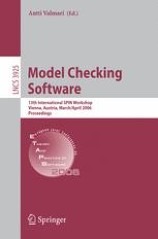
Model Checking Software ; Vol. 3925 ; 13th International SPIN Workshop, Vienna, Austria, March 30 - April 1, 2006, Proceedings
he name “SPIN” refers both to a workshopon model checking and to a famous model checking tool. The SPIN workshop is an annual forum for practitioners and researchersinterested in state space-based techniques for the validation and analysis of software and hardware systems, including communication protocols. It focuses on techniques based on explicit representations of state spaces, as implemented in the SPIN model checker or other tools, and techniques based on a combination of explicit representations with other representations. The SPIN model checker has proven to be particularly suited for the analysis of concurrent asynchronous systems. The workshop aims to encourage interaction and exchange of ideas with all related areas in software engineering.
